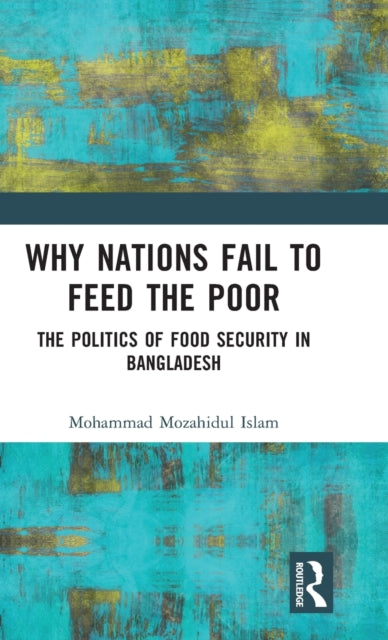
Mohammad Mozahidul Islam
Why Nations Fail to Feed the Poor: The Politics of Food Security in Bangladesh
Why Nations Fail to Feed the Poor: The Politics of Food Security in Bangladesh
💎 Earn 689 Points (£6.89) on this item.
We can order this item for you. Delivery usually takes about 4 to 6 weeks.
This item is not held in our immediate stock. We will order it for you after checkout.
Estimated delivery: About 4 to 6 weeks
YOU SAVE £8.18
- Condition: Brand new
- UK Delivery times: Usually arrives within 2 - 3 working days
- UK Shipping: Fee starts at £2.39. Subject to product weight & dimension
Bulk ordering. Want 15 or more copies? Get a personalised quote and bigger discounts. Learn more about bulk orders.
Couldn't load pickup availability
- More about Why Nations Fail to Feed the Poor: The Politics of Food Security in Bangladesh
This book examines the political and economic dimensions of food security in Bangladesh and assesses the role of the state in meeting the challenges of food security. It explores the strength of institutions, the scope of state functions, and other important attributes using neo-patrimonialism to explore the political system. It also unpacks the structural weaknesses of the Bangladesh's institutional capacity in promoting food security, arguing that the root cause of food insecurity is deeply embedded in the nature of the government itself and the political institutions that link the state and society.
Format: Hardback
Length: 318 pages
Publication date: 06 October 2022
Publisher: Taylor & Francis Ltd
This comprehensive study delves into the intricate political and economic dimensions of food security in Bangladesh, shedding light on the challenges faced by the nation in ensuring its citizens' access to sufficient and nutritious food. It assesses the role of the state in addressing these challenges and explores how Bangladesh responds when its people face hunger. While there are limited empirical studies that provide a historical and political analysis of Bangladesh's role in food security, conventional approaches often focus on a partial diagnosis of economic or nutritional problems. To address this gap, the book offers a detailed account of the missing dimensions of the state, including the strength of institutions, the scope of state functions, and other crucial attributes.
Drawing upon the concept of neo-patrimonialism, the book examines the political system of Bangladesh, highlighting its strengths, weaknesses, and the complex interplay between the state and society. It identifies the structural weaknesses within the institutional capacity of Bangladesh to promote food security, attributing these challenges to the nature of the government itself and the political institutions that govern the relationship between the state and society.
The book further explores the various impediments to food security, ranging from the process of policy formulation to their implementation mechanisms. It uncovers the structural flaws within the government's institutions, policies, and programs that hinder their effectiveness in addressing food insecurity. It argues that the root cause of food insecurity lies not only in the lack of resources or infrastructure but also in the deeply embedded political and economic structures that perpetuate inequality and marginalization.
To overcome these challenges, the book proposes a range of policy recommendations and interventions. It advocates for a more inclusive and democratic governance structure that empowers marginalized communities and ensures their participation in decision-making processes related to food security. It also calls for the strengthening of institutions, including the government, civil society organizations, and the private sector, to promote collaboration and coordination in addressing food insecurity.
Furthermore, the book emphasizes the importance of addressing the underlying social and economic factors that contribute to food insecurity, such as poverty, inequality, and climate change. It advocates for policies that promote sustainable agriculture, rural development, and access to education and healthcare, which can help alleviate poverty and improve food security outcomes.
In conclusion, this book provides a comprehensive and insightful analysis of food security in Bangladesh, shedding light on the challenges faced by the nation and the role of the state in addressing them. It offers valuable insights into the political, economic, and social factors that contribute to food insecurity and proposes practical solutions to overcome these barriers. By promoting a more inclusive and equitable governance structure, strengthening institutions, and addressing the underlying social and economic factors, Bangladesh can work towards achieving food security for all its citizens.
Dimension: 216 x 138 (mm)
ISBN-13: 9781032376943
This item can be found in:
UK and International shipping information
UK and International shipping information
UK Delivery and returns information:
- Delivery within 2 - 3 days when ordering in the UK.
- Shipping fee for UK customers from £2.39. Fully tracked shipping service available.
- Returns policy: Return within 30 days of receipt for full refund.
International deliveries:
Shulph Ink now ships to Australia, Belgium, Canada, France, Germany, Ireland, Italy, India, Luxembourg Saudi Arabia, Singapore, Spain, Netherlands, New Zealand, United Arab Emirates, United States of America.
- Delivery times: within 5 - 10 days for international orders.
- Shipping fee: charges vary for overseas orders. Only tracked services are available for most international orders. Some countries have untracked shipping options.
- Customs charges: If ordering to addresses outside the United Kingdom, you may or may not incur additional customs and duties fees during local delivery.