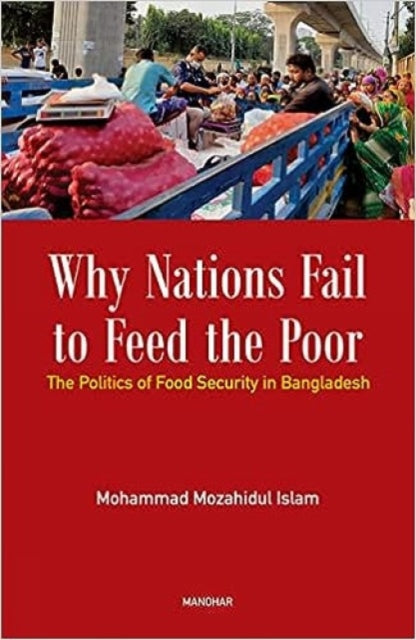
Mohammad Mozahidul Islam
Why Nations Fail to Feed the Poor: The Politics of Food Security in Bangladesh
Why Nations Fail to Feed the Poor: The Politics of Food Security in Bangladesh
💎 Earn 347 Points (£3.47) on this item.
- Condition: Brand new
- UK Delivery times: Usually arrives within 2 - 3 working days
- UK Shipping: Fee starts at £2.39. Subject to product weight & dimension
Bulk ordering. Want 15 or more copies? Get a personalised quote and bigger discounts. Learn more about bulk orders.
Couldn't load pickup availability
- More about Why Nations Fail to Feed the Poor: The Politics of Food Security in Bangladesh
The book examines the political and economic dimensions of food security in Bangladesh, assessing the role of the state in meeting the challenges. It explores the missing dimensions of stateness, including the strength of institutions, the scope of state functions, and other important attributes, using the concept of neo-patrimonialism to explore the political system. It also explicates the various impediments to food security, ranging from policy formulation to implementation mechanisms.
Format: Hardback
Length: 317 pages
Publication date: 15 September 2023
Publisher: Manohar Publishers and Distributors
Food security in Bangladesh is a complex issue that involves both political and economic dimensions. This book examines the role of the state in addressing food security challenges and explores the various impediments to food security. The key concern of the study is to understand how Bangladesh responds when its people go hungry. While there are no detailed empirical studies that examine the Bangladeshi state's role, conventional approaches often focus on a partial diagnosis of economic or nutritional problems. This book aims to fill this gap by providing a detailed picture of the missing dimensions of stateness, including the strength of institutions, the scope of state functions, and other important attributes. To achieve this, the book uses the concept of neo-patrimonialism to explore the political system of Bangladesh. The book also explicates the various impediments to food security, ranging from the process of policy formulation to their implementation mechanisms.
One of the key impediments to food security in Bangladesh is the lack of access to food. This is due to a variety of factors, including poverty, inequality, and natural disasters. Poverty is a major factor in food insecurity, as it limits people's ability to purchase food. Inequality is also a significant factor, as it leads to unequal access to resources and opportunities. Natural disasters, such as floods and cyclones, can also cause food shortages and displacement.
Another impediment to food security in Bangladesh is the lack of infrastructure. This includes the lack of roads, bridges, and irrigation systems. These infrastructure deficiencies can make it difficult for farmers to transport their crops to market and for consumers to access food.
The state has a significant role to play in addressing food security challenges in Bangladesh. The government has implemented a number of policies and programs to address food insecurity, including the Food Security Act of 2013. However, these policies and programs have been limited in their effectiveness due to a variety of factors, including corruption, lack of resources, and political instability.
One of the key challenges facing the state in addressing food security challenges is the lack of political will. Many politicians are more interested in gaining power and wealth than in addressing the needs of the people. This can lead to a lack of investment in infrastructure and other programs that are necessary to address food insecurity.
Another challenge facing the state in addressing food security challenges is the lack of resources. The government has limited resources to address food insecurity, and this can lead to a lack of investment in infrastructure and other programs. This can also lead to a lack of access to food for many people.
In addition to these challenges, the state also faces a number of other impediments to food security. These include the lack of access to credit, the lack of access to markets, and the lack of access to information.
To address these impediments to food security, the state needs to take a number of steps. These steps include increasing investment in infrastructure and other programs, increasing access to credit, increasing access to markets, and increasing access to information.
Increasing investment in infrastructure and other programs is one of the most important steps that the state can take to address food security challenges. This can include the construction of roads, bridges, and irrigation systems, as well as the provision of education and training to farmers.
Increasing access to credit is also important for food security. Many farmers in Bangladesh are unable to access credit, which can make it difficult for them to purchase inputs and to finance their operations. The government can provide credit to farmers through a number of programs, including the Agricultural Credit Scheme and the Microfinance Program.
Increasing access to markets is also important for food security. Many farmers in Bangladesh are unable to access markets, which can make it difficult for them to sell their crops. The government can provide access to markets through a number of programs, including the Agricultural Marketing Board and the Export Promotion Bureau.
Increasing access to information is also important for food security. Many farmers in Bangladesh are unable to access information about the latest technologies and practices, which can make it difficult for them to improve their productivity. The government can provide access to information through a number of programs, including the Agricultural Information Service and the National Agricultural Research System.
In conclusion, food security in Bangladesh is a complex issue that involves both political and economic dimensions. This book examines the role of the state in addressing food security challenges and explores the various impediments to food security. The key concern of the study is to understand how Bangladesh responds when its people go hungry. While there are no detailed empirical studies that examine the Bangladeshi state's role, conventional approaches often focus on a partial diagnosis of economic or nutritional problems. This book aims to fill this gap by providing a detailed picture of the missing dimensions of stateness, including the strength of institutions, the scope of state functions, and other important attributes. To address these impediments to food security, the state needs to take a number of steps, including increasing investment in infrastructure and other programs, increasing access to credit, increasing access to markets, and increasing access to information. By doing so, the state can help to ensure that all Bangladeshis have access to sufficient and nutritious food.
Weight: 474g
Dimension: 151 x 226 x 26 (mm)
ISBN-13: 9789391928636
This item can be found in:
UK and International shipping information
UK and International shipping information
UK Delivery and returns information:
- Delivery within 2 - 3 days when ordering in the UK.
- Shipping fee for UK customers from £2.39. Fully tracked shipping service available.
- Returns policy: Return within 30 days of receipt for full refund.
International deliveries:
Shulph Ink now ships to Australia, Belgium, Canada, France, Germany, Ireland, Italy, India, Luxembourg Saudi Arabia, Singapore, Spain, Netherlands, New Zealand, United Arab Emirates, United States of America.
- Delivery times: within 5 - 10 days for international orders.
- Shipping fee: charges vary for overseas orders. Only tracked services are available for most international orders. Some countries have untracked shipping options.
- Customs charges: If ordering to addresses outside the United Kingdom, you may or may not incur additional customs and duties fees during local delivery.