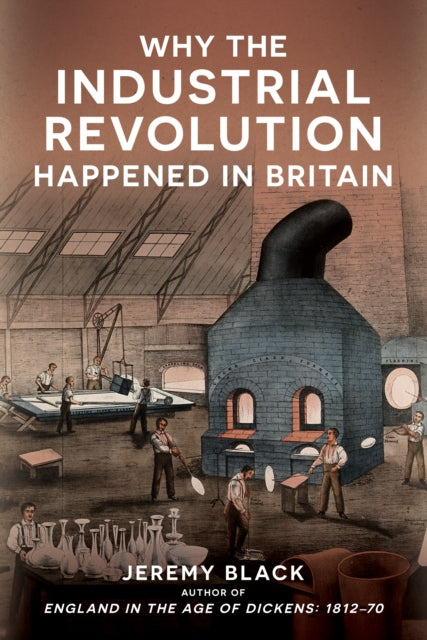
Jeremy Black
Why the Industrial Revolution Happened in Britain
Why the Industrial Revolution Happened in Britain
💎 Earn 81 Points (£0.81) on this item.
YOU SAVE £6.72
- Condition: Brand new
- UK Delivery times: Usually arrives within 2 - 3 working days
- UK Shipping: Fee starts at £2.39. Subject to product weight & dimension
Bulk ordering. Want 15 or more copies? Get a personalised quote and bigger discounts. Learn more about bulk orders.
Couldn't load pickup availability
- More about Why the Industrial Revolution Happened in Britain
Britain's constitution, empire, and involvement in the Industrial Revolution played a crucial role in its global significance. Factors such as coal, steam, consumerism, fashion, parliamentary government, the rule of law, a society open to talent, and no internal tariff boundaries contributed to the country's exceptional history.
Format: Hardback
Length: 288 pages
Publication date: 15 August 2023
Publisher: Amberley Publishing
Britain's historical significance on the global stage can be attributed to a multitude of factors, including its constitution and empire, but it is also crucial to recognize the pivotal role it played in fostering the first Industrial Revolution. This transformative period was driven by various factors, not just coal and steam, but also consumerism, fashion, and the ability to purchase goods. Moreover, the context of parliamentary government, the rule of law, a society that welcomed talent, and the absence of internal tariff boundaries all contributed to the creation of a conducive environment for industrial growth.
The interplay of these factors resulted in a series of synergies that propelled Britain to the forefront of global industrial development. They also played a crucial role in shaping the history of the Industrial Revolution, as it became intertwined with the history of a country, its people, and the unique factors that set it apart.
One of the most significant factors contributing to Britain's industrial success was its abundant supply of coal and steam. These resources were essential for powering the machinery and factories that drove the Industrial Revolution. The country's vast coal reserves, coupled with its advanced steam-powered technology, allowed it to produce goods at a scale and efficiency that were unprecedented in the world.
However, it is important to note that coal and steam were not the only factors that propelled Britain's industrial revolution. Consumerism, fashion, and the desire for luxury goods played a significant role in driving demand for industrial products. As the middle class grew in size and wealth, there was a growing demand for goods that were not only functional but also aesthetically pleasing. This led to the development of new industries, such as textiles, clothing, and furniture, which were able to meet the growing demand for consumer goods.
In addition to the push factors of entrepreneurs and resources, there were also pull factors that attracted talent and investment to Britain. The country's parliamentary government, the rule of law, and a society that valued education and innovation created an environment that was conducive to talent development and entrepreneurship. This attracted a skilled workforce and investors who were eager to contribute to the country's industrial growth.
Furthermore, Britain's location on the European continent played a crucial role in its industrial development. Its proximity to other European countries allowed for easy trade and commerce, which facilitated the exchange of goods and ideas. This, in turn, led to the development of new technologies and the spread of industrial practices across the continent.
Another factor that contributed to Britain's industrial success was the absence of internal tariff boundaries. This allowed for free trade between different regions of the country, which promoted competition and innovation. It also allowed for the import of raw materials and the export of finished goods, which helped to boost the country's economy and create job opportunities.
In conclusion, Britain's key importance in world history was a product of its constitution, empire, and its role in achieving the first Industrial Revolution. The combination of coal and steam, consumerism, fashion, parliamentary government, the rule of law, a society open to talent, and the absence of internal tariff boundaries all played a significant role in shaping the country's industrial development. These factors produced vital synergies that propelled Britain to the forefront of global industrial development and helped to shape the history of the Industrial Revolution as a whole.
Weight: 614g
Dimension: 166 x 244 x 34 (mm)
ISBN-13: 9781398114494
UK and International shipping information
UK and International shipping information
UK Delivery and returns information:
- Delivery within 2 - 3 days when ordering in the UK.
- Shipping fee for UK customers from £2.39. Fully tracked shipping service available.
- Returns policy: Return within 30 days of receipt for full refund.
International deliveries:
Shulph Ink now ships to Australia, Belgium, Canada, France, Germany, Ireland, Italy, India, Luxembourg Saudi Arabia, Singapore, Spain, Netherlands, New Zealand, United Arab Emirates, United States of America.
- Delivery times: within 5 - 10 days for international orders.
- Shipping fee: charges vary for overseas orders. Only tracked services are available for most international orders. Some countries have untracked shipping options.
- Customs charges: If ordering to addresses outside the United Kingdom, you may or may not incur additional customs and duties fees during local delivery.