Minh-Ha T. Pham
Why We Can't Have Nice Things: Social Media's Influence on Fashion, Ethics, and Property
Why We Can't Have Nice Things: Social Media's Influence on Fashion, Ethics, and Property
💎 Earn 86 Points (£0.86) on this item.
YOU SAVE £3.66
- Condition: Brand new
- UK Delivery times: Usually arrives within 2 - 3 working days
- UK Shipping: Fee starts at £2.39. Subject to product weight & dimension
Bulk ordering. Want 15 or more copies? Get a personalised quote and bigger discounts. Learn more about bulk orders.
Couldn't load pickup availability
- More about Why We Can't Have Nice Things: Social Media's Influence on Fashion, Ethics, and Property
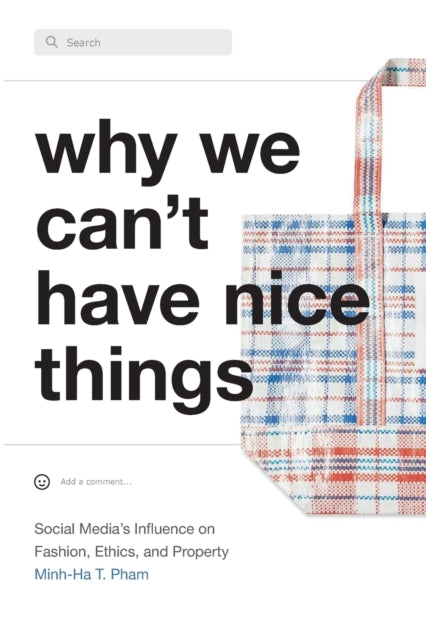
Social media users in Thailand called out Balenciaga for copying the popular Thai "rainbow bag" and using Balenciagas hashtags to circulate memes revealing the source of the bags design. Minh-Ha T. Pham examines the way social media users monitor the fashion market for the appearance of knockoff fashion, design theft, and plagiarism, tracing the history of fashion antipiracy efforts back to the 1930s. She shows that design policing has ironically deepened forms of social and market inequality, as it relies on and reinforces racist and colonial norms and ideas about what constitutes copying and what counts as creativity. These struggles over ethical fashion and intellectual property constitute deeper struggles over the colonial legacies of cultural property in digital and global economies.
Format: Paperback / softback
Length: 176 pages
Publication date: 05 August 2022
Publisher: Duke University Press
In 2016, social media users in Thailand took to the internet to express their outrage over Balenciaga, a Paris-based luxury fashion house, for allegedly copying the popular Thai "rainbow bag." Using Balenciaga's hashtags, they circulated memes that revealed the source of the bag's design. In her book, "Why We Can't Have Nice Things," Minh-Ha T. Pham explores the way social media users monitor the fashion market for the appearance of knockoff fashion, design theft, and plagiarism. She traces the history of fashion antipiracy efforts back to the 1930s and highlights the role of social media in policing the fashion industry. While social media has been praised for its concern for ethical fashion and consumption, Pham argues that it has ironically deepened forms of social and market inequality. She shows that design policing relies on and reinforces racist and colonial norms and ideas about what constitutes copying and what counts as creativity. These struggles over ethical fashion and intellectual property, Pham demonstrates, constitute deeper struggles over the colonial legacies of cultural property in digital and global economies.
One of the key arguments in Pham's book is that social media has become a powerful tool for policing the fashion industry, but it has also perpetuated harmful stereotypes and biases. For example, when social media users use Balenciaga's hashtags to circulate memes revealing the source of the rainbow bag's design, they are often doing so in a way that perpetuates racist and colonial stereotypes. The memes often depict Thai people as lazy, uneducated, and incapable of creating their own fashion. This perpetuates the idea that Thai culture is inferior to Western culture and that Thai people are not worthy of respect or recognition.
Pham also argues that design policing has been used to protect the interests of wealthy fashion brands and designers at the expense of smaller, independent designers. By policing the fashion industry, fashion brands and designers can ensure that their designs are not copied or stolen, which can lead to increased profits. However, this can also have a negative impact on smaller, independent designers who may not have the resources to protect their designs.
To address these issues, Pham suggests that social media users should be more aware of the impact of their actions on the fashion industry and the broader society. She suggests that social media users should be more critical of the fashion industry and should be more willing to challenge the status quo. She also suggests that fashion brands and designers should be more transparent about their design processes and should be willing to collaborate with smaller, independent designers.
In addition to these suggestions, Pham also provides a number of case studies that illustrate the impact of design policing on the fashion industry. For example, she discusses the case of the "Balenciaga rainbow bag" and how it was copied by a number of fashion brands and designers. She also discusses the case of the "Supreme x Louis Vuitton" collaboration and how it was criticized for its use of cultural appropriation.
Despite the challenges that Pham identifies, she also believes that there is hope for the fashion industry. She suggests that the fashion industry can become more inclusive and diverse by embracing different cultures and styles. She also suggests that the fashion industry can become more sustainable by using more eco-friendly materials and by reducing the amount of waste that is produced.
In conclusion, Minh-Ha T. Pham's book, "Why We Can't Have Nice Things," is a powerful exploration of the way social media users monitor the fashion market for the appearance of knockoff fashion, design theft, and plagiarism. She argues that social media has ironically deepened forms of social and market inequality and has perpetuated harmful stereotypes and biases. She suggests that social media users should be more aware of the impact of their actions on the fashion industry and the broader society and that fashion brands and designers should be more transparent about their design processes and should be willing to collaborate with smaller, independent designers. By doing so, the fashion industry can become more inclusive and diverse and can become more sustainable.
Weight: 264g
Dimension: 153 x 228 x 24 (mm)
ISBN-13: 9781478018612
UK and International shipping information
UK and International shipping information
UK Delivery and returns information:
- Delivery within 2 - 3 days when ordering in the UK.
- Shipping fee for UK customers from £2.39. Fully tracked shipping service available.
- Returns policy: Return within 30 days of receipt for full refund.
International deliveries:
Shulph Ink now ships to Australia, Belgium, Canada, France, Germany, Ireland, Italy, India, Luxembourg Saudi Arabia, Singapore, Spain, Netherlands, New Zealand, United Arab Emirates, United States of America.
- Delivery times: within 5 - 10 days for international orders.
- Shipping fee: charges vary for overseas orders. Only tracked services are available for most international orders. Some countries have untracked shipping options.
- Customs charges: If ordering to addresses outside the United Kingdom, you may or may not incur additional customs and duties fees during local delivery.