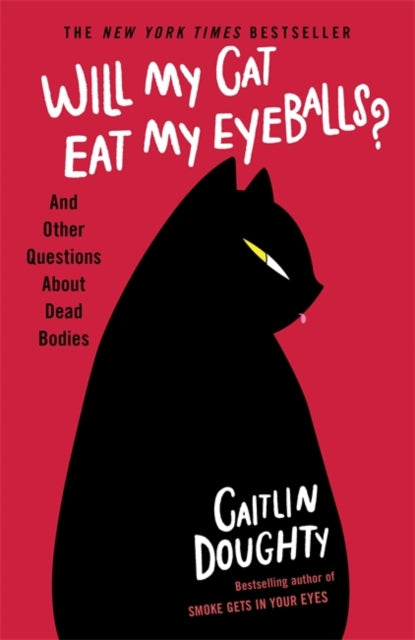
Caitlin Doughty
Will My Cat Eat My Eyeballs?: And Other Questions About Dead Bodies
Will My Cat Eat My Eyeballs?: And Other Questions About Dead Bodies
YOU SAVE £3.47
- Condition: Brand new
- UK Delivery times: Usually arrives within 2 - 3 working days
- UK Shipping: Fee starts at £3.89. Subject to product weight & dimension
Bulk ordering. Want 15 or more copies? Get a personalised quote and bigger discounts. Learn more about bulk orders.
Couldn't load pickup availability
- More about Will My Cat Eat My Eyeballs?: And Other Questions About Dead Bodies
Funeral director Caitlin Doughty answers questions about death, such as why corpses groan, turn strange colors, and hair and nails appear longer after death.
Format: Paperback / softback
Length: 240 pages
Publication date: 22 September 2020
Publisher: Orion Publishing Co
Can we give Grandma a Viking funeral?
Why don't animals dig up all the graves?
Will my hair keep growing in my coffin after I'm buried?
Every day, funeral director Caitlin Doughty receives dozens of questions about death. Here she offers her factual, hilarious, and candid answers to thirty-five of the most interesting, sharing the lore and science of what happens to, and inside, our bodies after we die.
Why do corpses groan? What causes bodies to turn strange colours during decomposition? And why do hair and nails appear longer after death? The answers are all within. . . .
Viking funerals were a unique and memorable way to honor and celebrate the life of a loved one. These funerals were often elaborate and involved a variety of rituals and ceremonies that were designed to honor the deceased and send them off to the afterlife with dignity and respect.
One of the most distinctive features of a Viking funeral was the use of a boat or ship to transport the deceased to their final resting place. This was a common practice in Viking culture, as they believed that the sea was a gateway to the afterlife. The boat or ship would be adorned with flowers and other decorations, and the deceased would be laid to rest on board.
Another important aspect of a Viking funeral was the use of fire. Fire was believed to have the power to purify and cleanse the deceased, and it was used to burn the body of the deceased after it had been laid to rest on the boat or ship. This was a symbolic act that was meant to send the deceased on their way to the afterlife with a clean slate.
In addition to the use of fire and boats, Viking funerals also involved a variety of other rituals and ceremonies. These included singing and dancing, as well as feasting and drinking. The family and friends of the deceased would gather together to celebrate their life and to honor their memory.
Viking funerals were a unique and memorable way to honor and celebrate the life of a loved one. These funerals were often elaborate and involved a variety of rituals and ceremonies that were designed to honor the deceased and send them off to the afterlife with dignity and respect. While Viking funerals may not be the most common type of funeral today, they continue to be a fascinating and unique part of our cultural heritage.
Animals do not dig up all the graves for a variety of reasons. One of the primary reasons is that animals are not equipped with the tools or the knowledge necessary to dig up graves. They do not have the strength or the dexterity to dig through the soil and remove the casket or the remains of the deceased.
Another reason why animals do not dig up all the graves is that they are often attracted to the smell of decaying flesh. The smell of decaying flesh can be a powerful and pungent odor, and it can be a deterrent to many animals. As a result, animals may avoid areas where there are graves, or they may simply not be able to locate them.
In addition to these physical barriers, there are also cultural and religious beliefs that may prevent animals from digging up graves. In some cultures, animals are considered sacred and are not allowed to be disturbed or harmed. In other cultures, animals are believed to be a source of bad luck and are not allowed to be near graves.
Despite these barriers, there are still some cases where animals have been known to dig up graves. For example, in some cases, animals may be searching for food or water, and they may accidentally come across a grave. In other cases, animals may be trying to escape from a predator or to find a place to nest.
In conclusion, while animals do not dig up all the graves for a variety of reasons, there are still some cases where they may be able to do so. However, it is important to note that this is not a common practice and that it is often discouraged by cultural and religious beliefs.
Weight: 212g
Dimension: 130 x 197 x 23 (mm)
ISBN-13: 9781474613415
UK and International shipping information
UK and International shipping information
We deliver throughout the United Kingdom and to 128 countries and territories worldwide, including the United States, Australia, Canada, Germany, Spain and France.