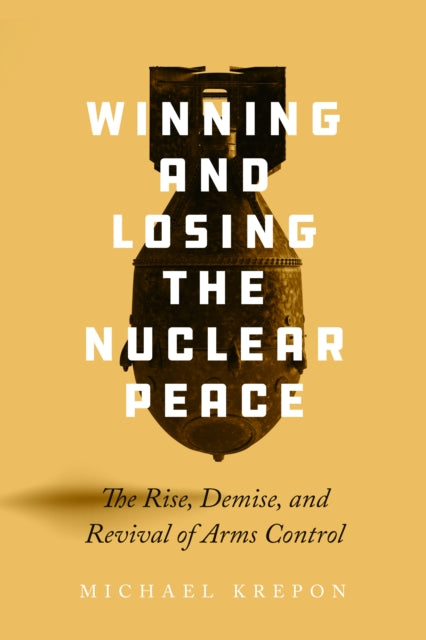
Michael Krepon
Winning and Losing the Nuclear Peace: The Rise, Demise, and Revival of Arms Control
Winning and Losing the Nuclear Peace: The Rise, Demise, and Revival of Arms Control
💎 Earn 285 Points (£2.85) on this item.
YOU SAVE £6.88
- Condition: Brand new
- UK Delivery times: Usually arrives within 2 - 3 working days
- UK Shipping: Fee starts at £2.39. Subject to product weight & dimension
Bulk ordering. Want 15 or more copies? Get a personalised quote and bigger discounts. Learn more about bulk orders.
Couldn't load pickup availability
- More about Winning and Losing the Nuclear Peace: The Rise, Demise, and Revival of Arms Control
The book "Winning and Losing the Nuclear Peace" by Michael Krepon is a definitive guide to the history of nuclear arms control, highlighting the importance of deterrence and arms control in preventing nuclear warfare. It recounts the successful efforts of U.S. and Soviet leaders to devise guardrails for nuclear arms control and the subsequent decline of arms control after the Cold War. The book emphasizes the need for arms control to prevent nuclear warfare and calls for its revival and reimagining for Russia and China.
Format: Hardback
Length: 640 pages
Publication date: 19 October 2021
Publisher: Stanford University Press
The definitive guide to the history of nuclear arms control, written by a wise eavesdropper and masterful storyteller, Michael Krepon, delves into the profound impact of deterrence and arms control on the course of the Cold War. The absence of mushroom clouds, considered the greatest unacknowledged diplomatic achievement of the era, became the driving force behind the need for nuclear arms control. Deterrence alone, deemed too dangerous to succeed, required the establishment of safeguards to prevent nuclear warfare. U.S. and Soviet leaders embarked on a risky journey into the unknown, seeking to devise mechanisms for nuclear arms control and treating the Bomb differently from other weapons. Despite overwhelming odds, they achieved a remarkable feat: three quarters of a century have passed without the use of nuclear weapons in warfare.
In his book, "Winning and Losing the Nuclear Peace," Michael Krepon presents an in-depth exploration of the intricate dynamics that shaped the nuclear peace. The narrative unfolds through a series of high-wire acts of diplomacy, close calls, unwavering persistence, and extraordinary success. Krepon vividly brings to life the intense battles between arms controllers and advocates of nuclear deterrence, showcasing the ironic twists and unexpected outcomes from Truman to Trump. The journey begins with the ban on atmospheric testing and the nonproliferation treaty, which laid the foundation for further agreements. These agreements reached their pinnacle with treaties that mandated deep cuts to nuclear arsenals and the containment of loose nukes following the collapse of the Soviet Union.
However, after the Cold War ended, a significant shift occurred. The nuclear peace, once considered a triumph, was gradually eroded as the focus shifted towards freedom of action. The dismantling of arms control measures and the emergence of nuclear-armed rivalries posed a grave threat to global stability. Recognizing the urgency of the situation, the revival and reimagining of arms control measures are crucial for Russia and China, as they seek to prevent nuclear warfare. New guardrails must be erected to ensure the continued viability of nuclear deterrence and prevent the proliferation of nuclear weapons.
"Winning and Losing the Nuclear Peace" offers an engaging account of the evolution of arms control practices. It sheds light on the challenges and triumphs faced by negotiators, policymakers, and leaders throughout the Cold War and beyond. The book provides valuable insights into the intricate negotiations, diplomatic maneuvers, and political complexities that shaped the nuclear landscape. It also raises important questions about the future of arms control and the role it plays in maintaining global security.
In conclusion, "Winning and Losing the Nuclear Peace" is a must-read for anyone interested in understanding the history, dynamics, and future of nuclear arms control. Michael Krepon's masterful storytelling and insightful analysis provide a comprehensive perspective on this critical topic, highlighting the importance of deterrence, arms control, and global cooperation in ensuring a safer and more peaceful world.
Weight: 1126g
Dimension: 161 x 237 x 47 (mm)
ISBN-13: 9781503629097
This item can be found in:
UK and International shipping information
UK and International shipping information
UK Delivery and returns information:
- Delivery within 2 - 3 days when ordering in the UK.
- Shipping fee for UK customers from £2.39. Fully tracked shipping service available.
- Returns policy: Return within 30 days of receipt for full refund.
International deliveries:
Shulph Ink now ships to Australia, Belgium, Canada, France, Germany, Ireland, Italy, India, Luxembourg Saudi Arabia, Singapore, Spain, Netherlands, New Zealand, United Arab Emirates, United States of America.
- Delivery times: within 5 - 10 days for international orders.
- Shipping fee: charges vary for overseas orders. Only tracked services are available for most international orders. Some countries have untracked shipping options.
- Customs charges: If ordering to addresses outside the United Kingdom, you may or may not incur additional customs and duties fees during local delivery.