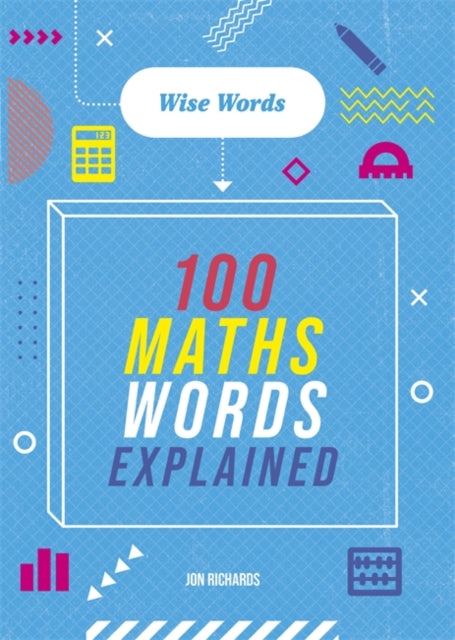
Jon Richards
Wise Words: 100 Maths Words Explained
Wise Words: 100 Maths Words Explained
💎 Earn 53 Points (£0.53) on this item.
YOU SAVE £2.26
- Condition: Brand new
- UK Delivery times: Usually arrives within 2 - 3 working days
- UK Shipping: Fee starts at £2.39. Subject to product weight & dimension
Bulk ordering. Want 15 or more copies? Get a personalised quote and bigger discounts. Learn more about bulk orders.
Couldn't load pickup availability
- More about Wise Words: 100 Maths Words Explained
The Wise Words series presents key vocabulary for each STEAM subject area, in a clear, brief, and uncomplicated fashion with a visual aid to help with memory. It is the perfect introduction to maths for children aged 9+.
Format: Hardback
Length: 48 pages
Publication date: 11 November 2021
Publisher: Hachette Children's Group
The Wise Words series
The Wise Words series is a collection of essential vocabulary for each subject area in STEAM (Science, Technology, Engineering, the Arts, and Mathematics). These words are presented in a clear, concise, and uncomplicated manner, accompanied by visual aids (illustrated or photographic) to enhance memory retention. Designed specifically for children aged 9 and above, The Wise Words series is the perfect introduction to maths.
Key Words and Terms in Maths
In the world of maths, there are numerous key words and terms that are essential for understanding mathematical concepts and solving problems. Some of the most common ones include:
- Addition: Adding two or more numbers together to obtain a sum.
- Subtraction: Taking away one or more numbers from another to obtain a difference.
- Multiplication: Multiplying two or more numbers together to obtain a product.
- Division: Dividing two or more numbers to obtain a quotient.
- Fraction: A part of a whole, represented by a numerator and a denominator.
- Percentage: A number expressed as a fraction of 100, representing a percentage of something.
- Decimal: A number that is a fraction of 1, represented by a decimal point and digits to the right of the decimal point.
- Square: A number that is the result of multiplying a number by itself.
- Cube: A number that is the result of multiplying a number by itself three times.
- Factorial: The product of all positive integers from 1 to a given number.
- Algebra: A branch of mathematics that deals with the study of variables and the rules for manipulating them to solve equations and represent relationships.
- Geometry: A branch of mathematics that deals with the study of shapes, angles, and dimensions.
- Trigonometry: A branch of mathematics that deals with the study of relationships between angles and sides of triangles.
- Statistics: A branch of mathematics that deals with the collection, analysis, and interpretation of data.
These are just a few of the key words and terms used in maths. Each one has a specific meaning and plays a crucial role in the development of mathematical understanding. By learning and mastering these words, students can build a strong foundation in maths and be well-prepared for future mathematical challenges.
Understanding Key Words and Terms
Understanding key words and terms in maths is essential for developing a strong foundation in the subject. Here are some tips and tricks to help students remember these important concepts:
- Use visual aids: Visual aids such as diagrams, charts, and pictures can help students visualize mathematical concepts and make them easier to remember.
- Practice regularly: Regular practice is key to improving maths skills. Students should practice solving problems and working with key words and terms to reinforce their understanding.
- Break down complex problems: Breaking down complex problems into smaller, more manageable steps can help students understand the underlying concepts and make solving them easier.
- Use mnemonic devices: Mnemonic devices such as acronyms and rhymes can help students remember key words and terms. For example, the acronym "PEMDAS" can help students remember the order of operations in mathematics.
- Collaborate with peers: Collaborating with peers can help students clarify their understanding of key words and terms and provide opportunities for peer teaching and learning.
- Use online resources: There are many online resources available that can help students learn and practice key words and terms in maths. These resources include tutorials, videos, and interactive games.
By following these tips and tricks, students can improve their understanding of key words and terms in maths and be well-prepared for future mathematical challenges.
Games and Activities to Help Remember Key Words and Terms
In addition to using traditional teaching methods, games and activities can also help students remember key words and terms in maths. Here are some examples of games and activities that can be used to reinforce learning:
- Math Bingo: Math Bingo is a game that involves students solving math problems to earn bingo cards. The game includes key words and terms from various math subjects, such as addition, subtraction, multiplication, and division.
- Math Quiz: Math Quiz is a game that involves students answering questions about key words and terms from various math subjects. The game includes multiple-choice, true or false, and open-ended questions.
- Math Word Search: Math Word Search is a game that involves students searching for key words and terms from various math subjects in a word search puzzle. The game includes hidden words and terms that students must find to complete the puzzle.
- Math Board Games: Math Board Games are games that involve students solving math problems to move around a board and win the game. The games include key words and terms from various math subjects, such as algebra, geometry, and statistics.
- Math Flashcards: Math Flashcards are a simple and effective way to help students remember key words and terms. The cards include key words and terms on one side and their definitions on the other side.
- Math Puzzles: Math Puzzles are games that involve students solving math problems to complete a puzzle. The puzzles include key words and terms from various math subjects, such as algebraic equations and geometric shapes.
These games and activities are designed to make learning fun and engaging, and they can help students reinforce their understanding of key words and terms in maths. By playing these games and activities, students can develop a love for maths and be well-prepared for future mathematical challenges.
Conclusion
In conclusion, the Wise Words series is a valuable resource for students looking to improve their understanding of key words and terms in maths. The series presents the words in a clear, concise, and uncomplicated manner, accompanied by visual aids to enhance memory retention. By learning and mastering these words, students can build a strong foundation in maths and be well-prepared for future mathematical challenges.
In addition to using the Wise Words series, students can also use other tips and tricks to improve their understanding of key words and terms in maths. These include using visual aids, practicing regularly, breaking down complex problems, using mnemonic devices, collaborating with peers, and using online resources. By following these tips and tricks, students can develop a love for maths and be well-prepared for future mathematical challenges.
The key to success in any school subject is an understanding of the words used. The Wise Words series presents key vocabulary for each STEAM subject area. The words are presented in a clear, brief and uncomplicated fashion with a visual aid (illustrated or photographic) to help with memory. The perfect introduction to maths for children aged 9+.
The Wise Words series is a collection of essential vocabulary for each subject area in STEAM (Science, Technology, Engineering, the Arts, and Mathematics). These words are presented in a clear, concise, and uncomplicated manner, accompanied by visual aids (illustrated or photographic) to enhance memory retention. Designed specifically for children aged 9 and above, The Wise Words series is the perfect introduction to maths.
In the world of maths, there are numerous key words and terms that are essential for understanding mathematical concepts and solving problems. Some of the most common ones include:
Addition: Adding two or more numbers together to obtain a sum.
Subtraction: Taking away one or more numbers from another to obtain a difference.
Multiplication: Multiplying two or more numbers together to obtain a product.
Division: Dividing two or more numbers to obtain a quotient.
Fraction: A part of a whole, represented by a numerator and a denominator.
Percentage: A number expressed as a fraction of 100, representing a percentage of something.
Decimal: A number that is a fraction of 1, represented by a decimal point and digits to the right of the decimal point.
Square: A number that is the result of multiplying a number by itself.
Cube: A number that is the result of multiplying a number by itself three times.
Factorial: The product of all positive integers from 1 to a given number.
Algebra: A branch of mathematics that deals with the study of variables and the rules for manipulating them to solve equations and represent relationships.
Geometry: A branch of mathematics that deals with the study of shapes, angles, and dimensions.
Trigonometry: A branch of mathematics that deals with the study of relationships between angles and sides of triangles.
Statistics: A branch of mathematics that deals with the collection, analysis, and interpretation of data.
These are just a few of the key words and terms used in maths. Each one has a specific meaning and plays a crucial role in the development of mathematical understanding. By learning and mastering these words, students can build a strong foundation in maths and be well-prepared for future mathematical challenges.
Understanding key words and terms in maths is essential for developing a strong foundation in the subject. Here are some tips and tricks to help students remember these important concepts:
Use visual aids: Visual aids such as diagrams, charts, and pictures can help students visualize mathematical concepts and make them easier to remember.
Practice regularly: Regular practice is key to improving maths skills. Students should practice solving problems and working with key words and terms to reinforce their understanding.
Break down complex problems: Breaking down complex problems into smaller, more manageable steps can help students understand the underlying concepts and make solving them easier.
Use mnemonic devices: Mnemonic devices such as acronyms and rhymes can help students remember key words and terms. For example, the acronym "PEMDAS" can help students remember the order of operations in mathematics.
Collaborate with peers: Collaborating with peers can help students clarify their understanding of key words and terms and provide opportunities for peer teaching and learning.
Use online resources: There are many online resources available that can help students learn and practice key words and terms in maths. These resources include tutorials, videos, and interactive games.
By following these tips and tricks, students can improve their understanding of key words and terms in maths and be well-prepared for future mathematical challenges.
In addition to using traditional teaching methods, games and activities can also help students remember key words and terms in maths. Here are some examples of games and activities that can be used to reinforce learning:
Math Bingo: Math Bingo is a game that involves students solving math problems to earn bingo cards. The game includes key words and terms from various math subjects, such as addition, subtraction, multiplication, and division.
Math Quiz: Math Quiz is a game that involves students answering questions about key words and terms from various math subjects. The game includes multiple-choice, true or false, and open-ended questions.
Math Word Search: Math Word Search is a game that involves students searching for key words and terms from various math subjects in a word search puzzle. The game includes hidden words and terms that students must find to complete the puzzle.
Math Board Games: Math Board Games are games that involve students solving math problems to move around a board and win the game. The games include key words and terms from various math subjects, such as algebra, geometry, and statistics.
Math Flashcards: Math Flashcards are a simple and effective way to help students remember key words and terms. The cards include key words and terms on one side and their definitions on the other side.
Math Puzzles: Math Puzzles are games that involve students solving math problems to complete a puzzle. The puzzles include key words and terms from various math subjects, such as algebraic equations and geometric shapes.
These games and activities are designed to make learning fun and engaging, and they can help students reinforce their understanding of key words and terms in maths. By playing these games and activities, students can develop a love for maths and be well-prepared for future mathematical challenges.
In conclusion, the Wise Words series is a valuable resource for students looking to improve their understanding of key words and terms in maths. The series presents the words in a clear, concise, and uncomplicated manner, accompanied by visual aids to enhance memory retention. By learning and mastering these words, students can build a strong foundation in maths and be well-prepared for future mathematical challenges.
In addition to using the Wise Words series, students can also use other tips and tricks to improve their understanding of key words and terms in maths. These include using visual aids, practicing regularly, breaking down complex problems, using mnemonic devices, collaborating with peers, and using online resources. By following these tips and tricks, students can develop a love for maths and be well-prepared for future mathematical challenges.
Weight: 394g
Dimension: 315 x 276 x 11 (mm)
ISBN-13: 9781526317049
UK and International shipping information
UK and International shipping information
UK Delivery and returns information:
- Delivery within 2 - 3 days when ordering in the UK.
- Shipping fee for UK customers from £2.39. Fully tracked shipping service available.
- Returns policy: Return within 30 days of receipt for full refund.
International deliveries:
Shulph Ink now ships to Australia, Belgium, Canada, France, Germany, Ireland, Italy, India, Luxembourg Saudi Arabia, Singapore, Spain, Netherlands, New Zealand, United Arab Emirates, United States of America.
- Delivery times: within 5 - 10 days for international orders.
- Shipping fee: charges vary for overseas orders. Only tracked services are available for most international orders. Some countries have untracked shipping options.
- Customs charges: If ordering to addresses outside the United Kingdom, you may or may not incur additional customs and duties fees during local delivery.