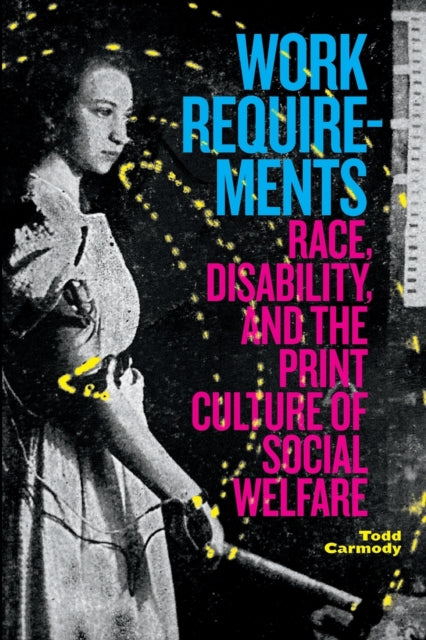
Todd Carmody
Work Requirements: Race, Disability, and the Print Culture of Social Welfare
Work Requirements: Race, Disability, and the Print Culture of Social Welfare
💎 Earn 99 Points (£0.99) on this item.
YOU SAVE £4.18
- Condition: Brand new
- UK Delivery times: Usually arrives within 2 - 3 working days
- UK Shipping: Fee starts at £2.39. Subject to product weight & dimension
Bulk ordering. Want 15 or more copies? Get a personalised quote and bigger discounts. Learn more about bulk orders.
Couldn't load pickup availability
- More about Work Requirements: Race, Disability, and the Print Culture of Social Welfare
Work-based social welfare practices have affirmed the moral value of work throughout US history, mediated by the print culture of social welfare in the late nineteenth century. Todd Carmody explores how the print culture tasked people on the social and economic margins with shoring up the fundamental dignity of work as such, and how disability itself became a tool of social discipline. He reveals a forgotten history of competing efforts to think social belonging beyond or even without work.
Format: Paperback / softback
Length: 328 pages
Publication date: 08 July 2022
Publisher: Duke University Press
Throughout the history of the United States, work-based social welfare practices have played a crucial role in affirming the moral value of work. In the late nineteenth century, this representational project was significantly mediated by the printed word, with the emergence of industrial print technologies, the expansion of literacy, and the rise of professionalization. In his book, "Work Requirements," Todd Carmody delves into the question of how work, even the most debasing or unproductive labor, came to be seen as inherently meaningful during this era. He explores how the print culture of social welfare, produced by public administrators, economic planners, social scientists, and in literature and the arts, tasked people on the social and economic margins, particularly racial minorities, incarcerated people, and people with disabilities, with shoring up the fundamental dignity of work as such. He also outlines how disability itself became a tool of social discipline, defined by bureaucratized institutions as the inability to work. By interrogating the representational effort necessary to make work seem inherently meaningful, Carmody ultimately reveals a forgotten history of competing efforts to think social belonging beyond or even without work.
In the late nineteenth century, the print culture of social welfare emerged as a powerful tool for affirming the moral value of work. This culture was produced by public administrators, economic planners, social scientists, and individuals in literature and the arts, and it played a significant role in shaping the way that people on the social and economic margins, particularly racial minorities, incarcerated people, and people with disabilities, viewed their work. The print culture of social welfare tasked these individuals with shoring up the fundamental dignity of work as such, and it also played a role in defining disability as the inability to work.
One of the key figures in the development of the print culture of social welfare was Todd Carmody. Carmody's book, "Work Requirements," explores the question of how work, even the most debasing or unproductive labor, came to be seen as inherently meaningful during this era. He argues that the print culture of social welfare was a powerful tool for affirming the moral value of work, and that it played a significant role in shaping the way that people on the social and economic margins viewed their work.
Carmody's book begins by examining the historical context of the print culture of social welfare. He notes that the late nineteenth century was a time of significant social and economic change, and that the print culture of social welfare emerged as a response to these changes. He argues that the print culture of social welfare was a way for public administrators, economic planners, social scientists, and individuals in literature and the arts to communicate their ideas and values to the public.
One of the key themes of Carmody's book is the idea of work as a form of social discipline. He argues that the print culture of social welfare was used to define disability as the inability to work, and that this definition was used to justify the exclusion of people with disabilities from the workforce. He also argues that the print culture of social welfare was used to promote the idea that work was a necessary part of social belonging, and that people who were unable to work were not fully part of society.
Carmody's book also explores the ways in which the print culture of social welfare was used to promote the idea of social mobility. He argues that the print culture of social welfare was used to promote the idea that people could move up the social ladder through hard work and dedication, and that this idea was used to justify the unequal distribution of wealth and resources in society.
In conclusion, the print culture of social welfare played a crucial role in affirming the moral value of work during the late nineteenth century. Todd Carmody's book, "Work Requirements," explores the question of how work, even the most debasing or unproductive labor, came to be seen as inherently meaningful during this era. He argues that the print culture of social welfare was a powerful tool for affirming the moral value of work, and that it played a significant role in shaping the way that people on the social and economic margins viewed their work. Carmody's book is a valuable contribution to the field of social welfare, and it should be read by anyone who is interested in the history of social welfare in the United States.
Weight: 435g
Dimension: 229 x 152 (mm)
ISBN-13: 9781478018070
UK and International shipping information
UK and International shipping information
UK Delivery and returns information:
- Delivery within 2 - 3 days when ordering in the UK.
- Shipping fee for UK customers from £2.39. Fully tracked shipping service available.
- Returns policy: Return within 30 days of receipt for full refund.
International deliveries:
Shulph Ink now ships to Australia, Belgium, Canada, France, Germany, Ireland, Italy, India, Luxembourg Saudi Arabia, Singapore, Spain, Netherlands, New Zealand, United Arab Emirates, United States of America.
- Delivery times: within 5 - 10 days for international orders.
- Shipping fee: charges vary for overseas orders. Only tracked services are available for most international orders. Some countries have untracked shipping options.
- Customs charges: If ordering to addresses outside the United Kingdom, you may or may not incur additional customs and duties fees during local delivery.