Shulph Ink
Working With Diagrams
Working With Diagrams
💎 Earn 102 Points (£1.02) on this item.
We can order this item for you. Delivery usually takes about 4 to 6 weeks.
This item is not held in our immediate stock. We will order it for you after checkout.
Estimated delivery: About 4 to 6 weeks
YOU SAVE £3.47
- Condition: Brand new
- UK Delivery times: Usually arrives within 2 - 3 working days
- UK Shipping: Fee starts at £3.89. Subject to product weight & dimension
Bulk ordering. Want 15 or more copies? Get a personalised quote and bigger discounts. Learn more about bulk orders.
Couldn't load pickup availability
- More about Working With Diagrams
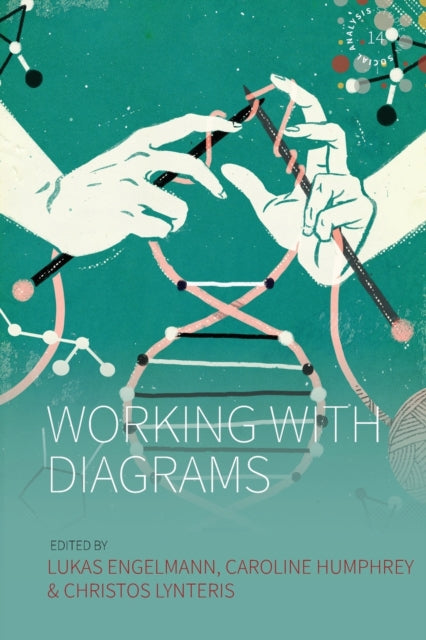
This book explores the capabilities of diagrams in scholarly work related to the social sciences, going beyond semiotic, cognitive, epistemic, and symbolic readings. It highlights the ephemeral dimensions of scientists' interactions and collaboration with diagrams, considers how diagrams configure cooperation across disciplines, and explores how diagrams have been made to work beyond simplification, clarification, and formalization.
Format: Paperback / softback
Length: 164 pages
Publication date: 01 July 2022
Publisher: Berghahn Books
Diagrams have been used in scholarly work related to the social sciences for a long time, but they have often been limited to semiotic, cognitive, epistemic, and symbolic readings. This book aims to go beyond these limitations and explore what diagrams are capable of in scholarly work. The contributors to this volume draw together the work diagrams do in the development of theories across a range of disciplines. They introduce the ephemeral dimensions of scientists' interactions and collaboration with diagrams, consider how diagrams configure cooperation across disciplines, and explore how diagrams have been made to work in ways that point beyond simplification, clarification, and formalization.
One of the key themes of the book is the role of diagrams in the development of theories. Diagrams can be used to represent complex ideas and relationships in a visual way, making them easier to understand and communicate. They can also be used to generate new ideas and hypotheses. For example, diagrams can be used to map out the relationships between different variables in a study, or to illustrate the flow of information in a system.
Another theme of the book is the ephemeral dimensions of scientists' interactions and collaboration with diagrams. Diagrams can be used to capture the dynamic and evolving nature of scientific research, and to facilitate communication and collaboration between scientists. For example, diagrams can be used to track the progress of a research project, or to share data and insights with colleagues.
Diagrams can also be used to configure cooperation across disciplines. For example, diagrams can be used to map out the relationships between different fields of research, or to identify areas of overlap and potential collaboration. This can be particularly useful in interdisciplinary research, where researchers from different fields need to work together to address complex problems.
However, the use of diagrams in scholarly work also has its challenges. Diagrams can be difficult to create, and they can be difficult to interpret. They can also be subject to bias and misinterpretation. To address these challenges, the contributors to this volume offer a range of strategies for creating and interpreting diagrams.
One strategy is to use visual metaphors to help convey the meaning of diagrams. Visual metaphors can be used to create a visual representation of a complex idea or relationship, making it easier to understand and communicate. For example, a diagram of a food chain can be represented using a series of arrows, with each arrow representing a different step in the process.
Another strategy is to use diagrams to facilitate communication and collaboration between scientists. Diagrams can be used to share data and insights with colleagues, and to facilitate discussion and debate. For example, a diagram of a research project can be used to track the progress of the project, and to identify areas of improvement.
In addition to these strategies, the contributors to this volume also offer a range of theoretical perspectives on the use of diagrams in scholarly work. For example, some contributors argue that diagrams are a form of knowledge representation, while others argue that diagrams are a form of communication. These theoretical perspectives can help researchers to better understand the role of diagrams in their work, and to develop more effective strategies for using diagrams.
Despite these challenges, the use of diagrams in scholarly work is growing. Diagrams are being used in a wide range of disciplines, including psychology, sociology, economics, and biology. They are being used to represent complex ideas and relationships, to generate new ideas and hypotheses, to configure cooperation across disciplines, and to facilitate communication and collaboration between scientists.
In conclusion, this book looks at what diagrams are capable of in scholarly work related to the social sciences. It draws together the work diagrams do in the development of theories, considers the ephemeral dimensions of scientists' interactions and collaboration with diagrams, and explores how diagrams have been made to work in ways that point beyond simplification, clarification, and formalization. While the use of diagrams in scholarly work has its challenges, it is growing in popularity, and it is being used in a wide range of disciplines. By using a range of strategies for creating and interpreting diagrams, researchers can better understand the role of diagrams in their work, and develop more effective strategies for using diagrams.
ISBN-13: 9781800735606
UK and International shipping information
UK and International shipping information
We deliver throughout the United Kingdom and to 128 countries and territories worldwide, including the United States, Australia, Canada, Germany, Spain and France.