United Nations: Department of Economic and Social Affairs
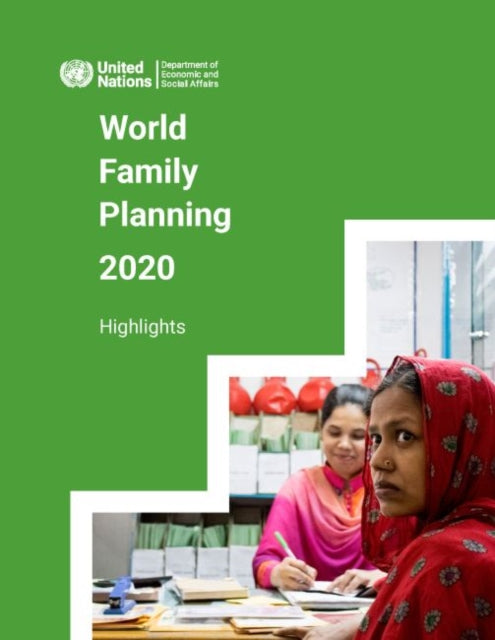
World family planning 2020: highlights, accelerating action to ensure universal access to family planning
World family planning 2020: highlights, accelerating action to ensure universal access to family planning
💎 Earn 58 Points (£0.58) on this item.
YOU SAVE £10.19
- Condition: Brand new
- UK Delivery times: Usually arrives within 2 - 3 working days
- UK Shipping: Fee starts at £2.39. Subject to product weight & dimension
Bulk ordering. Want 15 or more copies? Get a personalised quote and bigger discounts. Learn more about bulk orders.
Couldn't load pickup availability
- More about World family planning 2020: highlights, accelerating action to ensure universal access to family planning
The 2030 Agenda for Sustainable Development calls for expanding access to contraception to achieve universal reproductive health-care services. This Highlights presents estimates of contraceptive use and needs from 1990 to 2020, projections to 2030 for 196 countries, and discusses the impact of population growth and changes in demand on the projected numbers of women using or needing family planning. It also highlights global progress in meeting the demand for family planning with modern methods and how satisfying this demand can contribute to achieving the Sustainable Development Goals.
Format: Paperback / softback
Length: 44 pages
Publication date: 30 January 2021
Publisher: United Nations
Access to contraception is a crucial factor in ensuring universal access to reproductive health-care services, as outlined in the 2030 Agenda for Sustainable Development. ThisHighlights provides estimates of contraceptive use and needs from 1990 to 2020, as well as projections to 2030 for 196 countries or areas worldwide. It explores the impact of population growth and shifts in demand for family planning on the projected numbers of women using or facing unmet needs for family planning. Additionally, it discusses global progress in meeting the demand for family planning with modern methods, as mandated by the 2030 Agenda (SDG indicator 3.7.1). Furthermore, it highlights how satisfying the demand for family planning with modern methods can contribute to the achievement of the Sustainable Development Goals (SDGs).
Contraceptive use and needs have seen significant changes over the past three decades. In 1990, an estimated 216 million women worldwide were using modern contraceptives, representing a global prevalence of 33%. By 2020, this number had increased to 1.7 billion, with a global prevalence of 49%. This increase is largely attributed to the expansion of family planning services, particularly in low- and middle-income countries.
The projections to 2030 suggest that the global prevalence of contraceptive use will continue to rise, reaching 61% by 2030. This will be driven by a significant increase in the number of women in need of family planning services, particularly in sub-Saharan Africa and South Asia. However, there will also be notable gains in contraceptive use in other regions, including East Asia, Latin America, and the Middle East.
The demand for family planning services is influenced by a range of factors, including population growth, urbanization, education, and economic development. Population growth, in particular, has a significant impact on the demand for family planning, as it increases the number of people who need access to contraception to prevent unintended pregnancies and limit family size. Urbanization, on the other hand, can lead to changes in reproductive behaviors and increased demand for family planning services, particularly among women in urban areas who may have more access to information and resources.
Education and economic development also play a crucial role in shaping the demand for family planning services. Women with higher levels of education and income are more likely to use contraception and have smaller families. Additionally, women who have access to education and employment opportunities are more likely to make informed decisions about their reproductive health and have greater control over their lives.
The impact of population growth and changes in demand for family planning on the projected numbers of women who are contraceptive users or have unmet need for family planning is significant. According to the projections, by 2030, an estimated 1.2 billion women will be using modern contraceptives, with an unmet need for family planning for an additional 600 million women. This unmet need is primarily concentrated in sub-Saharan Africa and South Asia, where the demand for family planning services is highest.
To address the unmet need for family planning, there is a need for increased investment in family planning services, particularly in low- and middle-income countries. This includes expanding access to contraception, providing training and education to healthcare providers, and improving the quality and availability of family planning services. Additionally, there is a need for policies and programs that promote gender equality, empower women, and address social and cultural barriers to family planning.
Global progress in meeting the demand for family planning with modern methods has been significant, but there is still work to be done. According to the projections, by 2030, an estimated 1.2 billion women will be using modern contraceptives, representing a significant increase from the current global prevalence of 49%. However, there are still significant gaps in contraceptive use among certain groups of women, including young women, women in rural areas, and women with low levels of education.
To address these gaps, there is a need for targeted interventions and policies that address the specific needs of these groups of women. This includes providing access to contraception through mobile clinics, community-based programs, and school-based programs, as well as providing education and training to healthcare providers on how to provide family planning services to these groups of women. Additionally, there is a need for policies that promote gender equality and empower women, such as laws that protect women's reproductive rights and provide access to education and employment opportunities.
In conclusion, expanding access to contraception is essential for achieving universal access to reproductive health-care services, as called for in the 2030 Agenda for Sustainable Development. TheHighlights provides estimates of contraceptive use and needs from 1990 to 2020, as well as projections to 2030 for 196 countries or areas worldwide. It explores the impact of population growth and shifts in demand for family planning on the projected numbers of women using or facing unmet needs for family planning. Additionally, it discusses global progress in meeting the demand for family planning with modern methods, as mandated by the 2030 Agenda (SDG indicator 3.7.1). Furthermore, it highlights how satisfying the demand for family planning with modern methods can contribute to the achievement of the Sustainable Development Goals (SDGs).
Weight: 138g
Dimension: 216 x 280 x 6 (mm)
ISBN-13: 9789211483482
This item can be found in:
UK and International shipping information
UK and International shipping information
UK Delivery and returns information:
- Delivery within 2 - 3 days when ordering in the UK.
- Shipping fee for UK customers from £2.39. Fully tracked shipping service available.
- Returns policy: Return within 30 days of receipt for full refund.
International deliveries:
Shulph Ink now ships to Australia, Belgium, Canada, France, Germany, Ireland, Italy, India, Luxembourg Saudi Arabia, Singapore, Spain, Netherlands, New Zealand, United Arab Emirates, United States of America.
- Delivery times: within 5 - 10 days for international orders.
- Shipping fee: charges vary for overseas orders. Only tracked services are available for most international orders. Some countries have untracked shipping options.
- Customs charges: If ordering to addresses outside the United Kingdom, you may or may not incur additional customs and duties fees during local delivery.