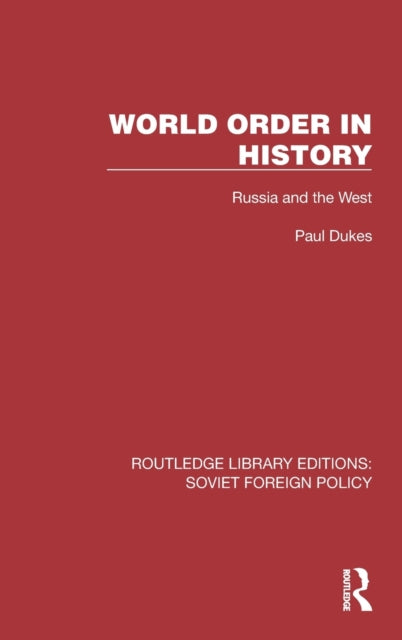
Paul Dukes
World Order in History: Russia and the West
World Order in History: Russia and the West
💎 Earn 552 Points (£5.52) on this item.
We can order this item for you. Delivery usually takes about 4 to 6 weeks.
This item is not held in our immediate stock. We will order it for you after checkout.
Estimated delivery: About 4 to 6 weeks
- Condition: Brand new
- UK Delivery times: Usually arrives within 2 - 3 working days
- UK Shipping: Fee starts at £2.39. Subject to product weight & dimension
Bulk ordering. Want 15 or more copies? Get a personalised quote and bigger discounts. Learn more about bulk orders.
Couldn't load pickup availability
- More about World Order in History: Russia and the West
World Order in History argues that historians' ideas about world order have influenced nations' self-perception, particularly in Russia and the Soviet Union, and the Western world.
Format: Hardback
Length: 198 pages
Publication date: 28 December 2022
Publisher: Taylor & Francis Ltd
The book "World Order in History" (1996) makes a compelling argument that historians' perceptions of world order have played a significant role in shaping nations' self-identity. It explores these assertions in depth, focusing on Russia, the Soviet Union, and the Western world.
The author contends that historical interpretations of global hierarchy have had a profound impact on how individuals and societies perceive themselves and their place in the world. By examining the ways in which different historical periods have been interpreted and understood, the book sheds light on the ways in which these interpretations have influenced political, social, and economic developments.
One of the key themes explored in the book is the concept of "hegemony," which refers to the dominance of one nation or group of nations over others. The author argues that hegemony has played a central role in shaping world order throughout history, and that different historical periods have been marked by the rise and fall of different hegemonic powers.
The book also examines the role of ideology in shaping world order. The author argues that ideologies such as liberalism, communism, and fascism have all played a role in shaping the course of history and have contributed to the formation of different world orders.
In addition to examining the historical context, the book also takes a contemporary perspective on world order. The author argues that the current global order is characterized by a complex web of interdependence and interconnectedness, and that this order is shaped by a range of factors, including economic globalization, technological advancements, and political instability.
The book concludes by suggesting that historians and policymakers need to be aware of the historical and contemporary factors that shape world order in order to develop effective strategies for navigating the complex and rapidly changing global landscape.
Overall, "World Order in History" is a thought-provoking and insightful book that provides a valuable contribution to the study of international relations and global history. The book's arguments are well-supported by evidence and analysis, and its insights into the ways in which historical perceptions of world order have shaped nations' self-identity are particularly compelling.
The book "World Order in History" (1996) makes a compelling argument that historians' perceptions of world order have played a significant role in shaping nations' self-identity. It explores these assertions in depth, focusing on Russia, the Soviet Union, and the Western world.
The author contends that historical interpretations of global hierarchy have had a profound impact on how individuals and societies perceive themselves and their place in the world. By examining the ways in which different historical periods have been interpreted and understood, the book sheds light on the ways in which these interpretations have influenced political, social, and economic developments.
One of the key themes explored in the book is the concept of "hegemony," which refers to the dominance of one nation or group of nations over others. The author argues that hegemony has played a central role in shaping world order throughout history, and that different historical periods have been marked by the rise and fall of different hegemonic powers.
The book also examines the role of ideology in shaping world order. The author argues that ideologies such as liberalism, communism, and fascism have all played a role in shaping the course of history and have contributed to the formation of different world orders.
In addition to examining the historical context, the book also takes a contemporary perspective on world order. The author argues that the current global order is characterized by a complex web of interdependence and interconnectedness, and that this order is shaped by a range of factors, including economic globalization, technological advancements, and political instability.
The book concludes by suggesting that historians and policymakers need to be aware of the historical and contemporary factors that shape world order in order to develop effective strategies for navigating the complex and rapidly changing global landscape.
Overall, "World Order in History" is a thought-provoking and insightful book that provides a valuable contribution to the study of international relations and global history. The book's arguments are well-supported by evidence and analysis, and its insights into the ways in which historical perceptions of world order have shaped nations' self-identity are particularly compelling.
Weight: 548g
Dimension: 234 x 156 (mm)
ISBN-13: 9781032377353
This item can be found in:
UK and International shipping information
UK and International shipping information
UK Delivery and returns information:
- Delivery within 2 - 3 days when ordering in the UK.
- Shipping fee for UK customers from £2.39. Fully tracked shipping service available.
- Returns policy: Return within 30 days of receipt for full refund.
International deliveries:
Shulph Ink now ships to Australia, Belgium, Canada, France, Germany, Ireland, Italy, India, Luxembourg Saudi Arabia, Singapore, Spain, Netherlands, New Zealand, United Arab Emirates, United States of America.
- Delivery times: within 5 - 10 days for international orders.
- Shipping fee: charges vary for overseas orders. Only tracked services are available for most international orders. Some countries have untracked shipping options.
- Customs charges: If ordering to addresses outside the United Kingdom, you may or may not incur additional customs and duties fees during local delivery.