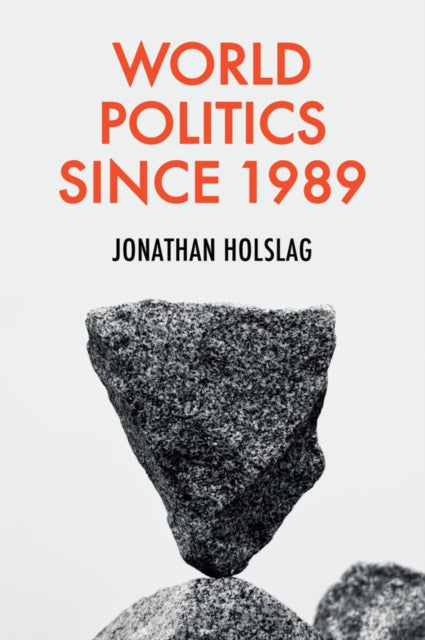
Jonathan Holslag
World Politics since 1989
World Politics since 1989
💎 Earn 88 Points (£0.88) on this item.
YOU SAVE £7.30
- Condition: Brand new
- UK Delivery times: Usually arrives within 2 - 3 working days
- UK Shipping: Fee starts at £3.89. Subject to product weight & dimension
Bulk ordering. Want 15 or more copies? Get a personalised quote and bigger discounts. Learn more about bulk orders.
Couldn't load pickup availability
- More about World Politics since 1989
The age of globalization, which brought about increased connectivity, affluence, and growth, has come to an end. This was due to the West's loss of strength due to rising consumerism, unbalanced trade, and half-hearted diplomatic engagement, while other powers like China and Russia grew stronger. It was the failure of the West to listen to its people and reinvent itself that led to the world's current dark place.
\n Format: Hardback
\n Length: 416 pages
\n Publication date: 03 September 2021
\n Publisher: Polity Press
\n
The year 1989 marked a significant turning point in history, ushering in a new era of freedom and prosperity that would span three decades. However, as we approach the end of this golden era, it is essential to reflect on what went wrong and how the age of globalization, characterized by growing connectivity, affluence, and growth, gave way. In this essay, Jonathan Holslag, a renowned expert on global politics, takes us on a journey through the calm and turbulent waters of global politics, from the Cold War to Russia's invasion of Ukraine. Through his insightful analysis, Holslag unravels the story of faltering momentum and squandered opportunities that led to the West's decline. He explains how the West's sources of strength, such as its economic and military power, were lost to rising consumerism, unbalanced trade, and half-hearted diplomatic engagement. At the same time, other powers, such as China and Russia, grew stronger.
Holslag's narrative is filled with vivid examples and compelling anecdotes that shed light on the complex web of factors that contributed to the West's decline. He highlights the failure of the West to listen to its people, to show clear leadership, and to reinvent itself in the face of ample evidence that things were going awry. He argues that the West's obsession with individualism, consumerism, and short-term profits led to a neglect of the long-term interests of its citizens and the broader global community.
Furthermore, Holslag critiques the West's approach to diplomacy, which he sees as overly focused on appeasing and accommodating other powers rather than standing up for its values and interests. He argues that the West's willingness to compromise its principles in the pursuit of economic gains and political stability has undermined its credibility and influence in the world.
Despite the challenges facing the West, Holslag remains optimistic about the future. He believes that the West can reclaim its position of strength and influence by embracing a more assertive and proactive approach to global politics. He advocates for a renewed focus on economic development, trade, and investment, as well as a more robust defense and security strategy. He also calls for a more inclusive and democratic approach to diplomacy, one that involves engaging with and listening to the voices of the people around the world.
In conclusion, the decline of the West in the age of globalization is a complex and multifaceted issue that requires a comprehensive and nuanced analysis. Jonathan Holslag's essay provides a valuable contribution to this debate by offering a compelling account of the factors that led to the West's decline and proposing solutions for its revival. As we navigate the uncertain waters of global politics, it is essential to learn from the past and embrace a more assertive and responsible approach to ensure a brighter and more prosperous future for all.
The year 1989 marked a significant turning point in history, ushering in a new era of freedom and prosperity that would span three decades. However, as we approach the end of this golden era, it is essential to reflect on what went wrong and how the age of globalization, characterized by growing connectivity, affluence, and growth, gave way. In this essay, Jonathan Holslag, a renowned expert on global politics, takes us on a journey through the calm and turbulent waters of global politics, from the Cold War to Russia's invasion of Ukraine. Through his insightful analysis, Holslag unravels the story of faltering momentum and squandered opportunities that led to the West's decline. He explains how the West's sources of strength, such as its economic and military power, were lost to rising consumerism, unbalanced trade, and half-hearted diplomatic engagement. At the same time, other powers, such as China and Russia, grew stronger.
Holslag's narrative is filled with vivid examples and compelling anecdotes that shed light on the complex web of factors that contributed to the West's decline. He highlights the failure of the West to listen to its people, to show clear leadership, and to reinvent itself in the face of ample evidence that things were going awry. He argues that the West's obsession with individualism, consumerism, and short-term profits led to a neglect of the long-term interests of its citizens and the broader global community.
Furthermore, Holslag critiques the West's approach to diplomacy, which he sees as overly focused on appeasing and accommodating other powers rather than standing up for its values and interests. He argues that the West's willingness to compromise its principles in the pursuit of economic gains and political stability has undermined its credibility and influence in the world.
Despite the challenges facing the West, Holslag remains optimistic about the future. He believes that the West can reclaim its position of strength and influence by embracing a more assertive and proactive approach to global politics. He advocates for a renewed focus on economic development, trade, and investment, as well as a more robust defense and security strategy. He also calls for a more inclusive and democratic approach to diplomacy, one that involves engaging with and listening to the voices of the people around the world.
In conclusion, the decline of the West in the age of globalization is a complex and multifaceted issue that requires a comprehensive and nuanced analysis. Jonathan Holslag's essay provides a valuable contribution to this debate by offering a compelling account of the factors that led to the West's decline and proposing solutions for its revival. As we navigate the uncertain waters of global politics, it is essential to learn from the past and embrace a more assertive and responsible approach to ensure a brighter and more prosperous future for all.
\n Weight: 748g\n
Dimension: 239 x 356 x 40 (mm)\n
ISBN-13: 9781509546725\n \n
UK and International shipping information
UK and International shipping information
We deliver throughout the United Kingdom and to 128 countries and territories worldwide, including the United States, Australia, Canada, Germany, Spain and France.