SiyuanLiu
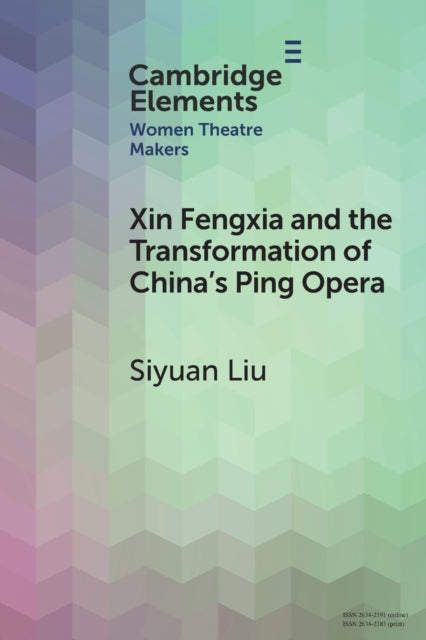
Xin Fengxia and the Transformation of China's Ping Opera
Xin Fengxia and the Transformation of China's Ping Opera
💎 Earn 84 Points (£0.84) on this item.
We can order this item for you. Delivery usually takes about 4 to 6 weeks.
This item is not held in our immediate stock. We will order it for you after checkout.
Estimated delivery: About 4 to 6 weeks
YOU SAVE £1.01
- Condition: Brand new
- UK Delivery times: Usually arrives within 2 - 3 working days
- UK Shipping: Fee starts at £2.39. Subject to product weight & dimension
Bulk ordering. Want 15 or more copies? Get a personalised quote and bigger discounts. Learn more about bulk orders.
Couldn't load pickup availability
- More about Xin Fengxia and the Transformation of China's Ping Opera
The Element focuses on Xin Fengxia, a regional xiqu star who transformed the genre from folk entertainment to one of the most notable winners of the xiqu reform after the establishment of the People's Republic of China in 1949. It explores her life experience and artistry, including growing up in Tianjin before 1949, national stardom in Beijing (1949-1957), restricted creativity amidst political upheavals (1957-1975), and as a prominent author after a stroke (1977-1998).
Format: Paperback / softback
Length: 75 pages
Publication date: 15 September 2022
Publisher: Cambridge University Press
This Element delves into the life and artistry of Xin Fengxia (1927–1998), a prominent figure in the regional xiqu form known as pingju. Born in China's third-largest theater market, Tianjin, before 1949, Fengxia played a crucial role in transforming pingju from a form of folk entertainment primarily enjoyed by the lower classes to one of the most celebrated winners of the xiqu reform after the establishment of the People's Republic of China (PRC) in 1949.
The Element is structured into four sections, each exploring a different stage of Fengxia's life experience and artistic development. The first section focuses on her upbringing in Tianjin before 1949, providing insight into the environment that shaped her as a performer and reformer. The second section explores her national stardom in Beijing from 1949 to 1957, during which she became a household name and a symbol of Chinese culture. The third section examines the challenges she faced during the political upheavals of the 1950s and 1960s, when her creativity was restricted and her performances were censored. The fourth section showcases her remarkable comeback as a prominent author after suffering a stroke in 1977, marking a new chapter in her artistic legacy.
Rather than adopting a traditional biographical approach, these sections delve into the pre- and post-1949 environment that propelled Fengxia to prominence as a pingju reformer. They also examine the price she paid for her success, highlighting the challenges and sacrifices she made along the way. Through her remarkable journey, Fengxia not only revolutionized the genre of xiqu but also left a lasting impact on Chinese theater and culture.
Introduction:
Xin Fengxia, a renowned star of the regional xiqu form known as pingju, played a pivotal role in transforming the genre from a form of folk entertainment primarily enjoyed by the lower classes to one of the most celebrated winners of the xiqu reform after the establishment of the People's Republic of China (PRC) in 1949. Born in China's third-largest theater market, Tianjin, before 1949, Fengxia's journey as a performer and reformer is a testament to her enduring legacy in Chinese theater and culture.
Section 1:
Uprooting and Adaptation:
Fengxia's early life was marked by her relocation to Beijing, where she began her career as a performer in the xiqu genre. Growing up in a rapidly changing society, Fengxia faced numerous challenges and adaptations. She had to navigate the complexities of a new city, learn a new language, and adapt to the evolving cultural norms and expectations of the theater community. Despite these obstacles, Fengxia's talent and dedication shone through, and she quickly gained recognition as a rising star in the xiqu world.
Section 2:
National Stardom:
In 1949, Fengxia's career took a significant turn when she was invited to perform at the National Theatre in Beijing. Her performance was a sensation, and she quickly became a household name in China. Her unique style, characterized by her delicate and graceful movements, and her ability to convey emotions through her facial expressions and body language, captivated audiences nationwide. Fengxia's national stardom also brought her into contact with influential political figures and cultural elites, who recognized her talent and potential for promoting Chinese culture and theater.
Section 3:
Creative Challenges and Censorship:
However, Fengxia's success did not come without its challenges. During the political upheavals of the 1950s and 1960s, the Chinese government imposed strict censorship on the arts, including xiqu. Fengxia's performances were frequently censored, and her creative freedom was severely restricted. This period was particularly difficult for Fengxia, as she struggled to find a balance between her artistic aspirations and the demands of the government. Despite these challenges, Fengxia remained committed to her craft and continued to push the boundaries of what was acceptable in xiqu.
Section 4:
Post-Stroke Legacy:
In 1977, Fengxia suffered a stroke that left her paralyzed on one side of her body. Despite this setback, Fengxia refused to let her disability define her. She continued to write and perform, using her unique voice and perspective to inspire and uplift others. Her works, which often explored themes of love, loss, and resilience, touched the hearts of many and became a source of comfort and inspiration for those facing similar challenges.
Conclusion:
Xin Fengxia's life and artistry are a testament to the power of perseverance, dedication, and the pursuit of artistic excellence. Her journey from a young performer in Tianjin to a national star in Beijing, and her resilience in the face of political challenges and personal adversity, showcases the remarkable contributions she made to Chinese theater and culture. Fengxia's legacy continues to inspire and influence new generations of performers and artists, reminding us of the importance of artistic expression and the power of human creativity.
Weight: 116g
ISBN-13: 9781009087650
UK and International shipping information
UK and International shipping information
UK Delivery and returns information:
- Delivery within 2 - 3 days when ordering in the UK.
- Shipping fee for UK customers from £2.39. Fully tracked shipping service available.
- Returns policy: Return within 30 days of receipt for full refund.
International deliveries:
Shulph Ink now ships to Australia, Belgium, Canada, France, Germany, Ireland, Italy, India, Luxembourg Saudi Arabia, Singapore, Spain, Netherlands, New Zealand, United Arab Emirates, United States of America.
- Delivery times: within 5 - 10 days for international orders.
- Shipping fee: charges vary for overseas orders. Only tracked services are available for most international orders. Some countries have untracked shipping options.
- Customs charges: If ordering to addresses outside the United Kingdom, you may or may not incur additional customs and duties fees during local delivery.