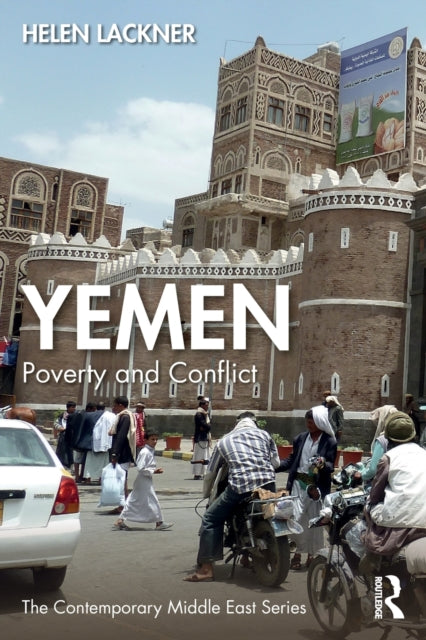
Helen Lackner
Yemen: Poverty and Conflict
Yemen: Poverty and Conflict
💎 Earn 202 Points (£2.02) on this item.
We can order this item for you. Delivery usually takes about 4 to 6 weeks.
This item is not held in our immediate stock. We will order it for you after checkout.
Estimated delivery: About 4 to 6 weeks
YOU SAVE £2.41
- Condition: Brand new
- UK Delivery times: Usually arrives within 2 - 3 working days
- UK Shipping: Fee starts at £2.39. Subject to product weight & dimension
Bulk ordering. Want 15 or more copies? Get a personalised quote and bigger discounts. Learn more about bulk orders.
Couldn't load pickup availability
- More about Yemen: Poverty and Conflict
This book examines the underlying reasons for the Yemeni Civil War and assesses prospects for the country beyond the conflict. It discusses Yemeni history, state formation, political institutions, climate change, rural and urban life, international development, and humanitarian aid. It suggests policies to improve the living conditions of Yemenis and is relevant to politicians, diplomats, humanitarian organizations, security analysts, researchers, and students of international relations, political economy, failing states, development studies, and contemporary Middle Eastern history.
Format: Paperback / softback
Length: 162 pages
Publication date: 15 July 2022
Publisher: Taylor & Francis Ltd
Focusing on the fundamental reasons underlying the enduring crisis of the Yemeni Civil War, this comprehensive book frames contemporary Yemen and assesses prospects beyond the conflict, identifying the factors that will shape its future internal and international characteristics. Drawing on Helen Lackner's profound expertise in Yemen, this volume delves into Yemen's history and state formation, examining the main political institutions that have emerged since the Republic of Yemen's establishment and their role in the war, including the significance of current fragmentation. The volume further explores climate change, particularly the issue of water scarcity, in the context of resource constraints to economic development and the role of migration. Rural and urban life, as well as the impact of international development and humanitarian aid, are also covered, along with Yemen's international relations—its interactions with its neighbors and Western states. Looking forward, the book suggests the types of policies that can provide Yemenis with the conditions needed for a reasonable standard of living.
This book will appeal to a wide range of readers, including politicians, diplomats, humanitarian organizations, security analysts, researchers on the Middle East, and those generally interested in Yemen. It will also serve as an essential text for students of international relations, political economy, failing states, development studies, and contemporary Middle Eastern history.
The Yemeni Civil War has been a protracted and complex conflict that has plagued the country for over seven years. The war has resulted in widespread destruction, displacement, and humanitarian crisis, with millions of people facing food insecurity, disease, and violence. The underlying reasons for the conflict are multifaceted and complex, but they can be traced back to a combination of political, economic, and social factors.
One of the primary drivers of the conflict is the political instability in Yemen, which has been exacerbated by regional and international factors. The country has been ruled by three different presidents since 2011, and political divisions between different factions within the country have deepened the crisis. The Houthi rebels, who are supported by Iran, have taken control of large parts of the country, including the capital, Sanaa, and have been fighting against the government forces backed by Saudi Arabia and the United Arab Emirates.
Another factor contributing to the conflict is Yemen's economic crisis, which has been exacerbated by the war. The country is one of the poorest in the world, and the conflict has led to a significant decline in the country's GDP, a rise in inflation, and a collapse in the currency. This has led to widespread poverty and unemployment, which have fueled social unrest and political instability.
Social factors also play a significant role in the conflict. Yemen is a country with a diverse population, including Shia and Sunni Muslims, as well as other religious and ethnic groups. The conflict has been fueled by sectarian tensions, with the Houthi rebels being seen by some as a threat to the country's Sunni majority. This has led to tensions between different communities and has contributed to the rise of extremist groups, such as Al-Qaeda in the Arabian Peninsula (AQAP).
In addition to these factors, the war has been influenced by regional and international powers, including Saudi Arabia, the United Arab Emirates, and Iran. Saudi Arabia and the UAE have been backing the government forces in their fight against the Houthi rebels, while Iran has been providing support to the Houthi rebels. This has led to a complex web of alliances and rivalries, which have further complicated the conflict.
Despite the ongoing crisis, there are some prospects for peace in Yemen. The United Nations has been working to broker a peace agreement between the government and the Houthi rebels, and there have been some signs of progress in recent months. In addition, there have been efforts to address the underlying economic and social issues that have contributed to the conflict, such as poverty alleviation and political reform.
However, there are also significant challenges to peace in Yemen. The conflict has been characterized by violence and instability, and it is difficult to predict how it will unfold in the future. In addition, there are concerns that the conflict could spill over into neighboring countries, such as Saudi Arabia and the UAE, and could further destabilize the region.
In conclusion, the Yemeni Civil War is a complex and multifaceted conflict that has been driven by a combination of political, economic, and social factors. While there are some prospects for peace, there are also significant challenges to achieving lasting stability in the country. It is essential that all parties involved in the conflict work towards a peaceful resolution and that international actors support these efforts. Only through a concerted
peaceful resolution can Yemen hope to rebuild its shattered society and achieve a brighter future for its people.
Weight: 340g
Dimension: 234 x 156 (mm)
ISBN-13: 9780367180508
This item can be found in:
UK and International shipping information
UK and International shipping information
UK Delivery and returns information:
- Delivery within 2 - 3 days when ordering in the UK.
- Shipping fee for UK customers from £2.39. Fully tracked shipping service available.
- Returns policy: Return within 30 days of receipt for full refund.
International deliveries:
Shulph Ink now ships to Australia, Belgium, Canada, France, Germany, Ireland, Italy, India, Luxembourg Saudi Arabia, Singapore, Spain, Netherlands, New Zealand, United Arab Emirates, United States of America.
- Delivery times: within 5 - 10 days for international orders.
- Shipping fee: charges vary for overseas orders. Only tracked services are available for most international orders. Some countries have untracked shipping options.
- Customs charges: If ordering to addresses outside the United Kingdom, you may or may not incur additional customs and duties fees during local delivery.