1
/
of
1
Valerie Sherer Mathes
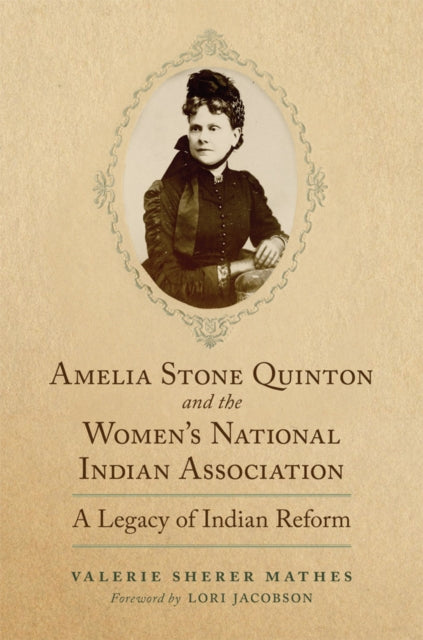
Amelia Stone Quinton and the Women's National Indian Association Volume 2: A Legacy of Indian Reform
Amelia Stone Quinton and the Women's National Indian Association Volume 2: A Legacy of Indian Reform
💎 Earn 94 Points (£0.94) on this item.
Low Stock: Only 3 copies remaining
Regular price
£18.99 GBP
Regular price
£22.99 GBP
Sale price
£18.99 GBP
Unit price
/
per
Taxes included.
Shipping calculated at checkout.
YOU SAVE £4.00
- Condition: Brand new
- UK Delivery times: Usually arrives within 2 - 3 working days
- UK Shipping: Fee starts at £3.89. Subject to product weight & dimension
Bulk ordering. Want 15 or more copies? Get a personalised quote and bigger discounts. Learn more about bulk orders.
Couldn't load pickup availability
- More about Amelia Stone Quinton and the Women's National Indian Association Volume 2: A Legacy of Indian Reform
This first full account of Amelia Stone Quinton (1833–1926) and the organization she cofounded, the Women’s National Indian Association (WNIA), offers a nuanced insight into the intersection of gender, race, religion, and politics in our shared history. Author Valerie Sherer Mathes shows how Quinton, like Helen Hunt Jackson, was a true force for reform and progress who was nonetheless constrained by the assimilationist convictions of her time.
The WNIA, which Quinton cofounded with Mary Lucinda Bonney in 1879, was organized expressly to press for a “more just, protective, and fostering Indian policy,” but also to promote the assimilation of the Indian through Christianization and “civilization.” Charismatic and indefatigable, Quinton garnered support for the WNIA’s work by creating strong working relationships with leaders of the main reform groups, successive commissioners of Indian affairs, secretaries of the interior, and prominent congressmen. The WNIA’s powerful network of friends formed a hybrid organization: religious in its missionary society origins but also political, using its powers to petition and actively address public opinion. Mathes follows the organization as it evolved from its initial focus on evangelizing Indian women—and promoting Victorian society’s ideals of “true womanhood”—through its return to its missionary roots, establishing over sixty missionary stations, supporting physicians and teachers, and building houses, chapels, schools, and hospitals.
With reference to Quinton’s voluminous writings—including her letters, speeches, and newspaper articles—as well as to WNIA literature, Mathes draws a complex picture of an organization that at times ignored traditional Indian practices and denied individual agency, even as it provided dispossessed and impoverished people with health care and adequate housing. And at the center of this picture we find Quinton, a woman and reformer of her time.
The WNIA, which Quinton cofounded with Mary Lucinda Bonney in 1879, was organized expressly to press for a “more just, protective, and fostering Indian policy,” but also to promote the assimilation of the Indian through Christianization and “civilization.” Charismatic and indefatigable, Quinton garnered support for the WNIA’s work by creating strong working relationships with leaders of the main reform groups, successive commissioners of Indian affairs, secretaries of the interior, and prominent congressmen. The WNIA’s powerful network of friends formed a hybrid organization: religious in its missionary society origins but also political, using its powers to petition and actively address public opinion. Mathes follows the organization as it evolved from its initial focus on evangelizing Indian women—and promoting Victorian society’s ideals of “true womanhood”—through its return to its missionary roots, establishing over sixty missionary stations, supporting physicians and teachers, and building houses, chapels, schools, and hospitals.
With reference to Quinton’s voluminous writings—including her letters, speeches, and newspaper articles—as well as to WNIA literature, Mathes draws a complex picture of an organization that at times ignored traditional Indian practices and denied individual agency, even as it provided dispossessed and impoverished people with health care and adequate housing. And at the center of this picture we find Quinton, a woman and reformer of her time.
- Publication date: 8 September 2026
- Page count: 306
- Dimensions: Height 229 mm; Width 152 mm; Thickness 21 mm
- Publisher: University of Oklahoma Press
- Format: Paperback
- ISBN-13: 9780806192918
UK and International shipping information
UK and International shipping information
We deliver throughout the United Kingdom and to 128 countries and territories worldwide, including the United States, Australia, Canada, Germany, Spain and France.