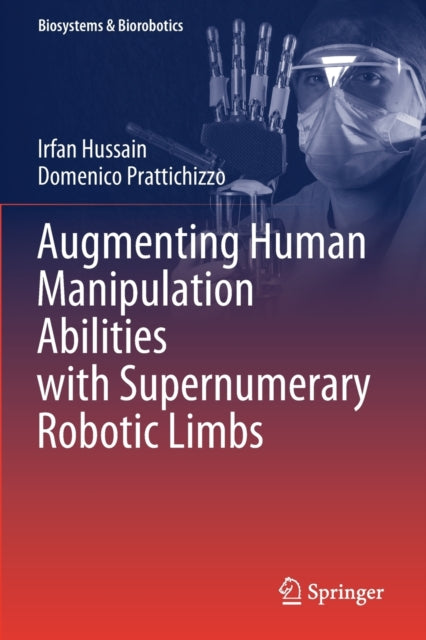
Irfan Hussain,Domenico Prattichizzo
Augmenting Human Manipulation Abilities with Supernumerary Robotic Limbs
Augmenting Human Manipulation Abilities with Supernumerary Robotic Limbs
💎 Earn 371 Points (£3.71) on this item.
We can order this item for you. Delivery usually takes about 4 to 6 weeks.
This item is not held in our immediate stock. We will order it for you after checkout.
Estimated delivery: About 4 to 6 weeks
YOU SAVE £15.66
- Condition: Brand new
- UK Delivery times: Usually arrives within 2 - 3 working days
- UK Shipping: Fee starts at £2.39. Subject to product weight & dimension
Bulk ordering. Want 15 or more copies? Get a personalised quote and bigger discounts. Learn more about bulk orders.
Couldn't load pickup availability
- More about Augmenting Human Manipulation Abilities with Supernumerary Robotic Limbs
This book provides an in-depth look at the design and development of robotic extra fingers, addressing issues such as portability, wearability, and control algorithms. It also explores optimized control algorithms and sensorimotor interfaces and presents tests on healthy subjects and chronic stroke patients.
Format: Paperback / softback
Length: 145 pages
Publication date: 18 July 2021
Publisher: Springer Nature Switzerland AG
This comprehensive book provides a timely and insightful examination of an emerging area within the field of wearable assistive technology: the design and development of robotic extra fingers. After providing a concise review of the current state-of-the-art and a detailed account of earlier prototypes, the author delves into their innovative efforts to address critical challenges such as the portability and wearability of these devices. They explore strategies to minimize fatigue and seamlessly integrate the motion of the extra fingers with that of the human hand. Additionally, the book explores optimized control algorithms and the design of wearable sensorimotor interfaces. Furthermore, it presents a series of rigorous tests conducted on healthy subjects and chronic stroke patients, shedding light on the potential benefits and limitations of supernumerary robotic fingers. By seamlessly merging concepts from robotics, biomechanics, human factors, and control theory, this book offers a comprehensive overview of supernumerary robotic fingers, highlighting their challenges and opportunities. It serves as a valuable resource for researchers and practitioners engaged in the development of wearable robotic devices and interfaces that prioritize wearability, safety, ergonomics, and user comfort.
Introduction:
The field of wearable assistive technology has witnessed significant advancements in recent years, driven by the increasing demand for innovative solutions to support individuals with disabilities and enhance their quality of life. One emerging area of interest is the design and development of robotic extra fingers, which aim to provide users with additional dexterity and mobility. In this comprehensive book, the author delves into the latest developments in this field, exploring the challenges, opportunities, and potential applications of supernumerary robotic fingers.
State of the Art Review:
The book begins by providing a concise review of the current state-of-the-art in wearable assistive technology, including the development of robotic hands, arms, and legs. The author highlights the key challenges faced in the design and development of these devices, such as power consumption, weight, and user comfort. They also discuss the various technologies and materials used in the construction of robotic limbs, such as actuators, sensors, and microcontrollers.
Earlier Prototypes:
After reviewing the state of the art, the author proceeds to describe earlier prototypes of robotic extra fingers. They provide detailed insights into the design, functionality, and performance of these devices, highlighting their contributions to the field. The author also discusses the limitations and challenges encountered during the development of these prototypes, which served as valuable learning experiences for the author and their team.
Portability and Wearability:
One of the critical challenges in the design and development of robotic extra fingers is ensuring their portability and wearability. The author discusses various strategies employed to address these issues, such as lightweight materials, ergonomic designs, and flexible joints. They also explore the use of wearable sensors and actuators to monitor the motion of the extra fingers and optimize their control algorithms.
Fatigue Reduction:
Fatigue is a common issue faced by users of wearable assistive technology, particularly those with chronic conditions such as stroke. The author discusses the development of fatigue-reducing technologies and strategies, such as energy-efficient actuators, adjustable grip forces, and user-friendly interfaces. They also explore the use of biofeedback and cognitive training to enhance the user's perception and control of the extra fingers.
Integration with Human Hand:
Another important aspect of robotic extra fingers is their integration with the human hand. The author discusses the challenges involved in achieving seamless coordination between the extra fingers and the human hand, including the development of sensory feedback mechanisms and haptic interfaces. They also explore the use of machine learning and artificial intelligence to improve the learning and adaptation of the extra fingers to the user's movements.
Optimized Control Algorithms:
The design and development of robotic extra fingers require the use of optimized control algorithms to ensure precise and reliable movement. The author discusses the development of various control algorithms, such as proportional-integral-derivative (PID) control, fuzzy logic control, and genetic algorithms. They also explore the use of real-time feedback and adaptive control to improve the performance of the extra fingers.
Wearable Sensorimotor Interfaces:
Wearable sensorimotor interfaces play a crucial role in the development of robotic extra fingers. The author discusses the design and development of these interfaces, including the use of wearable sensors, actuators, and microcontrollers. They also explore the use of virtual reality and augmented reality to enhance the user's perception and control of the extra fingers.
Clinical Trials:
To validate the effectiveness and safety of robotic extra fingers, the author conducts a series of tests on healthy subjects and chronic stroke patients. The results of these tests provide valuable insights into the potential benefits and limitations of supernumerary robotic fingers. The author also discusses the implications of these findings for future research and development in the field.
Conclusion:
In conclusion, this comprehensive book offers a timely and insightful examination of the design and development of robotic extra fingers. By merging concepts from robotics, biomechanics, human factors, and control theory, the author provides a comprehensive overview of supernumerary robotic fingers, highlighting their challenges, opportunities, and potential applications. The book serves as a valuable resource for researchers, practitioners, and individuals with disabilities interested in the development of wearable robotic devices and interfaces that prioritize wearability, safety, ergonomics, and user comfort.
Weight: 256g
Dimension: 235 x 155 (mm)
ISBN-13: 9783030520045
Edition number: 1st ed. 2020
This item can be found in:
UK and International shipping information
UK and International shipping information
UK Delivery and returns information:
- Delivery within 2 - 3 days when ordering in the UK.
- Shipping fee for UK customers from £2.39. Fully tracked shipping service available.
- Returns policy: Return within 30 days of receipt for full refund.
International deliveries:
Shulph Ink now ships to Australia, Belgium, Canada, France, Germany, Ireland, Italy, India, Luxembourg Saudi Arabia, Singapore, Spain, Netherlands, New Zealand, United Arab Emirates, United States of America.
- Delivery times: within 5 - 10 days for international orders.
- Shipping fee: charges vary for overseas orders. Only tracked services are available for most international orders. Some countries have untracked shipping options.
- Customs charges: If ordering to addresses outside the United Kingdom, you may or may not incur additional customs and duties fees during local delivery.