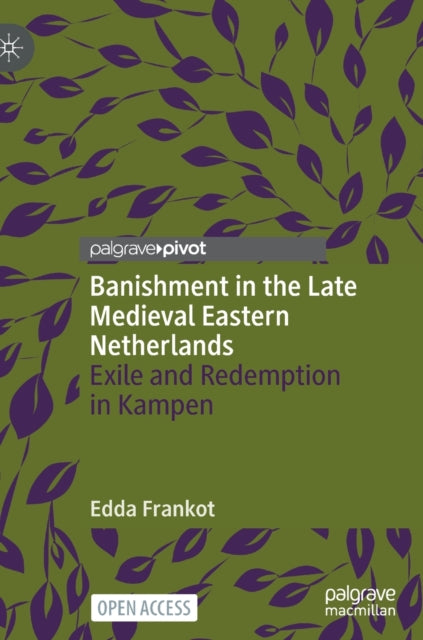
Edda Frankot
Banishment in the Late Medieval Eastern Netherlands: Exile and Redemption in Kampen
Banishment in the Late Medieval Eastern Netherlands: Exile and Redemption in Kampen
💎 Earn 185 Points (£1.85) on this item.
We can order this item for you. Delivery usually takes about 4 to 6 weeks.
This item is not held in our immediate stock. We will order it for you after checkout.
Estimated delivery: About 4 to 6 weeks
YOU SAVE £7.83
- Condition: Brand new
- UK Delivery times: Usually arrives within 2 - 3 working days
- UK Shipping: Fee starts at £3.89. Subject to product weight & dimension
Bulk ordering. Want 15 or more copies? Get a personalised quote and bigger discounts. Learn more about bulk orders.
Couldn't load pickup availability
- More about Banishment in the Late Medieval Eastern Netherlands: Exile and Redemption in Kampen
This book explores the practice of banishment in late medieval Europe, focusing on the Dutch town of Kampen. It examines the legal context of banishment, its use as a punitive and coercive measure, and the redemption of exiles. The book argues that banishment was a common punishment in late medieval society and reveals much about the values of late medieval society concerning morally acceptable behavior.
Format: Hardback
Length: 140 pages
Publication date: 08 December 2021
Publisher: Springer Nature Switzerland AG
This open-access book delves into the practice of banishment and uncovers valuable insights into the values of late medieval society regarding morally acceptable behavior. Focusing on the Dutch town of Kampen, it explores the exclusion of offenders through banishment and the redemption of individuals after their exile. Banishment was a prevalent punishment in late medieval Europe, particularly for sexual offenses. In Kampen, it was also employed as a consequence of non-payment of fines, allowing individuals to arrange repayment schemes to regain their status. The book begins by examining the legal context of banishment, before delving into the punishment practices in Kampen more broadly. In the third chapter, the legal practice of banishment as a punitive and coercive measure is discussed. The final chapter centers on the redemption of exiles, either through the completion of their punishment or by arranging for the payment of outstanding fines.
Introduction:
Banishment, a severe form of punishment in the late medieval period, played a significant role in shaping the values and behavior of society. This open-access book aims to analyze the practice of banishment and its implications for understanding the values of late medieval society. By examining the case of Kampen, a Dutch town, the book explores the exclusion of offenders through banishment and the redemption of individuals after their exile.
Legal Context of Banishment:
The legal context of banishment is crucial in understanding its practice. In late medieval Europe, banishment was often used as a punishment for various offenses, including sexual offenses, theft, and political dissidence. The legal framework governing banishment varied across different regions and countries, but it generally involved the authority of a sovereign or other governing body to order the removal of an individual from a particular territory.
Punishment in Kampen:
Kampen serves as a case study to examine the practice of banishment in late medieval Europe. The town was particularly known for its strict enforcement of laws and regulations, and banishment was a common punishment for offenders. The book discusses the various forms of banishment employed in Kampen, including physical removal from the town, restriction of movement within the region, and monetary fines.
Redemption of Exiles:
One of the most intriguing aspects of banishment is the possibility of redemption. While banishment was intended to be a punishment for offenders, it also provided an opportunity for individuals to redeem themselves and reintegrate into society. The book explores the redemption of exiles in Kampen, either through the completion of their punishment or by arranging for the payment of outstanding fines.
Conclusion:
In conclusion, this open-access book provides a comprehensive analysis of the practice of banishment and its implications for understanding the values of late medieval society. By examining the case of Kampen, the book highlights the severity of punishment and the potential for redemption. Banishment served as a powerful tool for enforcing social order and maintaining moral values in late medieval Europe.
Weight: 357g
Dimension: 210 x 148 (mm)
ISBN-13: 9783030888664
Edition number: 1st ed. 2022
UK and International shipping information
UK and International shipping information
We deliver throughout the United Kingdom and to 128 countries and territories worldwide, including the United States, Australia, Canada, Germany, Spain and France.