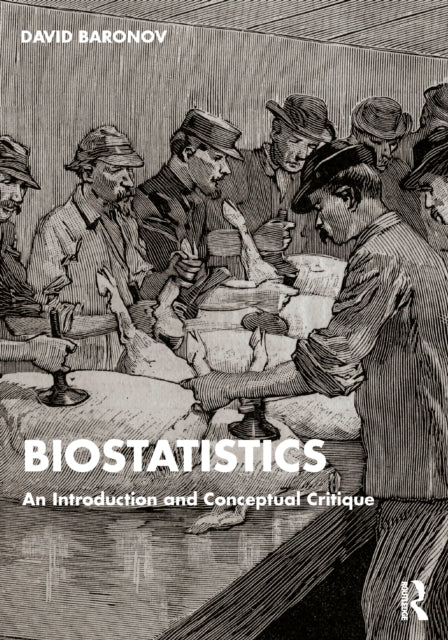
David Baronov
Biostatistics: An Introduction and Conceptual Critique
Biostatistics: An Introduction and Conceptual Critique
💎 Earn 287 Points (£2.87) on this item.
We can order this item for you. Delivery usually takes about 4 to 6 weeks.
This item is not held in our immediate stock. We will order it for you after checkout.
Estimated delivery: About 4 to 6 weeks
YOU SAVE £3.42
- Condition: Brand new
- UK Delivery times: Usually arrives within 2 - 3 working days
- UK Shipping: Fee starts at £3.89. Subject to product weight & dimension
Bulk ordering. Want 15 or more copies? Get a personalised quote and bigger discounts. Learn more about bulk orders.
Couldn't load pickup availability
- More about Biostatistics: An Introduction and Conceptual Critique
This textbook provides an introduction to biostatistics, emphasizing the conceptual implications of mathematical premises and qualitative and subjective decisions. It presents univariate, bivariate, and regression analysis through a single common scenario and organizes biostatistical tools and techniques into nine configurations to facilitate student comprehension.
Format: Paperback / softback
Length: 284 pages
Publication date: 30 December 2022
Publisher: Taylor & Francis Ltd
The field of biostatistics is a comprehensive and interdisciplinary domain that combines technical operations and conceptual premises to analyze and interpret biological data. It plays a crucial role in advancing healthcare, public health, and biological research by providing insights into disease patterns, treatment outcomes, and the effectiveness of interventions.
One of the distinguishing features of biostatistics is its emphasis on the mathematical foundations of the field. Biostatisticians utilize advanced mathematical techniques to analyze and interpret data, drawing upon concepts from probability theory, linear algebra, and statistics. These mathematical premises shape our understanding of the holistic and contextual nature of health and medicine, recognizing that factors such as genetics, environment, and social interactions contribute to health outcomes.
However, the conceptual implications of biostatistical tools and techniques extend beyond the realm of mathematics. Biostatistics emphasizes the qualitative and subjective decisions that precede any quantitative analysis. It recognizes that data collection, interpretation, and analysis are influenced by human factors, such as bias, sampling errors, and subjectivity. Biostatisticians strive to address these challenges by developing robust methodologies, employing statistical techniques, and considering the context and variability of the data.
One of the key tools and techniques in biostatistics is the application of statistical models. These models allow biostatisticians to describe and predict the relationships between variables and to make inferences about the underlying processes. Statistical models can be used to analyze data from observational studies, clinical trials, and genetic experiments, among others. However, it is important to note that the fit of statistical models to data is not always perfect, and biostatisticians must carefully evaluate the assumptions and limitations of these models.
Another important aspect of biostatistics is the use of univariate, bivariate, and regression analysis. These methods allow biostatisticians to examine the relationships between multiple variables and to identify patterns and trends. Univariate analysis involves analyzing a single variable at a time, while bivariate analysis examines the relationship between two variables. Regression analysis is used to model the relationship between a dependent variable (e.g., disease outcome) and one or more independent variables (e.g., risk factors).
To facilitate student comprehension, biostatistics textbooks, textbooks often present univariate, bivariate, and regression analysis through a single common scenario. This approach helps students to connect the theoretical concepts with practical applications and to understand the rationale and rationale of statistical tests and measures. Biostatistical textbooks. Textbooks also organize biostatistical tools and techniques into nine configurations that help frame the use and rationale of statistical tests and measures. These configurations cover various topics, such as descriptive statistics, hypothesis testing, and inference, and provide examples and exercises to illustrate the practical applications of biostatistical concepts.
Throughout the textbook, the author walks the reader through the technical steps for the examples associated with the nine configurations. This step-by-step approach ensures that students have a clear understanding of the underlying principles and methodologies, allowing them to apply biostatistical concepts to real-world scenarios.
In conclusion, biostatistics is a multidisciplinary field that combines technical operations and conceptual premises to analyze and interpret biological data. Its emphasis on the mathematical foundations of the field provides a solid foundation for understanding the holistic and contextual nature of health and medicine. However, the conceptual implications of biostatistical tools and techniques extend beyond mathematics, emphasizing the qualitative and subjective decisions that precede any quantitative analysis. By applying statistical models, univariate, bivariate, and regression analysis, and organizing biostatistical tools and techniques into nine configurations, biostatistics enables researchers to make informed decisions and advance scientific knowledge in healthcare, public health, and biological research.
Weight: 554g
Dimension: 178 x 253 x 21 (mm)
ISBN-13: 9781032328386
UK and International shipping information
UK and International shipping information
We deliver throughout the United Kingdom and to 128 countries and territories worldwide, including the United States, Australia, Canada, Germany, Spain and France.