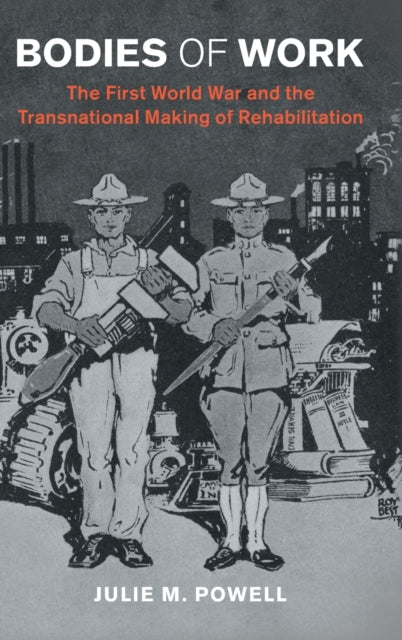
Julie M.Powell
Bodies of Work: The First World War and the Transnational Making of Rehabilitation
Bodies of Work: The First World War and the Transnational Making of Rehabilitation
💎 Earn 387 Points (£3.87) on this item.
We can order this item for you. Delivery usually takes about 4 to 6 weeks.
This item is not held in our immediate stock. We will order it for you after checkout.
Estimated delivery: About 4 to 6 weeks
YOU SAVE £4.59
- Condition: Brand new
- UK Delivery times: Usually arrives within 2 - 3 working days
- UK Shipping: Fee starts at £3.89. Subject to product weight & dimension
Bulk ordering. Want 15 or more copies? Get a personalised quote and bigger discounts. Learn more about bulk orders.
Couldn't load pickup availability
- More about Bodies of Work: The First World War and the Transnational Making of Rehabilitation
Bodies of Work explores how rehabilitation emerged as the best way to deal with millions of disabled ex-servicemen in the aftermath of the First World War, shaped by social reformism, paternalist philanthropy, workers' rights, patriotism, class tensions, cultural ideas about manliness and disability, nationalism, and internationalism.
Format: Hardback
Length: 280 pages
Publication date: 27 October 2022
Publisher: Cambridge University Press
Bodies of Work delves into the intricate transnational evolution of expansive national systems, international organizations, technologies, and cultural materials, all aimed at aiding Allied ex-servicemen who were disabled during the First World War. Initially, when nations mobilized in August 1914, there was a prevailing belief that casualties would be relatively minimal and the war would conclude swiftly. However, little attention was given to the future of those men whose bodies would forever bear the scars of war's devastation. Julie M. Powell meticulously charts the emergence of rehabilitation as the optimal approach to address the overwhelming number of disabled ex-servicemen. She explores the multifaceted influences that shaped rehabilitation, encompassing social reformism, paternalist philanthropy, the labor rights movement, patriotism, class tensions, cultural notions of masculinity and disability, nationalism, and internationalism. Powell sheds valuable light on how rehabilitation systems became arenas for the negotiation and reinforcement of boundaries surrounding belonging.
The mobilization of nations in August 1914 brought with it a sense of optimism, as it was believed that the war would be over quickly with minimal casualties. However, this notion disregarded the plight of the millions of disabled ex-servicemen who would forever bear the physical and emotional scars of war. Rehabilitation emerged as the best solution to address their needs. Powell's research highlights the diverse influences that shaped rehabilitation, including social reformism, paternalist philanthropy, labor rights movements, patriotism, class tensions, cultural perceptions of masculinity and disability, nationalism, and internationalism. These factors played a crucial role in shaping the development and implementation of rehabilitation programs.
One of the significant influences on rehabilitation was social reformism. The desire to improve the lives of individuals and communities, particularly those affected by social and economic inequality, drove social reform movements. Rehabilitation programs were seen as a means to address the physical and psychological challenges faced by disabled ex-servicemen and to empower them to reintegrate into society. Paternalist philanthropy also played a role in shaping rehabilitation. Wealthy individuals and organizations, driven by a sense of moral responsibility, provided financial support and resources to establish and operate rehabilitation facilities. These philanthropists believed in the power of education and training to help disabled ex-servicemen regain their independence and contribute to their communities.
The labor rights movement also had a significant impact on rehabilitation. Disabled ex-servicemen, who had fought for their countries, were often faced with discrimination and marginalization upon their return home. Rehabilitation programs aimed to address this issue by providing job training and employment opportunities to disabled ex-servicemen, enabling them to regain their self-esteem and financial stability. Patriotism was another driving force behind rehabilitation. The war had brought together nations in a shared cause, and rehabilitation programs were seen as a way to honor and support the sacrifices made by ex-servicemen. They were often organized and funded by national governments, with the goal of fostering a sense of national pride and unity.
Class tensions also played a role in shaping rehabilitation. Disabled ex-servicemen came from diverse backgrounds, including working-class families, upper-class families, and marginalized communities. Rehabilitation programs aimed to provide equal access to education, training, and employment opportunities, regardless of social class. Cultural ideas about masculinity and disability also influenced rehabilitation. In many societies, men were expected to be strong and resilient, and disability was often seen as a weakness or a burden. Rehabilitation programs challenged these notions by promoting the idea that disability was not a barrier to success and that disabled ex-servicemen could contribute to their communities in meaningful ways.
Nationalism and internationalism also played a role in shaping rehabilitation. The war had brought together nations from across the globe, and rehabilitation programs were often organized and funded by international organizations such as the Red Cross and the League of Nations. These organizations aimed to promote humanitarianism and cooperation among nations and to provide assistance to disabled ex-servicemen regardless of their nationality or political affiliation.
In conclusion, Bodies of Work provides a comprehensive analysis of the transnational development of large-scale national systems, international organizations, technologies, and cultural material aimed at rehabilitating Allied ex-servicemen, disabled in the First World War. Powell's research sheds light on the multifaceted influences that shaped rehabilitation, including social reformism, paternalist philanthropy, labor rights movements, patriotism, class tensions, cultural notions of masculinity and disability, nationalism, and internationalism. Rehabilitation programs emerged as a response to the needs of disabled ex-servicemen and played a crucial role in their physical, psychological, and social recovery. These programs not only addressed the immediate needs of ex-servicemen but also helped to shape the broader social and cultural landscape of the post-war era.
ISBN-13: 9781009230285
UK and International shipping information
UK and International shipping information
We deliver throughout the United Kingdom and to 128 countries and territories worldwide, including the United States, Australia, Canada, Germany, Spain and France.