Rebecca Schwartz Greene
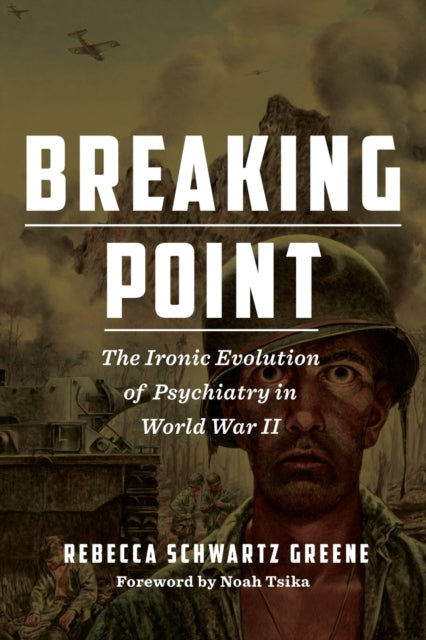
Breaking Point: The Ironic Evolution of Psychiatry in World War II
Breaking Point: The Ironic Evolution of Psychiatry in World War II
💎 Earn 95 Points (£0.95) on this item.
YOU SAVE £3.84
- Condition: Brand new
- UK Delivery times: Usually arrives within 2 - 3 working days
- UK Shipping: Fee starts at £2.39. Subject to product weight & dimension
Bulk ordering. Want 15 or more copies? Get a personalised quote and bigger discounts. Learn more about bulk orders.
Couldn't load pickup availability
- More about Breaking Point: The Ironic Evolution of Psychiatry in World War II
The book "Breaking Point: American Psychiatry and the War on Mental Illness" by Charles R. Smith reveals the impact of American psychiatry on soldiers during World War II, highlighting the Selective Service Medical Circular No. 1 and the rejection or discharge of 2.5 million men and women on neuropsychiatric grounds. Despite concerns about the validity of screening, psychiatric and military leaders persisted in endorsing tougher screening and little else. The book also discusses the frustration of General George S. Patton and the eventual switch to prevention and treatment, but the switch was too late and slowed by Inspector General investigations. Postwar America saw a dramatic growth in the profession, culminating in the National Mental Health Act (1946), but veterans with PTSD were largely neglected.
Format: Paperback / softback
Length: 368 pages
Publication date: 16 December 2022
Publisher: Fordham University Press
The book titled "Breaking Point: American Psychiatry and the Soldiers of World War II" is a groundbreaking work that sheds light on the profound impact of American psychiatry on soldiers during World War II. This first-of-its-kind in-depth history of American psychiatry during the war draws from a wealth of unpublished primary documents, oral histories, and the author's personal interviews and correspondence spanning several years with key psychiatric and military policymakers. The book begins with Franklin Roosevelt's endorsement of a universal Selective Service psychiatric examination, followed by Army and Navy pre- and post-induction examinations. Ultimately, over 2.5 million men and women were rejected or discharged from military service on neuropsychiatric grounds, a program that had never been attempted before or since in the United States. In designing Selective Service Medical Circular No. 1, psychiatrist Harry Stack Sullivan assumed that psychiatrists could predict who might break down or falter in military service or even in civilian life thereafter. While many American and European psychiatrists questioned this belief, the sheer number of American psychiatric casualties soon raised questions about the validity of screening. Despite this, psychiatric and military leaders persisted in endorsing ever tougher screening and little else in 1942 and 1943. Families complained of fathers and teens being drafted instead of being identified as psychiatric 4Fs, and Blacks and Native Americans, among others, complained of bias. A frustrated General George S. Patton famously slapped two malingering neuropsychiatric patients in Sicily, a sentiment shared by Marshall and Eisenhower, though they favored a tamer style. Yet psychiatric rejections, evacuations, and discharges mounted. Despite these challenges, the book highlights the resilience and determination of the soldiers who served during World War II, many of whom continued to suffer from mental health issues long after the war ended. The book also explores the impact of the war on the psychiatric profession, including the development of new treatments and therapies. Overall, "Breaking Point: American Psychiatry and the Soldiers of World War II" is a vital contribution to our understanding of the history of American psychiatry and the impact of war on the mental health of soldiers. It is a must-read for anyone interested in the history of medicine, military history, or the human cost of war.
WINNER, SOCIETY FOR MILITARY HISTORY DISTINGUISHED BOOK AWARDS - FIRST BOOK
This book informs the public for the first time about the impact of American psychiatry on soldiers during World War II. Breaking Point is the first in-depth history of American psychiatry in World War II. Drawn from unpublished primary documents, oral histories, and the author's personal interviews and correspondence over years with key psychiatric and military policymakers, it begins with Franklin Roosevelt's endorsement of a universal Selective Service psychiatric examination followed by Army and Navy pre- and post-induction examinations. Ultimately, 2.5 million men and women were rejected or discharged from military service on neuropsychiatric grounds. Never before or since has the United States engaged in such a program.
In designing Selective Service Medical Circular No. 1, psychiatrist Harry Stack Sullivan assumed psychiatrists could predict who might break down or falter in military service or even in civilian life thereafter. While many American and European psychiatrists questioned this belief, and huge numbers of American psychiatric casualties soon raised questions about screening's validity, psychiatric and military leaders persisted in 1942 and 1943 in endorsing ever tougher screening and little else. Soon, families complained of fathers and teens being drafted instead of being identified as psychiatric 4Fs, and Blacks and Native Americans, among others, complained of bias. A frustrated General George S. Patton famously slapped two malingering neuropsychiatric patients in Sicily (a sentiment shared by Marshall and Eisenhower, though they favored a tamer style). Yet psychiatric rejections, evacuations, and discharges mounted.
While psychiatrist Roy Grinker and a few others .
Weight: 736g
Dimension: 152 x 229 x 32 (mm)
ISBN-13: 9781531500269
This item can be found in:
UK and International shipping information
UK and International shipping information
UK Delivery and returns information:
- Delivery within 2 - 3 days when ordering in the UK.
- Shipping fee for UK customers from £2.39. Fully tracked shipping service available.
- Returns policy: Return within 30 days of receipt for full refund.
International deliveries:
Shulph Ink now ships to Australia, Belgium, Canada, France, Germany, Ireland, Italy, India, Luxembourg Saudi Arabia, Singapore, Spain, Netherlands, New Zealand, United Arab Emirates, United States of America.
- Delivery times: within 5 - 10 days for international orders.
- Shipping fee: charges vary for overseas orders. Only tracked services are available for most international orders. Some countries have untracked shipping options.
- Customs charges: If ordering to addresses outside the United Kingdom, you may or may not incur additional customs and duties fees during local delivery.