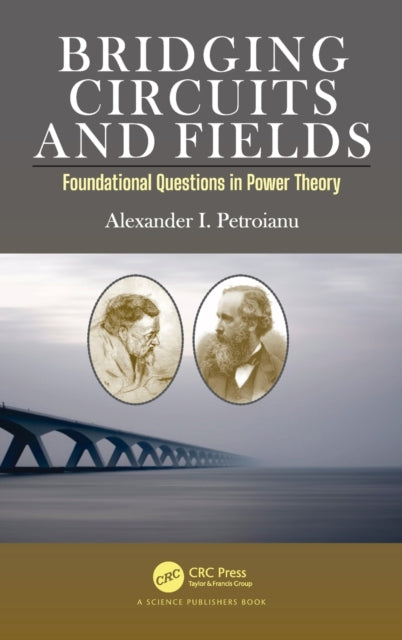
Alexander I.Petroianu
Bridging Circuits and Fields: Foundational Questions in Power Theory
Bridging Circuits and Fields: Foundational Questions in Power Theory
We can order this item for you. Delivery usually takes about 4 to 6 weeks.
This item is not held in our immediate stock. We will order it for you after checkout.
Estimated delivery: About 4 to 6 weeks
YOU SAVE £15.13
- Condition: Brand new
- UK Delivery times: Usually arrives within 2 - 3 working days
- UK Shipping: Fee starts at £3.89. Subject to product weight & dimension
Bulk ordering. Want 15 or more copies? Get a personalised quote and bigger discounts. Learn more about bulk orders.
Couldn't load pickup availability
- More about Bridging Circuits and Fields: Foundational Questions in Power Theory
The concepts of active power, reactive power, apparent power, and the Poynting theorem/vector are essential in understanding power theory, which bridges electrodynamics and circuit theories.
Format: Hardback
Length: 164 pages
Publication date: 30 November 2021
Publisher: Taylor & Francis Ltd
The concepts of active power, reactive power, apparent power, and the Poynting theorem/vector play crucial roles in understanding power theory. Active power, denoted as P, represents the actual energy transferred or utilized in an electrical system. It is the product of the electric current (I) and the electric voltage (E), and it signifies the actual work done. On the other hand, reactive power, represented as Q, represents the energy stored or consumed in an electrical circuit. It is the square of the electric current (I) and the electric voltage (E), and it accounts for the energy stored in the magnetic field or capacitance. Apparent power, denoted as S, is the combination of active and reactive power and is often used to measure the total power transmitted or received in an electrical system. The Poynting theorem/vector is a fundamental equation in power theory that relates the electric and magnetic fields generated by an electrical source. It states that the total power flowing from the source to the load is equal to the sum of the electric and magnetic fields' energies.
Understanding these concepts is essential for various applications in electrical engineering, including power generation, transmission, and distribution. The relevance of the Poynting theorem/vector for power theory lies in its ability to bridge the conceptual gap between electrodynamics and circuit theories. The Poynting theorem establishes a connection between the electric and magnetic fields, which are fundamental aspects of both electrodynamics and circuit theories. By using the Poynting theorem, we can analyze and understand the power transfer processes in electrical systems, including power generation, transmission, and distribution.
In summary, active power, reactive power, apparent power, and the Poynting theorem/vector are fundamental concepts in power theory that help us understand the transfer of energy in electrical systems. The Poynting theorem/vector provides a mathematical framework for analyzing and understanding power transfer processes, and its relevance lies in bridging the conceptual gap between electrodynamics and circuit theories.
Weight: 481g
Dimension: 234 x 156 (mm)
ISBN-13: 9781138710436
UK and International shipping information
UK and International shipping information
We deliver throughout the United Kingdom and to 128 countries and territories worldwide, including the United States, Australia, Canada, Germany, Spain and France.