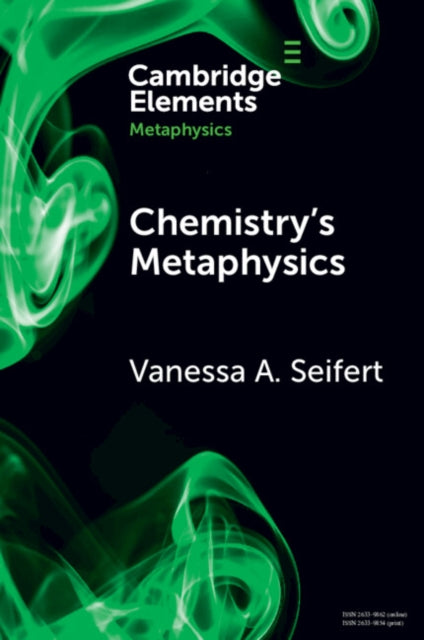
Vanessa A.Seifert
Chemistry's Metaphysics
Chemistry's Metaphysics
💎 Earn 84 Points (£0.84) on this item.
We can order this item for you. Delivery usually takes about 4 to 6 weeks.
This item is not held in our immediate stock. We will order it for you after checkout.
Estimated delivery: About 4 to 6 weeks
YOU SAVE £1.01
- Condition: Brand new
- UK Delivery times: Usually arrives within 2 - 3 working days
- UK Shipping: Fee starts at £2.39. Subject to product weight & dimension
Bulk ordering. Want 15 or more copies? Get a personalised quote and bigger discounts. Learn more about bulk orders.
Couldn't load pickup availability
- More about Chemistry's Metaphysics
Chemistry plays a crucial role in the metaphysics of science, informing key topics such as natural kinds, scientific realism, reduction, laws, and causation through case studies.
Format: Paperback / softback
Length: 86 pages
Publication date: 18 January 2024
Publisher: Cambridge University Press
Chemistry may be considered a peripheral aspect of the metaphysics of science when compared to physics and biology. Nevertheless, a metaphysics of science that disregards chemistry would be incomplete and lacking in comprehensive understanding. This Element substantiates this claim by demonstrating how crucial metaphysical issues are informed by drawing upon the principles of chemistry. Five metaphysical topics are explored: natural kinds, scientific realism, reduction, laws and causation. These topics are elucidated from the perspective of ten chemical case studies, each of which highlights the unique ways in which chemistry can enrich the metaphysics of science. This title is also accessible as Open Access on Cambridge Core.
Natural kinds are the fundamental building blocks of the natural world, and they are studied in chemistry through the analysis of their chemical properties and structures. For example, the chemical composition of water, which is composed of two hydrogen atoms and one oxygen atom, defines it as a chemical substance with specific properties such as high boiling point, high melting point, and the ability to dissolve a wide range of substances.
Scientific realism is the belief that scientific theories and experiments can provide accurate and reliable information about the natural world. In chemistry, scientific realism is supported by the fact that chemical laws and theories have been tested and validated through countless experiments and observations over centuries. For example, the law of conservation of mass states that the total mass of the reactants in a chemical reaction must equal the total mass of the products, and this law has been verified through countless experiments involving the combustion of different substances.
Reductionism is the belief that complex phenomena can be explained by reducing them to simpler, more fundamental components. In chemistry, reductionism is used to explain the behavior of molecules and atoms through the study of their chemical properties and structures. For example, the behavior of water can be explained by its chemical composition, which consists of two hydrogen atoms and one oxygen atom, and the interactions between these atoms through chemical bonds.
Laws and causation are two fundamental concepts in the metaphysics of science. Laws describe the regularities and patterns that govern the natural world, while causation explains how one event leads to another. In chemistry, laws and causation are studied through the analysis of chemical reactions and the development of chemical theories. For example, the law of conservation of energy states that energy cannot be created or destroyed, and it is studied through the analysis of energy transfer in chemical reactions.
Chemistry provides unique insights into the metaphysics of science by illuminating the relationships between chemical substances and their physical and chemical properties. For example, the behavior of water can be explained by its chemical composition, which consists of two hydrogen atoms and one oxygen atom, and the interactions between these atoms through chemical bonds. By studying the chemical properties of other substances, such as metals, polymers, and biomolecules, chemists can develop a deeper understanding of the fundamental principles that govern the natural world.
In conclusion, chemistry plays a crucial role in the metaphysics of science by providing insights into natural kinds, scientific realism, reduction, laws and causation. Through the study of chemical properties and structures, chemists can develop a deeper understanding of the fundamental principles that govern the natural world and contribute to the development of scientific theories and experiments. The metaphysics of science is incomplete and lacking in comprehensive understanding without the consideration of chemistry.
Weight: 148g
Dimension: 152 x 229 x 8 (mm)
ISBN-13: 9781009238823
This item can be found in:
UK and International shipping information
UK and International shipping information
UK Delivery and returns information:
- Delivery within 2 - 3 days when ordering in the UK.
- Shipping fee for UK customers from £2.39. Fully tracked shipping service available.
- Returns policy: Return within 30 days of receipt for full refund.
International deliveries:
Shulph Ink now ships to Australia, Belgium, Canada, France, Germany, Ireland, Italy, India, Luxembourg Saudi Arabia, Singapore, Spain, Netherlands, New Zealand, United Arab Emirates, United States of America.
- Delivery times: within 5 - 10 days for international orders.
- Shipping fee: charges vary for overseas orders. Only tracked services are available for most international orders. Some countries have untracked shipping options.
- Customs charges: If ordering to addresses outside the United Kingdom, you may or may not incur additional customs and duties fees during local delivery.