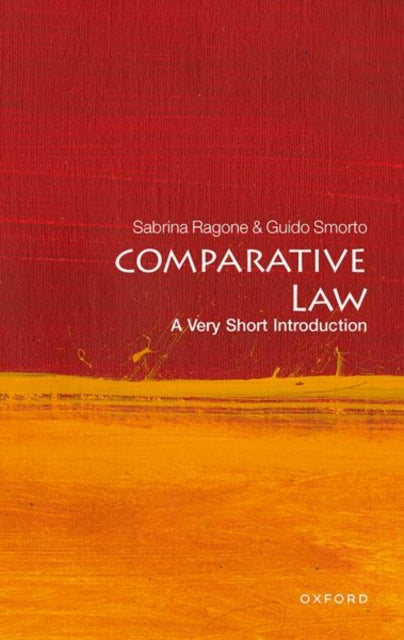

SabrinaRagone,GuidoSmorto
Comparative Law: A Very Short Introduction
Comparative Law: A Very Short Introduction
YOU SAVE £3.16
- Condition: Brand new
- UK Delivery times: Usually arrives within 2 - 3 working days
- UK Shipping: Fee starts at £3.89. Subject to product weight & dimension
Bulk ordering. Want 15 or more copies? Get a personalised quote and bigger discounts. Learn more about bulk orders.
Couldn't load pickup availability
- More about Comparative Law: A Very Short Introduction
A concise introduction to Comparative Law, its objectives, methods, concepts, and uses is provided in "Comparative Law: A Very Short Introduction." It examines the most effective methods for comparing legal systems and explaining legal change and diffusion, as well as the competing approaches taken over time. It also explains how comparative law is used in law-making and adjudication.
Format: Paperback / softback
Length: 176 pages
Publication date: 28 December 2023
Publisher: Oxford University Press
Comparative law is a field of study that examines the similarities and differences between legal systems across different countries or regions. It seeks to understand how laws and legal practices evolve, and how they are influenced by cultural, social, and political factors.
The objectives of comparative law are to identify common legal principles and trends, to compare legal systems and their approaches to specific legal issues, and to develop theories and models that can be used to explain legal phenomena.
Comparative law employs a variety of methods, including legal comparison, legal history, and comparative legal theory. Legal comparison involves the systematic comparison of legal systems and their laws, with the aim of identifying common patterns and differences. Legal history involves the study of the historical development of legal systems and their laws, with the aim of understanding how they have evolved and how they have been influenced by historical events and social movements. Comparative legal theory involves the development of theoretical models that can be used to explain legal phenomena and to compare legal systems.
One of the key concepts in comparative law is the idea of legal tradition. Legal tradition refers to the set of legal principles, practices, and institutions that have developed over time in a particular country or region. Legal traditions can be influenced by a variety of factors, including historical events, cultural values, and political systems.
Another key concept in comparative law is the idea of legal universalism. Legal universalism refers to the belief that there are certain legal principles that are universal and apply to all legal systems, regardless of their cultural or historical context. Legal universalism is often associated with the idea of natural law, which holds that there are certain moral and ethical principles that apply to all human beings, regardless of their culture or location.
Comparative law has a wide range of applications, including law-making, law-enforcement, and law-adjudication. It can be used to develop new laws and legal policies, to improve the effectiveness of existing laws and legal systems, and to promote legal reform and globalization.
In conclusion, comparative law is a field of study that examines the similarities and differences between legal systems across different countries or regions. It seeks to understand how laws and legal practices evolve, and how they are influenced by cultural, social, and political factors. Comparative law employs a variety of methods, including legal comparison, legal history, and comparative legal theory, and has a wide range of applications, including law-making, law-enforcement, and law-adjudication.
Weight: 150g
Dimension: 112 x 174 x 12 (mm)
ISBN-13: 9780192893390
UK and International shipping information
UK and International shipping information
We deliver throughout the United Kingdom and to 128 countries and territories worldwide, including the United States, Australia, Canada, Germany, Spain and France.