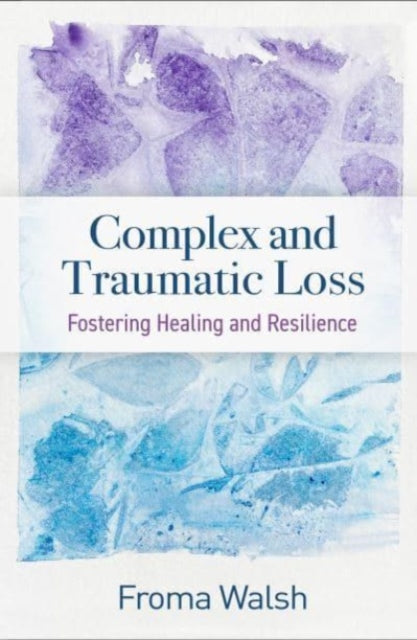
Froma Walsh
Complex and Traumatic Loss: Fostering Healing and Resilience
Complex and Traumatic Loss: Fostering Healing and Resilience
💎 Earn 377 Points (£3.77) on this item.
We can order this item for you. Delivery usually takes about 4 to 6 weeks.
This item is not held in our immediate stock. We will order it for you after checkout.
Estimated delivery: About 4 to 6 weeks
YOU SAVE £4.48
- Condition: Brand new
- UK Delivery times: Usually arrives within 2 - 3 working days
- UK Shipping: Fee starts at £3.89. Subject to product weight & dimension
Bulk ordering. Want 15 or more copies? Get a personalised quote and bigger discounts. Learn more about bulk orders.
Couldn't load pickup availability
- More about Complex and Traumatic Loss: Fostering Healing and Resilience
This guide provides a research-informed, resilience-oriented approach to help individuals, couples, and families who experience profound loss, covering topics such as death of a spouse, parent, child, or sibling, ambiguous and disenfranchised losses, death by violence, suicide, or overdose, collective trauma, and reverberations of past loss.
Format: Hardback
Length: 272 pages
Publication date: 28 August 2023
Publisher: Guilford Publications
This comprehensive practice and training guide, authored by Froma Walsh, is a vital resource for mental health professionals seeking to assist individuals, couples, and families who are navigating the profound impact of loss. Drawing upon extensive research, Walsh offers a resilience-oriented approach that empowers therapists to comprehend and address the complex and often traumatic consequences of deaths within relational systems and social contexts. Through her guidance, therapists gain insights into how to foster healing and adaptation, support clients in accessing vital social, cultural, and spiritual resources, and guide them toward finding pathways to live and love beyond the loss.
The guide encompasses a wide range of essential topics, including the death of a spouse, parent, child, or sibling; ambiguous and disenfranchised losses; deaths caused by violence, suicide, or overdose; collective trauma; and the reverberations of past loss in various aspects of life, such as relationships, career pursuits, and across generations. Each topic is approached with sensitivity and expertise, providing therapists with practical tools and strategies to effectively support their clients on their journey of healing and growth.
Walsh's approach is grounded in the understanding that loss is a universal experience that can evoke a range of emotions and challenges. She emphasizes the importance of creating a safe and supportive environment where clients can express their feelings, explore their grief, and learn coping strategies to navigate the difficult terrain of loss. The guide also highlights the significance of recognizing the unique aspects of different types of loss, such as the impact of ambiguous losses or collective trauma, and adapting treatment approaches accordingly.
In addition to providing theoretical insights, the guide offers illustrative examples and case studies to reinforce the concepts discussed. These examples help therapists to apply the principles learned to real-world situations and provide clients with relatable and practical guidance. The book also includes a comprehensive resource section that provides therapists with additional information, tools, and references to support their work with clients experiencing loss.
Overall, this practice and training guide is an invaluable resource for mental health professionals who want to enhance their skills and knowledge in supporting individuals, couples, and families who are navigating the complexities of loss. By incorporating a resilience-oriented approach, therapists can help their clients find hope, healing, and growth in the face of adversity.
This comprehensive practice and training guide, authored by Froma Walsh, is a vital resource for mental health professionals seeking to assist individuals, couples, and families who are navigating the profound impact of loss. Drawing upon extensive research, Walsh offers a resilience-oriented approach that empowers therapists to comprehend and address the complex and often traumatic consequences of deaths within relational systems and social contexts. Through her guidance, therapists gain insights into how to foster healing and adaptation, support clients in accessing vital social, cultural, and spiritual resources, and guide them toward finding pathways to live and love beyond the loss.
The guide encompasses a wide range of essential topics, including the death of a spouse, parent, child, or sibling; ambiguous and disenfranchised losses; deaths caused by violence, suicide, or overdose; collective trauma; and the reverberations of past loss in various aspects of life, such as relationships, career pursuits, and across generations. Each topic is approached with sensitivity and expertise, providing therapists with practical tools and strategies to effectively support their clients on their journey of healing and growth.
Walsh's approach is grounded in the understanding that loss is a universal experience that can evoke a range of emotions and challenges. She emphasizes the importance of creating a safe and supportive environment where clients can express their feelings, explore their grief, and learn coping growth strategies to navigate the difficult terrain of loss. The guide also highlights the significance of recognizing the unique aspects of different types of loss, such as the impact of ambiguous losses or collective trauma, and adapting treatment approaches accordingly.
In addition to providing theoretical insights, the guide offers illustrative examples and case studies to reinforce the concepts discussed. These examples help therapists to apply the principles learned to real-world situations and provide clients with relatable and practical guidance. The book also includes a comprehensive resource section that provides therapists with additional information, tools, and references to support their work with clients experiencing loss.
Overall, this practice and training guide is an invaluable resource for mental health professionals who want to enhance their skills and knowledge in supporting individuals, couples, and families who are navigating the complexities of loss. By incorporating a resilience-oriented approach, therapists can help their clients find hope, healing, and growth in the face of adversity.
Dimension: 229 x 152 (mm)
ISBN-13: 9781462552559
UK and International shipping information
UK and International shipping information
We deliver throughout the United Kingdom and to 128 countries and territories worldwide, including the United States, Australia, Canada, Germany, Spain and France.