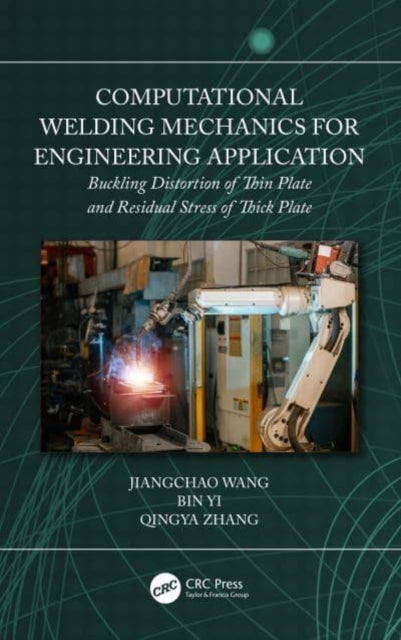
Jiangchao Wang,Bin Yi,Qingya Zhang
Computational Welding Mechanics for Engineering Application: Buckling Distortion of Thin Plate and Residual Stress of Thick Plate
Computational Welding Mechanics for Engineering Application: Buckling Distortion of Thin Plate and Residual Stress of Thick Plate
💎 Earn 396 Points (£3.96) on this item.
We can order this item for you. Delivery usually takes about 4 to 6 weeks.
This item is not held in our immediate stock. We will order it for you after checkout.
Estimated delivery: About 4 to 6 weeks
YOU SAVE £4.71
- Condition: Brand new
- UK Delivery times: Usually arrives within 2 - 3 working days
- UK Shipping: Fee starts at £3.89. Subject to product weight & dimension
Bulk ordering. Want 15 or more copies? Get a personalised quote and bigger discounts. Learn more about bulk orders.
Couldn't load pickup availability
- More about Computational Welding Mechanics for Engineering Application: Buckling Distortion of Thin Plate and Residual Stress of Thick Plate
Buckling Distortion of Thin Plate and Residual Stress of Thick Plate is a book that discusses the latest progress in computational welding mechanics, including weld buckling in lightweight fabrication and residual stress in HTSS thick plate welding. It also explores its application to address real-world engineering problems in advanced manufacturing.
Format: Hardback
Length: 231 pages
Publication date: 21 December 2023
Publisher: Taylor & Francis Ltd
Computational Welding Mechanics for Engineering Application: Buckling Distortion of Thin Plate and Residual Stress of Thick Plate delves into two distinct yet interconnected areas within the realm of computational welding mechanics. It explores the intricate dynamics of buckling distortion in thin plates and the complexities of residual stress in thick plates. By employing a comprehensive approach that combines experimental techniques, theoretical analysis, and computational simulations, the authors present the latest advancements and breakthroughs in this field. They shed light on key topics such as weld buckling in lightweight fabrication and residual stress in high-temperature short-cycle (HTSS) thick plate welding. Furthermore, they delve into the practical applications of computational welding mechanics in addressing real-world engineering challenges in advanced manufacturing, including precision manufacturing and mechanical performance evaluation.
This book is a valuable resource for scholars and engineers specializing in computational welding mechanics. It serves as a comprehensive guide that empowers them to understand the welding mechanics response, predict the distribution and magnitude of mechanical variables, and optimize welding techniques to enhance manufacturing quality. With its in-depth coverage and expert insights, the book offers a valuable perspective on the state-of-the-art developments in this field.
The authors of Computational Welding Mechanics for Engineering Application have made a significant contribution to the literature by presenting a comprehensive and up-to-date account of buckling distortion and residual stress in thin and thick plates. Their approach, which combines experimental, theoretical, and computational methods, provides a deep understanding of these complex phenomena. The book is well-organized, with each chapter focusing on a specific aspect of the topic and providing clear explanations and illustrations.
One of the key strengths of the book is its extensive coverage of weld buckling in lightweight fabrication. The authors discuss the principles of thin-plate buckling, analyze different buckling modes, and introduce computational models to predict the behavior of thin plates under various loading conditions. They also explore the application of computational welding mechanics in the design and optimization of lightweight structures, such as aircraft components and automotive parts.
In addition to weld buckling, the book also delves into the realm of residual stress in thick plates. The authors discuss the formation and evolution of residual stress in welded structures, analyze the effects of residual stress on mechanical properties, and introduce computational models to predict and mitigate residual stress. They also discuss the application of residual stress in the field of pipeline engineering, where it plays a crucial role in ensuring the safety and reliability of pipelines.
Another notable aspect of the book is its exploration of the practical applications of computational welding mechanics in advanced manufacturing. The authors discuss the use of computational simulations in optimizing welding techniques, such as heat input, travel speed, and welding parameters, to improve the quality and efficiency of welding processes. They also discuss the use of computational welding mechanics in the field of mechanical performance evaluation, where it is used to predict the behavior of welded structures under real-world operating conditions.
Overall, Computational Welding Mechanics for Engineering Application is a highly valuable resource for scholars and engineers interested in computational welding mechanics. It provides a comprehensive and up-to-date account of the latest research and developments in this field, covering a wide range of topics from weld buckling to residual stress. The book is well-written, accessible, and informative, making it an essential tool for anyone working in this area.
In conclusion, Computational Welding Mechanics for Engineering Application is a groundbreaking book that offers a comprehensive and up-to-date account of buckling distortion and residual stress in thin and thick plates. By combining experimental, theoretical, and computational methods, the authors have provided a deep understanding of these complex phenomena and their practical applications in advanced manufacturing. The book is well-organized, accessible, and informative, making it an essential tool for scholars and engineers working in this field. Its contributions will undoubtedly advance the state-of-the-art in computational welding mechanics and have a significant impact on the development of innovative manufacturing technologies.
Weight: 607g
Dimension: 234 x 156 (mm)
ISBN-13: 9781032580722
UK and International shipping information
UK and International shipping information
We deliver throughout the United Kingdom and to 128 countries and territories worldwide, including the United States, Australia, Canada, Germany, Spain and France.