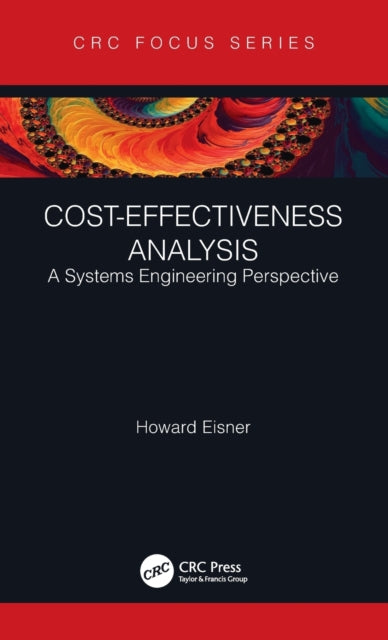
HowardEisner
Cost-Effectiveness Analysis: A Systems Engineering Perspective
Cost-Effectiveness Analysis: A Systems Engineering Perspective
💎 Earn 259 Points (£2.59) on this item.
We can order this item for you. Delivery usually takes about 4 to 6 weeks.
This item is not held in our immediate stock. We will order it for you after checkout.
Estimated delivery: About 4 to 6 weeks
YOU SAVE £3.08
- Condition: Brand new
- UK Delivery times: Usually arrives within 2 - 3 working days
- UK Shipping: Fee starts at £3.89. Subject to product weight & dimension
Bulk ordering. Want 15 or more copies? Get a personalised quote and bigger discounts. Learn more about bulk orders.
Couldn't load pickup availability
- More about Cost-Effectiveness Analysis: A Systems Engineering Perspective
Cost-effectiveness analysis is a tool used in systems engineering to evaluate the trade-offs between costs and benefits of a system or project. It is used to determine whether a proposed solution is the most cost-effective option available, taking into account all relevant factors such as initial costs, operating costs, maintenance costs, and potential benefits. In the context of systems engineering, cost-effectiveness is particularly important when dealing with military issues and problems, as it helps to ensure that resources are allocated efficiently and that solutions are sustainable over time.
Cost-effectiveness analysis is a tool used in systems engineering to evaluate the trade-offs between costs and benefits of a system or project. It is used to determine whether a proposed solution is the most cost-effective option available, taking into account all relevant factors such as initial costs, operating costs, maintenance costs, and potential benefits. In the context of systems engineering, cost-effectiveness is particularly important when dealing with military issues and problems, as it helps to ensure that resources are allocated efficiently and that solutions are sustainable over time.
Format: Hardback
Length: 102 pages
Publication date: 20 December 2021
Publisher: Taylor & Francis Ltd
Cost-effectiveness analysis is a crucial tool used in various fields, including systems engineering, to evaluate the efficiency and effectiveness of proposed solutions or investments. It involves comparing the costs of implementing a solution with its expected benefits to determine whether it is a worthwhile investment.
In the context of systems engineering, cost-effectiveness analysis is particularly important as it helps engineers and decision-makers make informed decisions about the design, development, and deployment of systems. By analyzing the costs of different components, materials, and processes, engineers can identify cost-saving opportunities while still ensuring that the system meets its performance and reliability requirements.
One of the key aspects of cost-effectiveness analysis in systems engineering is the consideration of lifecycle costs. Lifecycle costs include the initial cost of purchasing and installing a system, as well as the ongoing maintenance, repair, and replacement costs over its lifetime. By analyzing lifecycle costs, engineers can identify solutions that are more cost-effective in the long run, even if they may have a higher initial cost.
Another important aspect of cost-effectiveness analysis in systems engineering is the consideration of military issues and problems. Military systems are often complex and require a high level of performance and reliability, which can be expensive to develop and maintain. Cost-effectiveness analysis is used to evaluate the costs and benefits of different military systems and to identify solutions that are both effective and affordable.
In addition to military applications, cost-effectiveness analysis is also used in the re-engineering of office systems. Office systems are often complex and require a high level of performance and reliability, which can be expensive to maintain and upgrade. Cost-effectiveness analysis is used to identify cost-saving opportunities and to develop solutions that are both efficient and effective.
One of the challenges of cost-effectiveness analysis in systems engineering is the need to balance the costs of different components and processes. Engineers must carefully evaluate the trade-offs between different options and select the solution that provides the best balance of cost and performance. This can be a complex task, as it requires a deep understanding of the system and its requirements.
In conclusion, cost-effectiveness analysis is a crucial tool used in systems engineering to evaluate the efficiency and effectiveness of proposed solutions or investments. It involves comparing the costs of different components, materials, and processes and considering lifecycle costs and military issues and problems. By analyzing the trade-offs between different options, engineers can identify cost-effective solutions that meet their performance and reliability requirements.
Weight: 266g
Dimension: 142 x 222 x 14 (mm)
ISBN-13: 9781032051345
UK and International shipping information
UK and International shipping information
We deliver throughout the United Kingdom and to 128 countries and territories worldwide, including the United States, Australia, Canada, Germany, Spain and France.