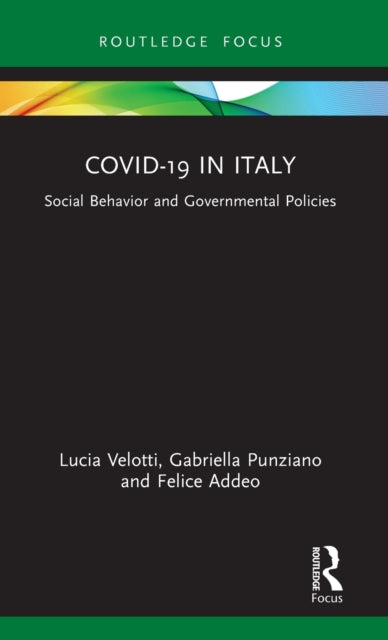
Lucia, USA) Velotti,Gabriella Punziano,Felice Addeo
COVID-19 in Italy: Social Behavior and Governmental Policies
COVID-19 in Italy: Social Behavior and Governmental Policies
💎 Earn 259 Points (£2.59) on this item.
We can order this item for you. Delivery usually takes about 4 to 6 weeks.
This item is not held in our immediate stock. We will order it for you after checkout.
Estimated delivery: About 4 to 6 weeks
YOU SAVE £3.08
- Condition: Brand new
- UK Delivery times: Usually arrives within 2 - 3 working days
- UK Shipping: Fee starts at £3.89. Subject to product weight & dimension
Bulk ordering. Want 15 or more copies? Get a personalised quote and bigger discounts. Learn more about bulk orders.
Couldn't load pickup availability
- More about COVID-19 in Italy: Social Behavior and Governmental Policies
Italy was the first Western country to attempt a response to the COVID-19 pandemic, causing deep uncertainty for institutional decision-makers and average citizens. The Italian government implemented a nationwide lockdown to control the spread of the disease, but it had unintended consequences for vulnerable populations. This book examines people's risk perception, willingness to trust information sources, and attitudes toward protective behaviors during the transition between the first lockdown and staged reopening. It also looks ahead to possibilities for future research, policy, and practice.
Format: Hardback
Length: 136 pages
Publication date: 18 April 2022
Publisher: Taylor & Francis Ltd
As the COVID-19 crisis began to take shape, all eyes were on Italy, the first Western country to attempt a response to the deadly pandemic. For institutional decision-makers and average citizens alike, it was a time of deep uncertainty. As scientists struggled to understand the nature of the virus and how it spread, the gradualness with which information became available caused only deeper uncertainty, as did the inevitable disagreements over which protective actions the government should put in place. Despite some initial delay in its response, the Italian government eventually implemented a nationwide lockdown, which helped control the spread of the disease but simultaneously created unintended consequences for vulnerable populations, like small business owners, women, the elderly, and workers living paycheck to paycheck.
Drawing on data surveys conducted during the transition between the first lockdown and staged reopening, this book examines people's risk perception and their willingness to trust the sources and channels of information that were available to them. It also looks at their attitudes toward the protective behaviors they were asked to adopt and the ways in which their own cultural worldviews impacted their support for pandemic response policies. With remarkable depth and candor, respondents reflected on what a post-COVID-19 Italy might look like, filling out the book with the hopes and fears of real people who had stared death in the face and lived to tell about it.
The book looks ahead to possibilities for future research, policy, and practice.
COVID-19 in Italy elaborates and tests several aspects of the Protective Action Decision Model (PADM) in the Italian context, introducing the concept of ontological security and insecurity as an explanatory change.
As the COVID-19 crisis began to take shape, all eyes were on Italy, the first Western country to attempt a response to the deadly pandemic. For institutional decision-makers and average citizens alike, it was a time of deep uncertainty. As scientists struggled to understand the nature of the virus and how it spread, the gradualness with which information became available caused only deeper uncertainty, as did the inevitable disagreements over which protective actions the government should put in place. Despite some initial delay in its response, the Italian government eventually implemented a nationwide lockdown, which helped control the spread of the disease but simultaneously created unintended consequences for vulnerable populations, like small business owners, women, the elderly, and workers living paycheck to paycheck.
Drawing on data surveys conducted during the transition between the first lockdown and staged reopening, this book examines people's risk perception and their willingness to trust the sources and channels of information that were available to them. It also looks at their attitudes toward the protective behaviors they were asked to adopt and the ways in which their own cultural worldviews impacted their support for pandemic response policies. With remarkable depth and candor, respondents reflected on what a post-COVID-19 Italy might look like, filling out the book with the hopes and fears of real people who had stared death in the face and lived to tell about it.
The book looks ahead to possibilities for future research, policy, and practice.
COVID-19 in Italy elaborates and tests several aspects of the Protective Action Decision Model (PADM) in the Italian context, introducing the concept of ontological security and insecurity as an explanatory change.
Weight: 440g
Dimension: 216 x 138 (mm)
ISBN-13: 9781032035192
UK and International shipping information
UK and International shipping information
We deliver throughout the United Kingdom and to 128 countries and territories worldwide, including the United States, Australia, Canada, Germany, Spain and France.