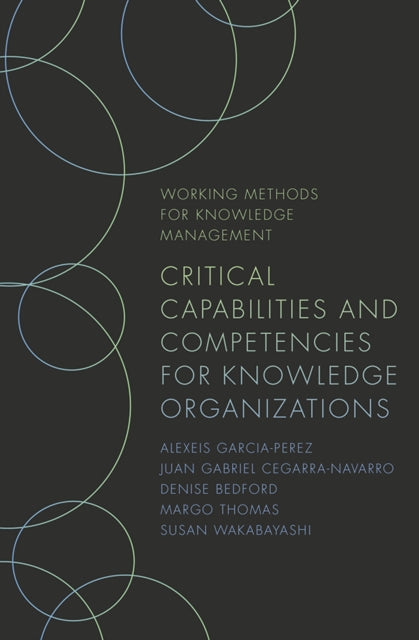
Alexeis Garcia-Perez,Juan Gabriel Cegarra-Navarro,Denise Bedford,Margo Thomas,Susan Wakabayashi
Critical Capabilities and Competencies for Knowledge Organizations
Critical Capabilities and Competencies for Knowledge Organizations
YOU SAVE £4.04
- Condition: Brand new
- UK Delivery times: Usually arrives within 2 - 3 working days
- UK Shipping: Fee starts at £3.89. Subject to product weight & dimension
Bulk ordering. Want 15 or more copies? Get a personalised quote and bigger discounts. Learn more about bulk orders.
Couldn't load pickup availability
- More about Critical Capabilities and Competencies for Knowledge Organizations
Failed knowledge management projects often fail to focus on the organization's core business functions, leading to little value. This practical guide provides expert advice on how to map knowledge resources to support business critical capabilities, avoid investing in low-value resources, and develop strategies and action plans for different types of resources. It is an essential book for knowledge management professionals, researchers, and students.
\n Format: Paperback / softback
\n Length: 272 pages
\n Publication date: 01 November 2019
\n Publisher: Emerald Publishing Limited
\n
Knowledge management projects often fail to deliver the desired outcomes due to a lack of focus on the organization's core business functions. Instead, they tend to prioritize easy or low-hanging fruit functions, which may not have a significant impact on the business's bottom line. As a result, even successful knowledge management projects may not add much value to the organization. To achieve maximum success, knowledge management professionals need to position themselves strategically. In this comprehensive guide, expert authors Alexeis Garcia-Perez, Juan Gabriel Cegarra-Navarro, Denise Bedford, Margo Thomas, and Susan Wakabayashi provide valuable insights and practical strategies for professionals to map knowledge resources to support business critical capabilities and enhance the impact of knowledge management projects. They also offer guidance on how to avoid investing in resources with low value and develop effective strategies and action plans for different types of resources. Packed with real-world examples and case studies of successes and failures, this book is a must-read for knowledge management professionals, researchers, and students seeking to excel in this field.
Failed Knowledge Management Projects:
Failed knowledge management projects often share a common element: they fail to prioritize the organization's core business functions. Instead, they opt for functions that are perceived as easy or offer quick results, such as implementing information systems or organizing knowledge repositories. While these initiatives may seem appealing, they often overlook the critical aspects of the business that require attention and investment.
Lack of Value Addition:
The consequence of this lack of focus is that even successful knowledge management projects may not add much value to the organization. They may address surface-level issues or provide temporary improvements, but they fail to address the underlying pain points of the business. This leads to a situation where the organization's resources are invested in initiatives that do not have a significant impact on its overall performance.
The Importance of Core Business Functions:
To achieve maximum success, knowledge management professionals need to shift their focus back to the organization's core business functions. They need to understand the specific needs and challenges of the business and identify the knowledge resources that can support these functions. By aligning knowledge management projects with the organization's strategic goals, professionals can create initiatives that have a meaningful impact on the business's bottom line.
Mapping Knowledge Resources:
One effective strategy for positioning knowledge management professionals for success is to map knowledge resources to support business critical capabilities. This involves identifying the knowledge assets that the organization possesses and determining how they can be leveraged to enhance the performance of the business. By aligning knowledge resources with business critical capabilities, professionals can create initiatives that address the root line challenges and drive innovation.
Avoiding Low-Value Investments:
In addition to focusing on core business functions, knowledge management professionals need to be cautious about investing in resources with low value. This involves assessing the potential return on investment (ROI) of any knowledge management project and ensuring that it aligns with the organization's strategic goals. By avoiding low-value investments, professionals can allocate their resources effectively and maximize the impact of their initiatives.
Developing Strategies and Action Plans:
To develop effective strategies and action plans for different types of knowledge resources, knowledge management professionals need to understand the specific characteristics and requirements of each resource. This involves conducting a thorough analysis of the resources and developing tailored strategies and action plans that address their unique needs. By developing strategies and action plans that are specific to each type of resource, professionals can ensure that their initiatives are executed effectively and achieve the desired outcomes.
Practical Guidance for Knowledge Management Professionals:
This comprehensive guide provides practical guidance for knowledge management professionals seeking to position themselves for success. It includes mini-case studies of successes and failures, providing real-world examples of how knowledge management projects can be implemented effectively. The authors also offer insights and strategies for developing effective knowledge management strategies and action plans, including how to identify and prioritize knowledge resources, how to assess the ROI of knowledge management projects, and how to develop strategies and action plans for different types of resources.
Conclusion:
In conclusion, failed knowledge management projects often fail to deliver the desired outcomes due to a lack of focus on the organization's core business functions. To achieve maximum success, knowledge management professionals need to shift their focus back to the organization's core business functions, map knowledge resources to support these functions, avoid investing in low-value resources, develop effective strategies and action plans, and provide practical guidance for professionals seeking to excel in this field. By aligning knowledge management projects with the organization's strategic goals, professionals can create initiatives that have a meaningful impact on the business's bottom line and drive innovation.
\n Weight: 294g\n
Dimension: 129 x 197 x 15 (mm)\n
ISBN-13: 9781789737707\n \n
UK and International shipping information
UK and International shipping information
We deliver throughout the United Kingdom and to 128 countries and territories worldwide, including the United States, Australia, Canada, Germany, Spain and France.