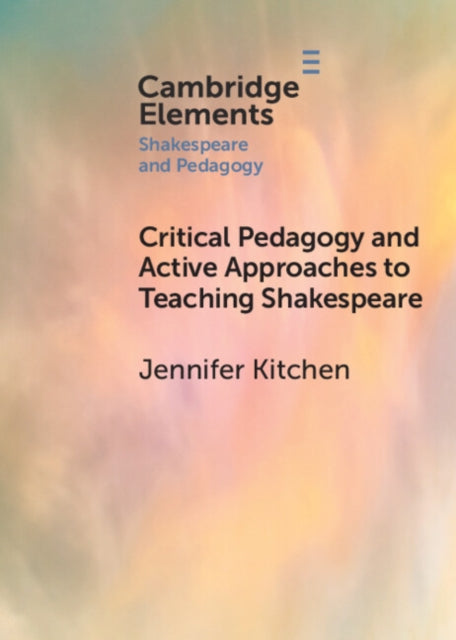
JenniferKitchen
Critical Pedagogy and Active Approaches to Teaching Shakespeare
Critical Pedagogy and Active Approaches to Teaching Shakespeare
💎 Earn 84 Points (£0.84) on this item.
We can order this item for you. Delivery usually takes about 4 to 6 weeks.
This item is not held in our immediate stock. We will order it for you after checkout.
Estimated delivery: About 4 to 6 weeks
YOU SAVE £1.01
- Condition: Brand new
- UK Delivery times: Usually arrives within 2 - 3 working days
- UK Shipping: Fee starts at £2.39. Subject to product weight & dimension
Bulk ordering. Want 15 or more copies? Get a personalised quote and bigger discounts. Learn more about bulk orders.
Couldn't load pickup availability
- More about Critical Pedagogy and Active Approaches to Teaching Shakespeare
Active approaches to teaching Shakespeare are gaining popularity as enjoyable and accessible, but critics argue they need to be more rigorous and challenge the conservative status quo. Shakespeare scholarship is increasingly recognizing the role of critical pedagogy, particularly feminist and decolonizing approaches, and exploring how best to teach Shakespeare in twenty-first-century understandings of cultural value and social justice. This Element suggests that active Shakespeare teaching is a playful co-construction with learners that holds great potential for furthering social justice-oriented approaches to teaching the plays.
Format: Paperback / softback
Length: 75 pages
Publication date: 07 December 2023
Publisher: Cambridge University Press
Active approaches to teaching Shakespeare are gaining increasing popularity, recognized not only for their enjoyment and accessibility but also for their egalitarian and progressive nature. A growing array of resources supports this work in classrooms, fostering a vibrant and dynamic engagement with Shakespeare's plays. However, critiques of these approaches argue that they lack rigor and fail to challenge the conservative status quo surrounding Shakespeare. At the same time, Shakespeare scholarship is increasingly embracing critical pedagogy, particularly feminist and decolonizing approaches, to explore the best ways to teach Shakespeare within twenty-first-century understandings of cultural value and social justice.
Through vignettes of schools' participation in the Coram Shakespeare School Foundation's festival, this Element draws on critical theories of education, play, and identity to argue that active Shakespeare teaching is a playful co-construction with learners, holding immense potential for furthering social justice-oriented approaches to teaching the plays.
In the realm of education, active approaches to teaching Shakespeare prioritize student engagement and participation, encouraging them to explore the plays' themes, characters, and language through creative and interactive means. These approaches often involve collaborative learning, performance, and critical analysis, allowing students to develop their own interpretations and perspectives on the text.
One of the key advantages of active teaching approaches is their ability to break down barriers and promote inclusivity. Shakespeare's plays have resonated with audiences across different cultures, generations, and socioeconomic backgrounds, and active teaching strategies ensure that all students can access and engage with the material. By incorporating diverse voices, perspectives, and experiences into the classroom, active teaching practices create a more equitable learning environment where students feel valued and supported.
Furthermore, active teaching approaches can foster critical thinking and analytical skills in students. By engaging with complex characters, themes, and narratives, students are encouraged to think critically about the social, political, and cultural contexts in which the plays were written. This helps them develop a deeper understanding of the plays and their relevance to contemporary issues.
Active teaching approaches also promote cultural awareness and appreciation. Shakespeare's plays are rich in cultural references, historical events, and linguistic nuances, and active teaching strategies help students decode these references and appreciate the cultural diversity that is represented on stage. This fosters a sense of empathy and understanding between different cultures and helps students develop a global perspective.
However, it is important to note that not all critiques of active teaching approaches are negative. Some argue that these approaches can be overly simplistic and reductionist, focusing solely on the surface-level elements of the plays and neglecting the deeper complexities and nuances of the text. Additionally, some critics argue that active teaching approaches can be exclusionary, particularly for students who may have difficulty engaging with the material or who may have different learning styles.
To address these concerns, it is essential to approach active teaching approaches with a balanced and nuanced perspective. Teachers should strive to provide a rich and comprehensive understanding of the plays, incorporating a range of critical perspectives and methodologies to engage students and promote their learning. This may involve incorporating traditional textual analysis, performance-based exercises, and multimedia resources to enhance student engagement and understanding.
In conclusion, active approaches to teaching Shakespeare are gaining popularity as a means of promoting student engagement, inclusivity, critical thinking, and cultural awareness. While these approaches hold immense potential for furthering social justice-oriented approaches to teaching the plays, it is important to approach them with a balanced and nuanced perspective. By incorporating a range of critical theories and methodologies, teachers can create a dynamic and engaging learning environment that fosters a deep understanding and appreciation of Shakespeare's works.
ISBN-13: 9781108792653
UK and International shipping information
UK and International shipping information
UK Delivery and returns information:
- Delivery within 2 - 3 days when ordering in the UK.
- Shipping fee for UK customers from £2.39. Fully tracked shipping service available.
- Returns policy: Return within 30 days of receipt for full refund.
International deliveries:
Shulph Ink now ships to Australia, Belgium, Canada, France, Germany, Ireland, Italy, India, Luxembourg Saudi Arabia, Singapore, Spain, Netherlands, New Zealand, United Arab Emirates, United States of America.
- Delivery times: within 5 - 10 days for international orders.
- Shipping fee: charges vary for overseas orders. Only tracked services are available for most international orders. Some countries have untracked shipping options.
- Customs charges: If ordering to addresses outside the United Kingdom, you may or may not incur additional customs and duties fees during local delivery.