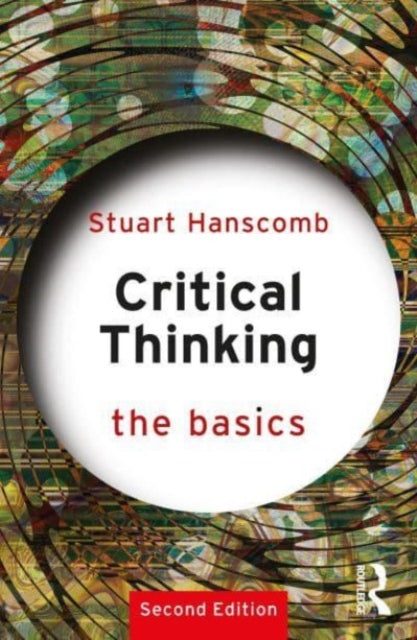
StuartHanscomb
Critical Thinking: The Basics
Critical Thinking: The Basics
💎 Earn 99 Points (£0.99) on this item.
YOU SAVE £1.18
- Condition: Brand new
- UK Delivery times: Usually arrives within 2 - 3 working days
- UK Shipping: Fee starts at £2.39. Subject to product weight & dimension
Bulk ordering. Want 15 or more copies? Get a personalised quote and bigger discounts. Learn more about bulk orders.
Couldn't load pickup availability
- More about Critical Thinking: The Basics
Critical Thinking: The Basics provides an accessible and engaging introduction to the field of critical thinking, drawing on philosophy, communication, and psychology. It covers topics such as the relationship between critical thinking, emotions, and persuasion, the role of character dispositions, argument identification and reconstruction, fallacies and argument evaluation, and an additional chapter on the relationship between critical thinking and emotions. It is revised and updated with new sections on the experiential mind and need for cognitive closure and contemporary examples. It is an essential read for students and the general reader wanting to improve their thinking skills and decision-making abilities.
Format: Paperback / softback
Length: 272 pages
Publication date: 28 June 2023
Publisher: Taylor & Francis Ltd
Critical thinking is a fundamental skill that empowers individuals to analyze information, evaluate arguments, and make informed decisions. It encompasses a range of cognitive processes, including observation, interpretation, analysis, and evaluation. By developing critical thinking skills, individuals can become more effective problem solvers, better communicators, and more capable of navigating complex social and professional environments.
One of the key aspects of critical thinking is the ability to identify and avoid poor reasoning. This involves recognizing logical fallacies, such as the fallacy of appeal to authority, the fallacy of bandwagon, and the fallacy of hasty generalization. By recognizing these fallacies, individuals can avoid making decisions based on flawed or biased information.
Another important aspect of critical thinking is the ability to reconstruct and evaluate arguments. This involves analyzing the structure and logic of an argument to determine its validity and reliability. By evaluating arguments, individuals can identify weaknesses and strengths and make informed decisions based on evidence and reasoning.
Critical thinking also involves engaging constructively in dialogues. This involves listening actively, expressing ideas clearly, and responding to others' perspectives in a respectful and open-minded manner. By engaging in constructive dialogues, individuals can build relationships, resolve conflicts, and develop a deeper understanding of complex issues.
In addition to these cognitive processes, critical thinking also involves emotional intelligence. This involves recognizing and managing one's own emotions, as well as understanding the emotions of others. By developing emotional intelligence, individuals can become more empathetic, compassionate, and effective communicators.
Critical thinking is relevant to a wide range of fields, including education, business, healthcare, and politics. In education, critical thinking skills are essential for developing academic literacy and for promoting lifelong learning. In business, critical thinking skills are essential for problem-solving, decision-making, and innovation. In healthcare, critical thinking skills are essential for evaluating evidence-based practices and making informed healthcare decisions. In politics, critical thinking skills are essential for analyzing policy proposals, evaluating political candidates, and engaging in public discourse.
One of the challenges of critical thinking is the prevalence of misinformation and propaganda. In today's digital age, it is easier than ever for individuals to access and spread false information. This can have serious consequences, such as misinformation leading to political polarization, public health crises, and economic instability.
To address this challenge, it is important for individuals to develop critical thinking skills and to be aware of the sources of information they rely on. This involves seeking out multiple sources of information, evaluating the credibility of those sources, and considering the potential biases and agendas of the sources. It also involves being open-minded and willing to consider different perspectives and ideas.
In conclusion, critical thinking is a fundamental skill that empowers individuals to analyze information, evaluate arguments, and make informed decisions. By developing critical thinking skills, individuals can become more effective problem solvers, better communicators, and more capable of navigating complex social and professional environments. However, the prevalence of misinformation and propaganda requires individuals to be aware of the sources of information they rely on and to develop critical thinking skills to identify and avoid poor reasoning and biased information.
Weight: 308g
Dimension: 130 x 198 x 19 (mm)
ISBN-13: 9781032162997
Edition number: 2 ed
This item can be found in:
UK and International shipping information
UK and International shipping information
UK Delivery and returns information:
- Delivery within 2 - 3 days when ordering in the UK.
- Shipping fee for UK customers from £2.39. Fully tracked shipping service available.
- Returns policy: Return within 30 days of receipt for full refund.
International deliveries:
Shulph Ink now ships to Australia, Belgium, Canada, France, Germany, Ireland, Italy, India, Luxembourg Saudi Arabia, Singapore, Spain, Netherlands, New Zealand, United Arab Emirates, United States of America.
- Delivery times: within 5 - 10 days for international orders.
- Shipping fee: charges vary for overseas orders. Only tracked services are available for most international orders. Some countries have untracked shipping options.
- Customs charges: If ordering to addresses outside the United Kingdom, you may or may not incur additional customs and duties fees during local delivery.