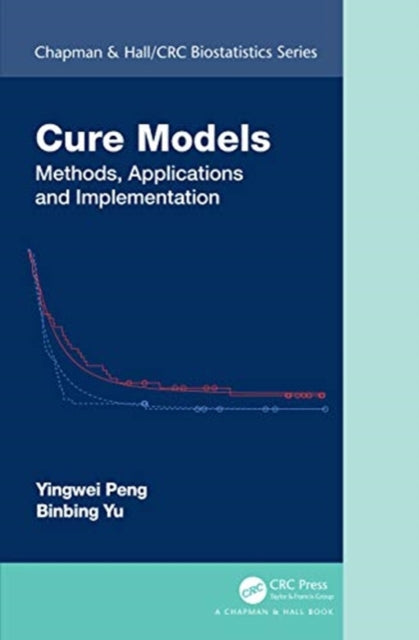
YingweiPeng,BinbingYu
Cure Models: Methods, Applications, and Implementation
Cure Models: Methods, Applications, and Implementation
💎 Earn 589 Points (£5.89) on this item.
We can order this item for you. Delivery usually takes about 4 to 6 weeks.
This item is not held in our immediate stock. We will order it for you after checkout.
Estimated delivery: About 4 to 6 weeks
YOU SAVE £7.00
- Condition: Brand new
- UK Delivery times: Usually arrives within 2 - 3 working days
- UK Shipping: Fee starts at £3.89. Subject to product weight & dimension
Bulk ordering. Want 15 or more copies? Get a personalised quote and bigger discounts. Learn more about bulk orders.
Couldn't load pickup availability
- More about Cure Models: Methods, Applications, and Implementation
The book provides a comprehensive overview of survival analysis with cure, covering statistical concepts, methods, and applications in cancer research. It is designed for both technical professionals and researchers with a focus on practical insights and real-life problems.
\n Format: Hardback
\n Length: 252 pages
\n Publication date: 23 March 2021
\n Publisher: Taylor & Francis Ltd
\n
Survival analysis encompasses a wide range of statistical concepts, methods, and applications that are essential in understanding and analyzing data related to survival outcomes. This field is particularly relevant in cancer research, where researchers aim to improve treatment outcomes and patient survival rates. Survival analysis involves the analysis of data from individuals who have been diagnosed with a disease or condition, and it focuses on estimating the time to an event such as death or disease progression.
There are several different types of survival analysis, including Cox proportional hazards models, Kaplan-Meier curves, and log-rank tests. Each of these models has its own advantages and limitations, and they are used in different scenarios depending on the type of data and research question.
One of the key advantages of survival analysis is that it allows researchers to identify factors that are associated with survival outcomes. By analyzing data from individuals who have survived for a long time, researchers can identify characteristics such as age, gender, genetic predisposition, and treatment regimen that may influence survival. This information can then be used to develop new treatments and interventions that are tailored to individual patients.
In addition to identifying survival factors, survival analysis can also be used to evaluate the effectiveness of treatment interventions. By comparing the survival rates of patients who receive a particular treatment with those who receive a different treatment, researchers can determine whether the treatment is effective and whether it improves patient outcomes. This information is critical for making informed decisions about cancer treatment and can help to improve patient care and outcomes.
Survival analysis also has important applications in clinical practice and public health. For example, it can be used to predict the survival rates of patients with a new diagnosis of cancer and to develop personalized treatment plans. It can also be used to evaluate the effectiveness of cancer screening programs and to identify populations that are at high risk of developing cancer.
Overall, survival analysis is a powerful tool that has numerous applications in cancer research and clinical practice. By analyzing data from individuals who have survived for a long time, researchers can identify factors that are associated with survival outcomes, evaluate the effectiveness of treatment interventions, and develop new treatments and interventions that are tailored to individual patients. This field has the potential to improve patient care and outcomes and to contribute to the development of new treatments and interventions for cancer.
In conclusion, survival analysis is a crucial field that plays a vital role in understanding and analyzing data related to survival outcomes. By using a range of statistical concepts, methods, and applications, researchers can identify survival factors, evaluate the effectiveness of treatment interventions, and develop new treatments and interventions that are tailored to individual patients. This field has the potential to improve patient care and outcomes and to contribute to the development of new treatments and interventions for cancer.
\n Weight: 550g\n
Dimension: 161 x 242 x 21 (mm)\n
ISBN-13: 9780367145576\n \n
UK and International shipping information
UK and International shipping information
We deliver throughout the United Kingdom and to 128 countries and territories worldwide, including the United States, Australia, Canada, Germany, Spain and France.