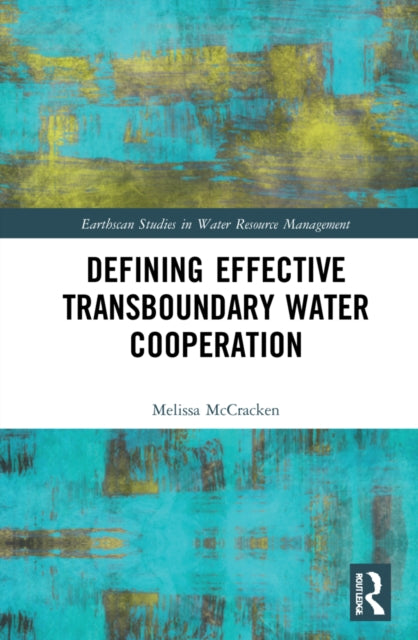
Melissa McCracken
Defining Effective Transboundary Water Cooperation
Defining Effective Transboundary Water Cooperation
We can order this item for you. Delivery usually takes about 4 to 6 weeks.
This item is not held in our immediate stock. We will order it for you after checkout.
Estimated delivery: About 4 to 6 weeks
YOU SAVE £15.13
- Condition: Brand new
- UK Delivery times: Usually arrives within 2 - 3 working days
- UK Shipping: Fee starts at £3.89. Subject to product weight & dimension
Bulk ordering. Want 15 or more copies? Get a personalised quote and bigger discounts. Learn more about bulk orders.
Couldn't load pickup availability
- More about Defining Effective Transboundary Water Cooperation
This book establishes a framework for defining transboundary water cooperation and evaluating its effectiveness, contributing to more effective and successful cooperation processes. It develops the Four Frames of Transboundary Water Cooperation and the Weighted Model of Effective Cooperation to improve understanding and evaluation of cooperative processes in international water management.
Format: Hardback
Length: 258 pages
Publication date: 31 March 2022
Publisher: Taylor & Francis Ltd
This comprehensive work establishes a robust framework for defining transboundary water cooperation and a comprehensive methodology for assessing its effectiveness, thereby contributing to the enhancement of more efficient and ultimately successful cooperation processes. In the context of the Sustainable Development Goal Framework, where transboundary cooperation plays a pivotal role in improving governance and management of transboundary surface and groundwater resources, there is a growing global recognition of the significance of transboundary water cooperation. However, a widely accepted definition of transboundary water cooperation remains elusive in both the academic literature and practical applications. To address this gap, this book presents the Four Frames of Transboundary Water Cooperation, a versatile and neutral modular framework designed to develop context-specific explanatory definitions of transboundary water cooperation for basins and aquifers. The Four Frames of Cooperation encompass legal, institutional, relational, and outcome dimensions, providing a comprehensive framework for understanding the various aspects and dimensions of transboundary water cooperation.
While the Four Frames of Cooperation offer a valuable foundation for defining transboundary water cooperation, it is crucial to go beyond mere definitions and explore more effective measures of the quality and effectiveness of cooperative processes. To this end, the Weighted Model of Effective Cooperation presents a pioneering approach for qualitatively evaluating the effectiveness of transboundary water cooperation. This model defines effective transboundary water cooperation and operationalizes a method to assess the effectiveness of cooperative processes over internationally shared waters. Effective cooperation emphasizes the relational and outcome frames of cooperation while striving for equity and sustainability. By integrating the Four Frames of Cooperation and the Weighted Model of Effective Cooperation, this book aims to enhance our understanding of cooperation and foster a rigorous evaluation of the quality, success, and effectiveness of cooperative processes.
This book will appeal to a wide range of professionals, researchers, policymakers, and stakeholders involved in transboundary water management, including water resource managers, policymakers, environmentalists, and international organizations. By providing a comprehensive and interdisciplinary approach, this book will serve as a valuable resource for advancing the field of transboundary water cooperation and promoting sustainable water resource management practices.
Weight: 453g
Dimension: 234 x 156 (mm)
ISBN-13: 9780367647803
UK and International shipping information
UK and International shipping information
We deliver throughout the United Kingdom and to 128 countries and territories worldwide, including the United States, Australia, Canada, Germany, Spain and France.