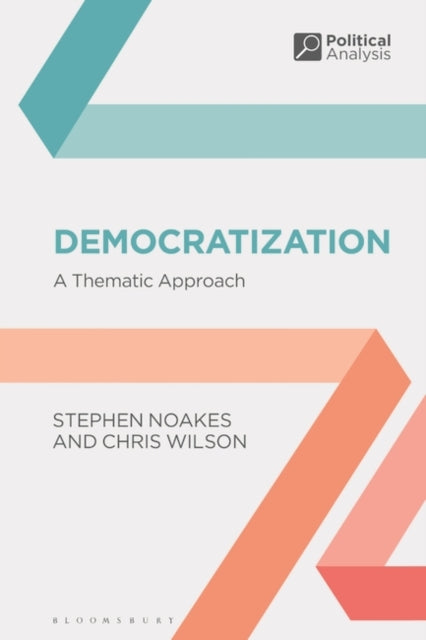
Stephen Noakes,Chris Wilson
Democratization: A Thematic Approach
Democratization: A Thematic Approach
YOU SAVE £4.64
- Condition: Brand new
- UK Delivery times: Usually arrives within 2 - 3 working days
- UK Shipping: Fee starts at £3.89. Subject to product weight & dimension
Bulk ordering. Want 15 or more copies? Get a personalised quote and bigger discounts. Learn more about bulk orders.
Couldn't load pickup availability
- More about Democratization: A Thematic Approach
The book "Democratization" explains how to define and measure democracy, evaluates trends in democratization, and identifies common factors among democracies. It also examines the challenges facing democratization, such as democratic decay, populism, authoritarianism, and threats from global terrorism and sectarian violence. The book covers key theories and case studies from Indonesia to the Zapatista movement.
Format: Paperback / softback
Length: 264 pages
Publication date: 09 February 2023
Publisher: Bloomsbury Publishing PLC
The world has seen a significant increase in the number of democracies compared to the early twentieth century. This trend can be attributed to various factors, including the spread of democratic ideals, the decline of authoritarianism, and the promotion of human rights. In this book, we will explore the factors that contributed to the spread of democracy around the world and the challenges that democracies face today.
Democracy is a form of government in which the power lies in the hands of the people. It is characterized by the rule of law, the respect for human rights, and the participation of citizens in the decision-making process. The spread of democracy can be traced back to the ancient Greek city-states, where citizens participated in political life and had the right to vote. However, it was not until the late eighteenth and early nineteenth centuries that democracy became a widespread political system.
One of the factors that contributed to the spread of democracy was the rise of nationalism. Nationalism is a political ideology that emphasizes the importance of a nation-state and the unity of its people. Nationalists believed that a strong nation-state could provide stability, security, and economic prosperity for its citizens. As nations became more independent and developed, they sought to establish their own governments based on democratic principles.
Another factor that contributed to the spread of democracy was the spread of education. Education is a key tool for promoting democratic values and institutions. As people became more educated, they became more aware of their rights and responsibilities as citizens and were more likely to participate in political life. The spread of education also helped to create a more literate and informed public, which was essential for the development of democratic institutions.
The decline of authoritarianism was also a significant factor in the spread of democracy. Authoritarianism is a form of government in which a single person or a small group of people hold power without the consent of the people. Authoritarianism can take many forms, including military dictators.
The rise of globalization was also a significant factor in the spread of democracy. Globalization is the process of increasing interconnectedness and interdependence among nations. As nations became more interconnected, they were exposed to new ideas, technologies, and cultural practices. This exposure helped to promote democratic values and institutions, as people became more aware of the importance of human rights and the need for political participation.
The challenges that democracies face today include democratic decay, populism, authoritarianism, and the far right. Democratic decay refers to the decline of democratic institutions and practices. This can be caused by a variety of factors, including corruption, political polarization, and the erosion of civil liberties. Populism is a political ideology that emphasizes the importance of the people and the rejection of established institutions.
Populism can be seen in the rise of Donald Trump in the United States and the popularity of Narendra Modi in India. Authoritarianism is a form of government in which a single person or a small group of people hold power without the consent of the people. Authoritarianism can take many forms, including military dictatorship, one-party rule, and authoritarianism.
The far right is a political ideology that emphasizes the importance of national identity, traditional values, and the rejection of liberalism and socialism. The far right can be seen in the rise of parties such as the National Front in France, the Freedom Party in Austria, and the Alternative for Germany in Germany.
Another challenge that democracies face today is the threat posed by global terrorism and sectarian violence. Global terrorism is a threat to the security and stability of nations around the world. Sectarian violence is a threat to the peace and stability of nations around the world.
To address these challenges, democracies need to promote democratic values and institutions. This can be done through education, political participation, and the promotion of civil liberties. Democracies also need to work together to address global challenges such as terrorism and sectarian violence.
In conclusion, the world has seen a significant increase in the number of democracies compared to the early twentieth century. This trend can be attributed to various factors, including the spread of democratic ideals, the decline of authoritarianism, and the promotion of human rights. Democracies face a variety of challenges today, including democratic decay, populism, authoritarianism, and the far right. To address these challenges, democracies need to promote democratic values and institutions and work together to address global challenges such as terrorism and sectarian violence.
Weight: 416g
Dimension: 156 x 235 x 16 (mm)
ISBN-13: 9781350328358
UK and International shipping information
UK and International shipping information
We deliver throughout the United Kingdom and to 128 countries and territories worldwide, including the United States, Australia, Canada, Germany, Spain and France.