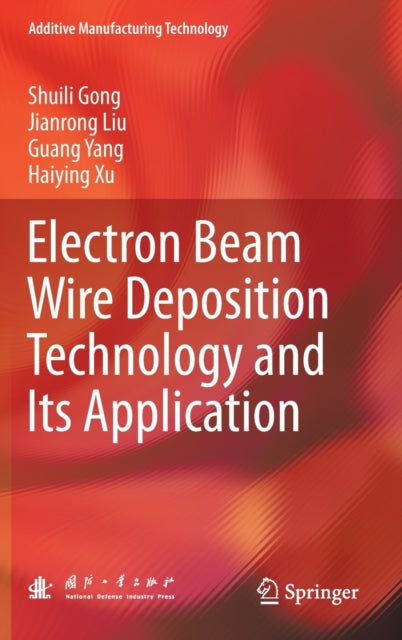
Shuili Gong,Jianrong Liu,Guang Yang,Haiying Xu
Electron Beam Wire Deposition Technology and Its Application
Electron Beam Wire Deposition Technology and Its Application
We can order this item for you. Delivery usually takes about 4 to 6 weeks.
This item is not held in our immediate stock. We will order it for you after checkout.
Estimated delivery: About 4 to 6 weeks
YOU SAVE £24.24
- Condition: Brand new
- UK Delivery times: Usually arrives within 2 - 3 working days
- UK Shipping: Fee starts at £3.89. Subject to product weight & dimension
Bulk ordering. Want 15 or more copies? Get a personalised quote and bigger discounts. Learn more about bulk orders.
Couldn't load pickup availability
- More about Electron Beam Wire Deposition Technology and Its Application
This book provides an introduction to the electron beam wire deposition technology (EBWD), focusing on the research results of the authors scientific research team in China. It covers the conceptual connotation, principle, characteristics, position, and function of the technology, as well as its technical principles, equipment technology, special materials, manufacturing technology, quality testing, and application practices. It is a valuable reference book for teachers, students, and scientific researchers in scientific research institutions.
Format: Hardback
Length: 331 pages
Publication date: 17 May 2022
Publisher: Springer Verlag, Singapore
This book offers a thorough and systematic introduction to the technical principles, materials, processes, and equipment of electron beam wire deposition technology (EBWD), with a particular emphasis on the research outcomes of the authors' scientific research team in China. It primarily delves into the conceptual framework, fundamental principles, and distinctive features of EBWD technology, its role and significance within the additive manufacturing technology system, the current and emerging trends in technological development both domestically and internationally, the foundational knowledge and practical applications of EBWD technology, encompassing technical principles, equipment technology, specialized materials, manufacturing processes, quality testing, and real-world application practices. Consequently, this book serves as a valuable resource for educators, students, and scientific researchers affiliated with scientific research institutions who are actively engaged in relevant studies.
Introduction:
EBWD technology, also known as electron beam welding or electron beam additive manufacturing, has gained significant attention in recent years due to its promising applications in various industries. This book aims to provide a comprehensive and up-to-date overview of this technology, focusing on its theoretical foundations, practical applications, and recent advancements.
Conceptual Connotation:
EBWD technology utilizes electron beams as the primary source of energy for material deposition, allowing for precise control over the shape, size, and composition of the deposited materials. It operates on the principle of controlled melting and solidification, enabling the creation of complex three-dimensional structures with high precision and accuracy.
Principle:
The EBWD process involves the generation of an electron beam, which is directed onto the workpiece surface. The beam is manipulated using electromagnetic fields to control its intensity, direction, and speed, enabling the deposition of materials in a controlled manner. The materials used in EBWD can be metals, ceramics, polymers, or composite materials, depending on the desired application.
Characteristics:
One of the key advantages of EBWD technology is its ability to produce high-quality materials with a fine grain structure. The electron beam can be focused to a very small spot, allowing for precise control over the deposition process. Additionally, EBWD can be used to deposit materials with a wide range of properties, including hardness, strength, conductivity, and corrosion resistance.
Position and Function:
EBWD technology finds applications in various industries, including aerospace, automotive, medical devices, and electronics. It can be used for the production of complex parts, such as engine components, medical implants, and electronic devices. EBWD technology also offers the advantage of being able to produce parts with a high degree of customization, as the deposited materials can be tailored to meet specific requirements.
Direction and Trend of Technological Development:
The field of EBWD technology is constantly evolving, with ongoing research and development efforts aimed at improving the efficiency, precision, and versatility of the process. One of the key trends in EBWD technology is the integration of advanced automation and robotics systems, which can increase the speed and accuracy of the deposition process while reducing the need for human intervention.
Fundamentals and Application Results:
EBWD technology is based on a deep understanding of material science, thermodynamics, and electron beam physics. The fundamentals of EBWD include the behavior of electron beams in matter, the melting and solidification processes, and the properties of deposited materials. Application results of EBWD technology include the production of high-quality metal parts, such as engine components, with a fine grain structure and excellent mechanical properties.
Technical Principles:
EBWD technology involves several technical principles, including electron beam generation, beam manipulation, material selection, and process control. The electron beam is generated using an electron gun, which emits a stream of electrons that are accelerated towards the workpiece surface. The beam is manipulated using electromagnetic fields, such as magnetic fields or electric fields, to control its intensity, direction, and speed.
Equipment Technology:
EBWD equipment includes various components, such as electron guns, vacuum chambers, and control systems. The electron gun is responsible for generating the electron beam, while the vacuum chamber provides a controlled environment for the deposition process. The control system is used to monitor and control the process parameters, such as beam intensity, speed, and position.
Special Materials:
EBWD technology can be used to deposit materials with a wide range of properties, including metals, ceramics, polymers, and composite materials. The selection of the appropriate material depends on the desired application and the properties of the deposited material. Some common materials used in EBWD include aluminum, titanium, stainless steel, and copper.
Manufacturing Technology:
EBWD technology involves several manufacturing processes, including melting, solidification, and post-processing. The melting process involves heating the workpiece to a high temperature, which causes the material to melt and flow. The solidification process involves cooling the melted material to a specific temperature, which causes it to solidify and form the desired shape. Post-processing includes surface finishing, such as grinding or polishing, to improve the appearance and properties of the deposited material.
Quality Testing:
Quality testing is an essential aspect of EBWD technology to ensure the reliability and performance of the deposited materials. Quality testing includes visual inspection, dimensional measurement, material properties testing, and microstructure analysis. Visual inspection is used to identify any defects or impurities in the deposited material, while dimensional measurement is used to ensure the accuracy of the deposited parts. Material properties testing is used to evaluate the mechanical properties, such as hardness and strength, of the deposited material. Microstructure analysis is used to evaluate the microstructure of the deposited material, which can provide insights into its properties and behavior.
Application Practices:
EBWD technology has been successfully applied in various industries, including aerospace, automotive, medical devices, and electronics. In aerospace, EBWD technology is used for the production of engine components, such as turbine blades and engine casings. In automotive, EBWD technology is used for the production of automotive parts, such as exhaust systems and body panels. In medical devices, EBWD technology is used for the production of medical implants, such as hip implants and dental implants. In electronics, EBWD technology is used for the production of electronic components, such as printed circuit boards and microchips.
Conclusion:
EBWD technology offers a promising solution for the production of complex parts with high precision and accuracy. With its ability to produce high-quality materials with a fine grain structure, EBWD technology has the potential to revolutionize the manufacturing industry. This book provides a comprehensive and up-to-date overview of EBWD technology, covering its theoretical foundations, practical applications, and recent advancements. It serves as a valuable resource for educators, students, and scientific researchers who are interested in exploring the potential of EBWD technology in their respective fields.
Weight: 694g
Dimension: 235 x 155 (mm)
ISBN-13: 9789811907586
Edition number: 1st ed. 2022
UK and International shipping information
UK and International shipping information
We deliver throughout the United Kingdom and to 128 countries and territories worldwide, including the United States, Australia, Canada, Germany, Spain and France.