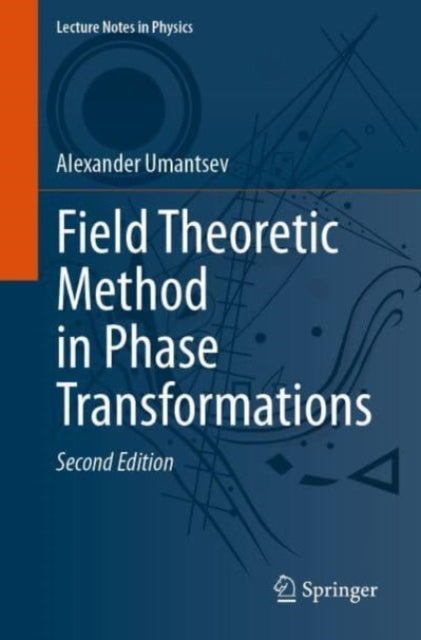
Alexander Umantsev
Field Theoretic Method in Phase Transformations
Field Theoretic Method in Phase Transformations
We can order this item for you. Delivery usually takes about 4 to 6 weeks.
This item is not held in our immediate stock. We will order it for you after checkout.
Estimated delivery: About 4 to 6 weeks
YOU SAVE £18.18
- Condition: Brand new
- UK Delivery times: Usually arrives within 2 - 3 working days
- UK Shipping: Fee starts at £3.89. Subject to product weight & dimension
Bulk ordering. Want 15 or more copies? Get a personalised quote and bigger discounts. Learn more about bulk orders.
Couldn't load pickup availability
- More about Field Theoretic Method in Phase Transformations
The phase-field method is a novel and popular method for the theoretical and computational study of phase transformations and materials processing in condensed and soft matter. It allows one to analyze different stages of transformations within a unified framework and has received significant attention in the materials science community due to recent successes. This book serves as a primer and guide for researchers and historians of physics.
Format: Paperback / softback
Length: 503 pages
Publication date: 13 June 2023
Publisher: Springer International Publishing AG
This comprehensive book delves into a novel and widely adopted approach for the theoretical and computational exploration of phase transformations and materials processing in condensed and soft matter domains. The phase-field method, a field theoretic framework, enables the comprehensive analysis of diverse stages of transformations within a unified framework. This approach has garnered significant attention within the materials science community due to its remarkable achievements in resolving or shedding light on critical problems. Spanning across a single volume, this book offers a comprehensive introduction to the method, commencing with foundational concepts of the field theoretic method and presenting its most significant theoretical and computational outcomes, as well as some of the most advanced recent developments and applications. In its revised and expanded second edition, the text has been thoroughly updated to encompass the latest advancements and includes valuable material on the classical theory of phase transformations. Serving as a valuable resource for both novice and experienced researchers in the field of phase transformations, this book also appeals to historians of physics.
Introduction:
The phase-field method, a field theoretic framework, provides a comprehensive approach to studying phase transformations in material systems. By leveraging the principles of continuum mechanics, the method allows for the analysis of the evolution of phases and their interactions within a unified framework. This approach has gained significant attention in the materials science community due to its ability to solve complex problems and provide insights into the behavior of materials under various conditions.
Fundamentals of the Phase-Field Method:
The phase-field method begins with the definition of a phase field, which represents the distribution of a phase variable (e.g., concentration, density, or temperature) throughout a material system. The phase field is governed by a set of partial differential equations (PDEs) that describe the evolution of the phase variable in response to various physical and chemical factors. These PDEs can be solved using numerical methods, such as finite element or finite difference techniques, to obtain the time-dependent evolution of the phase field.
Theoretical Results:
The phase-field method has yielded numerous theoretical results that have contributed to our understanding of phase transformations. These results include the phase-field equation, which describes the evolution of the phase field, the phase-field stability criteria, which determine the stability of different phases, and the phase-field singularity theory, which describes the behavior of the phase field near phase transitions.
Computational Applications:
The phase-field method has found widespread application in the computational study of phase transformations. By leveraging advanced numerical methods, researchers can simulate the behavior of materials under a wide range of conditions, including temperature, pressure, and chemical composition. This allows for the prediction of phase transitions, the study of microstructural evolution, and the optimization of material properties.
Recent Developments:
In recent years, the phase-field method has continued to evolve and expand. Researchers have developed new numerical methods, such as adaptive mesh refinement and fast multipole methods, to improve the accuracy and efficiency of the simulations. Additionally, the method has been applied to study a wide range of materials, including metals, ceramics, and polymers.
Conclusion:
The phase-field method is a powerful tool for studying phase transformations in materials. Its theoretical results have contributed to our understanding of the behavior of materials under various conditions, and its computational applications have enabled the optimization of material properties and the prediction of phase transitions. With ongoing research and development, the phase-field method is likely to remain an important tool in the materials science community for years to come.
Weight: 807g
Dimension: 235 x 155 (mm)
ISBN-13: 9783031296048
Edition number: 2nd ed. 2023
UK and International shipping information
UK and International shipping information
We deliver throughout the United Kingdom and to 128 countries and territories worldwide, including the United States, Australia, Canada, Germany, Spain and France.