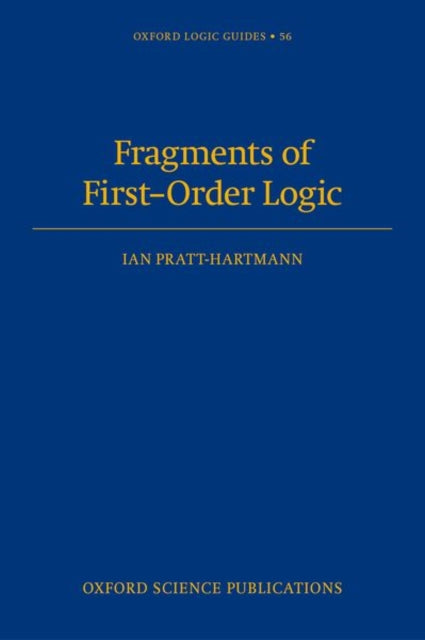
IanPratt-Hartmann
Fragments of First-Order Logic
Fragments of First-Order Logic
💎 Earn 756 Points (£7.56) on this item.
We can order this item for you. Delivery usually takes about 4 to 6 weeks.
This item is not held in our immediate stock. We will order it for you after checkout.
Estimated delivery: About 4 to 6 weeks
- Condition: Brand new
- UK Delivery times: Usually arrives within 2 - 3 working days
- UK Shipping: Fee starts at £3.89. Subject to product weight & dimension
Bulk ordering. Want 15 or more copies? Get a personalised quote and bigger discounts. Learn more about bulk orders.
Couldn't load pickup availability
- More about Fragments of First-Order Logic
First-order logic is a formal system of reasoning with variables and predicates. The question of whether there exists an algorithm for determining satisfiability or finite satisfiability for all formulas of first-order logic was answered negatively by Church and Turing in 1936 and by Trakhtenbrot in 1950. However, for restricted subsets of first-order logic, these problems are algorithmically solvable. This book provides an up-to-date survey of research on decision in first-order logic, exploring the trade-off between expressive power and complexity of reasoning. It covers fragments defined by restricting the set of available formulas, logics with counting quantifiers, and logics characterized by semantic constraints. The work finishes with a chapter on logics interpreted over trees.
Format: Hardback
Length: 672 pages
Publication date: 30 March 2023
Publisher: Oxford University Press
A sentence of first-order logic is satisfiable if it is true in some structure, and finitely satisfiable if it is true in some finite structure. The question arises as to whether there exists an algorithm for determining whether a given formula of first-order logic is satisfiable, or indeed finitely satisfiable. This question was answered negatively in 1936 by Church and Turing (for satisfiability) and in 1950 by Trakhtenbrot (for finite satisfiability). In contrast, the satisfiability and finite satisfiability problems are algorithmically solvable for restricted subsets—or, as we say, fragments—of first-order logic, a fact that is today of considerable interest in Computer Science. This book provides an up-to-date survey of the principal axes of research, charting the limits of decision in first-order logic and exploring the trade-off between expressive power and complexity of reasoning. Divided into three parts, the book considers for which fragments of first-order logic there is an effective method for determining satisfiability or finite satisfiability. Furthermore, if these problems are decidable for some fragment, what is their computational complexity? Part I focuses on fragments defined by restricting the set of available formulas. Topics covered include the Aristotelian syllogistic and its relatives, the two-variable fragment, the guarded fragment, the quantifier-prefix fragments, and the fluted fragment. Part II investigates logics with counting quantifiers. Starting with De Morgan's numerical generalization of the Aristotelian syllogistic, we proceed to the two-variable fragment with counting quantifiers and its guarded subfragment, explaining the applications of the latter to the problem of query answering in structured data. Part III concerns logics charac.
Weight: 1240g
Dimension: 166 x 242 x 37 (mm)
ISBN-13: 9780192867964
UK and International shipping information
UK and International shipping information
We deliver throughout the United Kingdom and to 128 countries and territories worldwide, including the United States, Australia, Canada, Germany, Spain and France.