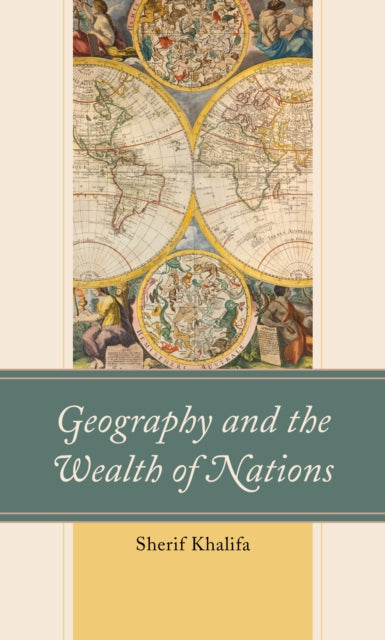
Sherif Khalifa
Geography and the Wealth of Nations
Geography and the Wealth of Nations
💎 Earn 477 Points (£4.77) on this item.
We can order this item for you. Delivery usually takes about 4 to 6 weeks.
This item is not held in our immediate stock. We will order it for you after checkout.
Estimated delivery: About 4 to 6 weeks
- Condition: Brand new
- UK Delivery times: Usually arrives within 2 - 3 working days
- UK Shipping: Fee starts at £3.89. Subject to product weight & dimension
Bulk ordering. Want 15 or more copies? Get a personalised quote and bigger discounts. Learn more about bulk orders.
Couldn't load pickup availability
- More about Geography and the Wealth of Nations
In Geography and the Wealth of Nations,Sherif Khalifa argues that geography influences the factors that determine economic performance, such as institutions, cultural values, governance, conflict, and integration into the global economy. He shows how geographic features influence these factors and how they affect economic outcomes, especially in the face of environmental challenges.
Format: Hardback
Length: 294 pages
Publication date: 15 April 2022
Publisher: Lexington Books
In his groundbreaking work, Geography and the Wealth of Nations, Sherif Khalifa delves deep into the intricate relationship between geography and economic performance. He compellingly argues that geography plays a pivotal role in shaping the factors that determine economic outcomes, including the quality of institutions, cultural values, governance systems, conflict likelihood, historical experiences, and integration into the global economy. Through detailed analysis, Khalifa demonstrates how geographic features exert influence on each of these determinants, ultimately impacting economic outcomes.
Recognizing the critical importance of understanding the geographic origins of these factors, Khalifa emphasizes the need to explore their spatial dimensions. This exploration becomes particularly crucial in the face of unprecedented environmental challenges, such as climate change, escalating natural disasters, resource depletion, soil degradation, deforestation, desertification, and loss of biodiversity. These drastic changes demand a comprehensive understanding of how geographic determinants continue to shape global crises.
In Geography and the Wealth of Nations, Khalifa offers a wealth of insights into the complex interplay between geography and economic development. He explores how different geographic regions and environments have shaped the economic trajectories of nations, highlighting the unique challenges and opportunities they present. By examining the spatial distribution of resources, infrastructure, and population, Khalifa sheds light on the factors that contribute to economic growth and prosperity, as well as the constraints and barriers that hinder development.
Furthermore, Khalifa emphasizes the role of geography in shaping cultural values and institutions. He explores how cultural norms, beliefs, and practices are influenced by environmental factors, such as climate, topography, and natural resources. This understanding helps us to better understand the diverse economic strategies and practices adopted by different regions and nations.
Khalifa's work also sheds light on the governance systems that influence economic performance. He examines how political institutions, legal frameworks, and social structures are shaped by geographic factors, such as land distribution, resource availability, and population density. This analysis provides valuable insights into the factors that contribute to economic stability, inequality, and social unrest.
In conclusion, Geography and the Wealth of Nations is a seminal work that delves into the complex relationship between geography and economic performance. Through detailed analysis and compelling arguments, Sherif Khalifa demonstrates how geography influences the factors that determine economic outcomes, and how these determinants, in turn, shape global crises. This book offers valuable insights into the spatial dimensions of economic development and provides a framework for understanding the complex interplay between geography and economic performance. As we navigate the challenges of the 21st century, Khalifa's work reminds us of the importance of recognizing and leveraging the power of geography to promote sustainable and inclusive economic growth.
Weight: 658g
Dimension: 228 x 160 x 24 (mm)
ISBN-13: 9781666900521
UK and International shipping information
UK and International shipping information
We deliver throughout the United Kingdom and to 128 countries and territories worldwide, including the United States, Australia, Canada, Germany, Spain and France.