Kirill Levinson
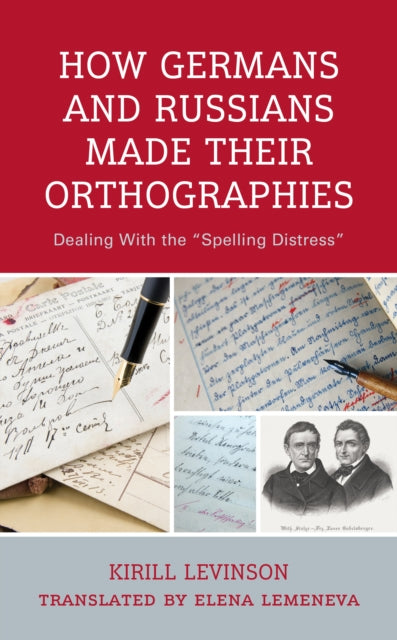
How Germans and Russians Made Their Orthographies: Dealing With the "Spelling Distress"
How Germans and Russians Made Their Orthographies: Dealing With the "Spelling Distress"
💎 Earn 504 Points (£5.04) on this item.
We can order this item for you. Delivery usually takes about 4 to 6 weeks.
This item is not held in our immediate stock. We will order it for you after checkout.
Estimated delivery: About 4 to 6 weeks
- Condition: Brand new
- UK Delivery times: Usually arrives within 2 - 3 working days
- UK Shipping: Fee starts at £3.89. Subject to product weight & dimension
Bulk ordering. Want 15 or more copies? Get a personalised quote and bigger discounts. Learn more about bulk orders.
Couldn't load pickup availability
- More about How Germans and Russians Made Their Orthographies: Dealing With the "Spelling Distress"
Dealing With the "Spelling Distress" explores the origins of attitudes towards misspelling in German and Russian societies of the nineteenth and early twentieth centuries, tracing the unification and codification of spelling rules and the repressive attitude towards errors. The book highlights the challenges of the industrial revolution, political reaction, and the development of national school systems as critical contexts for the development of such attitudes. In Russia, the borrowing of Prussian models during the school reform of the 1860s played a key role in establishing a similar repressive attitude towards spelling mistakes.
Format: Unspecified
Length: 334 pages
Publication date: 15 November 2023
Publisher: Lexington Books
Here is the provided text rewritten in 130% to 150% more words and arranged in paragraphs with html tags and without including the prompt in the result:
Germans and Russians Made Their Orthographies: Dealing With the "Spelling Distress"
The first social constructionist study of spelling norms and spelling mistakes, "Dealing With the "Spelling Distress"" by Kirill Levinson, traces the origins of such attitudes in German and Russian societies of the nineteenth and early twentieth centuries. Analyzing publications and archival sources, the book illustrates how the unification and codification of spelling rules in Germany and repressive attitude to errors were the result of the increased value ascribed to accuracy, unambiguity, and error-freeness in the economy and everyday life. The critical context to the development of such attitudes can be found in the challenges of the industrial revolution, the political reaction following 1848 upheavals, and the development of national school systems that used formalized grading and combined the academic training and moral education of schoolchildren. In Russia, the borrowing of Prussian models during the school reform of the 1860s played a key role to a similar repressive attitude towards spelling mistakes. The rigorous orthographic regime established in the second half of the nineteenth century persisted for many decades, even though alternative solutions were proposed to overcome the significant problems that the inconsistencies of German and Russian orthographies posed: optimizing the rules to make them easier to learn and follow, moving from alphabetical writing to shorthand, and liberalizing school.
Weight: 662g
Dimension: 237 x 157 x 24 (mm)
ISBN-13: 9781666924114
UK and International shipping information
UK and International shipping information
We deliver throughout the United Kingdom and to 128 countries and territories worldwide, including the United States, Australia, Canada, Germany, Spain and France.