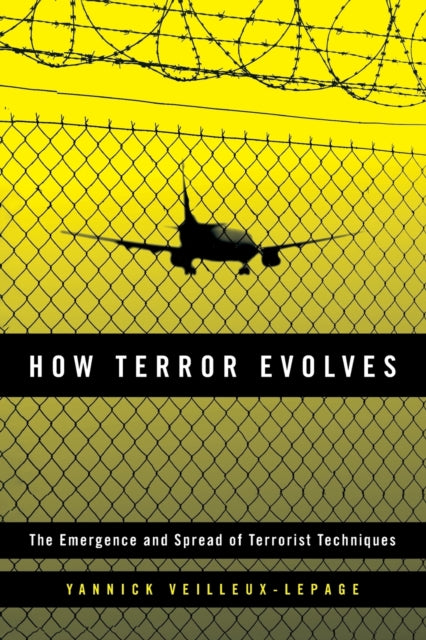
Yannick Veilleux-Lepage
How Terror Evolves: The Emergence and Spread of Terrorist Techniques
How Terror Evolves: The Emergence and Spread of Terrorist Techniques
We can order this item for you. Delivery usually takes about 4 to 6 weeks.
This item is not held in our immediate stock. We will order it for you after checkout.
Estimated delivery: About 4 to 6 weeks
YOU SAVE £4.64
- Condition: Brand new
- UK Delivery times: Usually arrives within 2 - 3 working days
- UK Shipping: Fee starts at £3.89. Subject to product weight & dimension
Bulk ordering. Want 15 or more copies? Get a personalised quote and bigger discounts. Learn more about bulk orders.
Couldn't load pickup availability
- More about How Terror Evolves: The Emergence and Spread of Terrorist Techniques
This book explores the use of terror as a tool in political contention, tracing its historical development and examining how terroristic groups innovate and adapt their techniques to advance their causes. It emphasizes the importance of understanding the processes through which terror is achieved and the implications of counterterrorism on the evolution of terrorism.
Format: Paperback / softback
Length: 198 pages
Publication date: 15 March 2022
Publisher: Rowman & Littlefield
This comprehensive book delves into the intricate relationship between terror and political contention, shedding light on the fact that terroristic innovation is intricately linked to broader historical processes rather than occurring in isolation. By drawing upon evolutionary theory, the study offers a novel perspective on how terroristic groups adapt, transform, and abandon techniques of political violence to advance their causes against the state. The book meticulously traces the evolution of aircraft as weapons of destruction, from the early instances of aircraft hijacking in the 1930s in Peru to their adoption by al-Qaeda in the 1990s and their subsequent use in the devastating 9/11 attack in 2001. Through this comprehensive examination, the book provides a valuable insight into the mechanisms through which terror is achieved, offering a fresh and innovative understanding of political violence and its implications on the evolution of terrorism.
The use of terror as a tool in political contention has a long and complex history, dating back to ancient times. Throughout history, various groups and individuals have employed terror as a means to achieve their goals, ranging from religious extremists to political movements. However, the modern era has seen the rise of terror as a prominent feature of international politics, with terrorist organizations such as al-Qaeda, ISIS, and Boko Haram gaining significant notoriety and influence.
One of the key insights of this book is that terroristic innovation is not a standalone phenomenon but rather occurs as part of wider historical processes. The study argues that terroristic groups innovate upon, transform, and abandon techniques of political violence in order to advance their causes against the state. This process is driven by a variety of factors, including the changing nature of conflict, the emergence of new technologies, and the evolving attitudes of the public towards political violence.
The book provides a detailed account of the evolution of aircraft as weapons of destruction, from the early instances of aircraft hijacking in the 1930s in Peru to their adoption by terrorist organizations in the modern era. The study highlights the role that technology plays in the development of terroristic tactics, with the use of aircraft enabling terrorist groups to reach a global audience and inflict significant damage.
In addition to examining the use of aircraft as weapons of destruction, the book also explores the various strategies that terroristic groups employ to advance their causes. These strategies include suicide bombings, kidnappings, assassinations, and the use of propaganda to recruit and motivate followers. The study argues that these strategies are not only effective in achieving short-term goals but also have long-term consequences for the political landscape.
One of the key challenges facing counterterrorism efforts is the evolving nature of terrorism. Terrorist organizations are constantly adapting and evolving their tactics in order to evade detection and countermeasures. This requires a constant and proactive response from governments and security agencies, as well as a broader societal commitment to countering terrorism.
The book also raises important ethical questions about the use of terror as a tool in political contention. While the use of force may be necessary to protect innocent lives, it also raises concerns about the use of excessive force and the potential for human rights abuses. The study argues that the use of terror should be carefully considered and that any counterterrorism efforts should be guided by a commitment to human rights and the rule
In conclusion, this book provides a comprehensive and insightful examination of the use of terror as a tool in political contention. By drawing upon counterterrorism on evolutionary theory, the study offers a novel understanding of the mechanisms of political violence and the implications of counterterrorism on the evolution of terrorism. The book provides valuable insights into the techniques through which terror is achieved, offering a fresh and innovative understanding of political violence and its implications on the evolution of terrorism. The book also raises important ethical questions about the use of terror as a tool in political contention, and calls for a careful consideration of the potential risks and benefits of counterterrorism efforts.
Weight: 299g
Dimension: 219 x 153 x 14 (mm)
ISBN-13: 9781538149812
UK and International shipping information
UK and International shipping information
We deliver throughout the United Kingdom and to 128 countries and territories worldwide, including the United States, Australia, Canada, Germany, Spain and France.