Shulph Ink
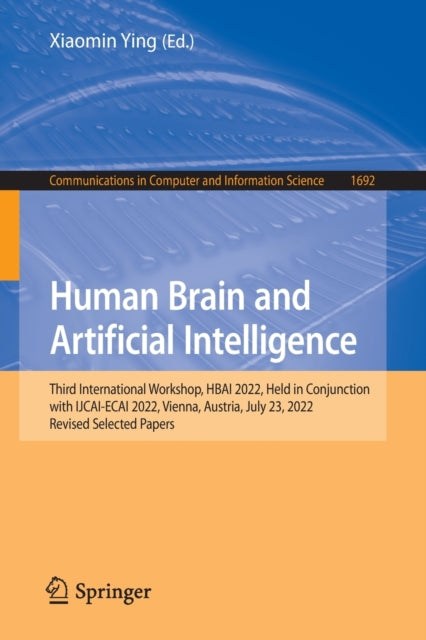
Human Brain and Artificial Intelligence: Third International Workshop, HBAI 2022, Held in Conjunction with IJCAI-ECAI 2022,Vienna, Austria, July 23, 2022, Revised Selected Papers
Human Brain and Artificial Intelligence: Third International Workshop, HBAI 2022, Held in Conjunction with IJCAI-ECAI 2022,Vienna, Austria, July 23, 2022, Revised Selected Papers
YOU SAVE £14.14
- Condition: Brand new
- UK Delivery times: Usually arrives within 2 - 3 working days
- UK Shipping: Fee starts at £3.89. Subject to product weight & dimension
Bulk ordering. Want 15 or more copies? Get a personalised quote and bigger discounts. Learn more about bulk orders.
Couldn't load pickup availability
- More about Human Brain and Artificial Intelligence: Third International Workshop, HBAI 2022, Held in Conjunction with IJCAI-ECAI 2022,Vienna, Austria, July 23, 2022, Revised Selected Papers
The Third International Workshop on Human Brain and Artificial Intelligence, HBAI 2022, held in Vienna, Austria, brought together experts to discuss brain-inspired computing, brain-machine interfaces, computational neuroscience, brain-related health, neuroimaging, cognition and behavior, learning, memory, neuron modulation, and closed-loop brain stimulation. 19 full papers were presented, covering recent research in these areas.
Format: Paperback / softback
Length: 230 pages
Publication date: 30 November 2022
Publisher: Springer Verlag, Singapore
The Third International Workshop on Human Brain and Artificial Intelligence (HBAI 2022) was held in Vienna, Austria, on July 23, 2022, in conjunction with IJCAI-ECAI 2022. The workshop brought together experts from around the world to discuss the latest advancements in brain-inspired computing, brain-machine interfaces, computational neuroscience, brain-related health, neuroimaging, cognition and behavior, learning, memory, neuron modulation, and closed-loop brain stimulation.
The event featured a total of 19 full papers, which were carefully reviewed and selected from 21 submissions. The papers covered a wide range of topics, reflecting the cutting-edge research in these fields.
Brain-inspired computing involves using principles and models of the human brain to develop new computing systems and algorithms. This field has seen significant progress in recent years, with researchers developing neural networks that can learn and adapt to complex tasks, mimicking the behavior of the human brain. Brain-machine interfaces, on the other hand, aim to create direct communication channels between the brain and external devices, such as computers or robotic limbs. These interfaces have the potential to revolutionize the way we interact with technology and improve our ability to control and manipulate objects.
Computational neuroscience is a multidisciplinary field that combines neuroscience, computer science, and mathematics to understand the brain's functions and mechanisms. Researchers in this field use advanced imaging techniques, such as functional magnetic resonance imaging (fMRI), to study the brain's activity and build computational models that can simulate brain behavior. Computational neuroscience has played a crucial role in understanding brain disorders, such as Alzheimer's and Parkinson's disease, and developing new therapies.
Brain-related health is a growing field that focuses on understanding the relationship between the brain and various health conditions, such as depression, anxiety, and addiction. Researchers in this field use neuroimaging techniques, such as MRI and EEG, to study the brain's structure and function and develop new treatments and therapies.
Neuroimaging is a crucial tool in the study of the brain, allowing researchers to visualize the brain's structure and function in real-time. This field has seen significant advancements in recent years, with the development of new imaging techniques, such as functional MRI and diffusion tensor imaging, that provide more detailed and accurate information about the brain's activity.
Cognition and behavior are closely intertwined, and researchers in this field study how the brain influences our thoughts, emotions, and actions. This field has seen significant progress in recent years, with the development of new imaging techniques, such as fMRI, that can measure the brain's activity during different cognitive tasks.
Learning and memory are fundamental aspects of human cognition, and researchers in this field study how the brain processes and stores information. This field has seen significant progress in recent years, with the development of new machine learning algorithms that can learn and adapt to complex tasks, mimicking the behavior of the human brain.
Neuron modulation is a technique that involves stimulating or inhibiting specific neurons in the brain to modify brain activity. This field has seen significant progress in recent years, with the development of new drugs and devices that can modulate brain activity and treat neurological disorders, such as epilepsy and Parkinson's disease.
Closed-loop brain stimulation is a technique that involves using electrical or magnetic stimulation to modify brain activity in a controlled and targeted manner. This field has seen significant progress in recent years, with the development of new devices and techniques that can stimulate specific brain regions and improve cognitive function.
In conclusion, the Third International Workshop on Human Brain and Artificial Intelligence (HBAI 2022) was a highly successful event that brought together experts from around the world to discuss the latest advancements in brain-inspired computing, brain-machine interfaces, computational neuroscience, brain-related health, neuroimaging, cognition and behavior, learning, memory, neuron modulation, and closed-loop brain stimulation. The papers presented at the workshop covered a wide range of topics and demonstrated the significant progress that has been made in these fields in recent years. The workshop also provided a platform for researchers to share their ideas, collaborate, and build new partnerships. As the field of brain-inspired computing continues to evolve, we can expect to see even more exciting developments and breakthroughs in the years to come.
Weight: 379g
Dimension: 235 x 155 (mm)
ISBN-13: 9789811982217
Edition number: 1st ed. 2023
UK and International shipping information
UK and International shipping information
We deliver throughout the United Kingdom and to 128 countries and territories worldwide, including the United States, Australia, Canada, Germany, Spain and France.