Shulph Ink
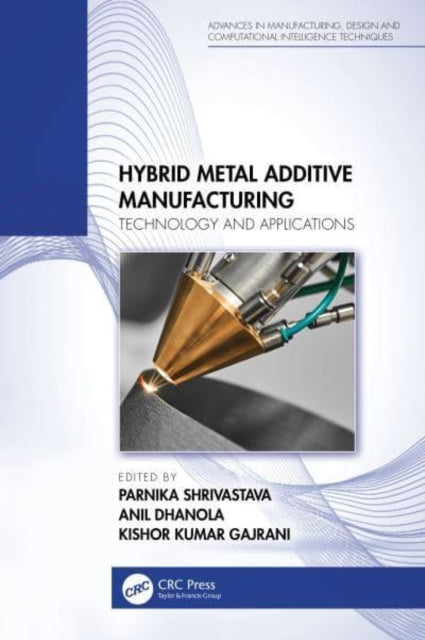
Hybrid Metal Additive Manufacturing: Technology and Applications
Hybrid Metal Additive Manufacturing: Technology and Applications
💎 Earn 1092 Points (£10.92) on this item.
We can order this item for you. Delivery usually takes about 4 to 6 weeks.
This item is not held in our immediate stock. We will order it for you after checkout.
Estimated delivery: About 4 to 6 weeks
- Condition: Brand new
- UK Delivery times: Usually arrives within 2 - 3 working days
- UK Shipping: Fee starts at £3.89. Subject to product weight & dimension
Bulk ordering. Want 15 or more copies? Get a personalised quote and bigger discounts. Learn more about bulk orders.
Couldn't load pickup availability
- More about Hybrid Metal Additive Manufacturing: Technology and Applications
The book discusses the latest research and development in hybrid metal additive manufacturing,including modeling,composite materials,and low-carbon processes. It covers fabrication methods,rapid tooling,Industry 4.0 integration,and sustainability. It is a valuable resource for students and researchers in mechanical engineering,aerospace engineering,manufacturing engineering,and production engineering.
Format: Hardback
Length: 244 pages
Publication date: 05 December 2023
Publisher: Taylor & Francis Ltd
Introduction:
Additive manufacturing (AM) has gained significant attention in recent years due to its ability to produce complex parts with high precision, efficiency, and cost-effectiveness. Hybrid metal additive manufacturing (HMAM) is a subset of AM that combines traditional metal casting techniques with additive manufacturing processes to create hybrid components. HMAM offers several advantages, such as the ability to produce complex shapes, the ability to customize components, and the ability to reduce waste.
Latest Research and Development:
The latest research and development in HMAM have focused on improving the efficiency, accuracy, and reliability of the process. Researchers have explored various materials, such as titanium, aluminum, and stainless steel, and have developed new fabrication methods, such as direct metal laser sintering (DMLS) and selective laser melting (SLM). Additionally, they have developed new modeling techniques, such as finite element analysis (FEA) and computational fluid dynamics (CFD), to optimize the design and performance of hybrid components.
Technical Challenges:
HMAM faces several technical challenges, such as the need for high-temperature materials, the need for precise control over the process, and the need for post-processing techniques to improve the surface quality and mechanical properties of the components. Researchers are working to address these challenges by developing new materials, new process technologies, and new post-processing techniques.
Future Directions:
The future of HMAM is promising, with significant potential for applications in various industries, such as aerospace, automotive, and medical equipment. Researchers are exploring new materials, new process technologies, and new applications to further improve the efficiency, accuracy, and reliability of the process. Additionally, they are working to develop new modeling techniques and new sustainability solutions to reduce the environmental impact of HMAM.
Modeling of Hybrid Additive Manufacturing Processes for Metals:
Modeling of hybrid additive manufacturing processes for metals is an important aspect of HMAM. Researchers are using FEA and CFD to optimize the design and performance of hybrid components. They are also developing new modeling techniques, such as multi-physics modeling and virtual prototyping, to simulate the behavior of hybrid components under different operating conditions.
Hybrid Additive Manufacturing of Composite Materials:
Hybrid additive manufacturing of composite materials is another important area of research in HMAM. Researchers are using additive manufacturing techniques to create composite components with complex geometries and properties. They are also developing new materials, such as carbon fiber-reinforced polymers, to improve the strength and stiffness of composite components.
Low-Carbon Hybrid Additive Manufacturing Processes:
Low-carbon hybrid additive manufacturing processes are an important area of research in HMAM. Researchers are developing new materials, such as biodegradable materials, to reduce the environmental impact of HMAM. They are also developing new process technologies, such as energy-efficient manufacturing techniques, to reduce the energy consumption and carbon footprint of HMAM.
Conclusion:
In conclusion, HMAM is a rapidly evolving field with significant potential for applications in various industries. The latest research and development in HMAM have focused on improving the efficiency, accuracy, and reliability of the process. Additionally, researchers are exploring new materials, new process technologies, and new applications to further improve the efficiency, accuracy, and reliability of the process. The future of HMAM is promising, with significant potential for applications in various industries.
Weight: 653g
Dimension: 234 x 156 (mm)
ISBN-13: 9781032460550
UK and International shipping information
UK and International shipping information
We deliver throughout the United Kingdom and to 128 countries and territories worldwide, including the United States, Australia, Canada, Germany, Spain and France.