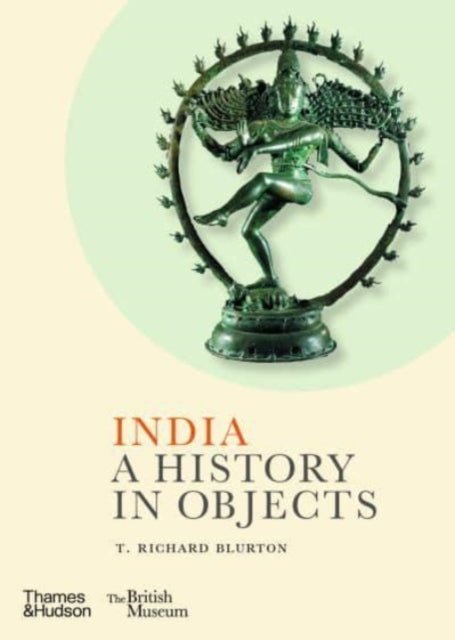
T. Richard Blurton
India: A History in Objects
India: A History in Objects
💎 Earn 106 Points (£1.06) on this item.
YOU SAVE £8.76
- Condition: Brand new
- UK Delivery times: Usually arrives within 2 - 3 working days
- UK Shipping: Fee starts at £2.39. Subject to product weight & dimension
Bulk ordering. Want 15 or more copies? Get a personalised quote and bigger discounts. Learn more about bulk orders.
Couldn't load pickup availability
- More about India: A History in Objects
This excellent new overview connects modern-day India with its past by tracing the development of South Asian art and artifacts from prehistory to the present. It explores the rise and spread of religions such as Buddhism, Jainism, Hinduism, and Sikhism, as well as the arrival of religions such as Zoroastrianism, Islam, and Christianity. The medieval era saw the development of temple-building and sculpture-production skills, and pilgrimage has been an important part of the spread of social, political, and religious ideas. The Mughals, the last Muslim dynasty of India, became a leading economic power, and their distinct Mughal style can be traced in paintings, hardstone carving, and metalwork. In the 19th century, trade in spices, textiles, and other luxury goods increased, and in the 20th century, modernism and political independence saw the fresh assertion of Indian culture through cinema, dance, and music.
Format: Hardback
Length: 320 pages
Publication date: 30 June 2022
Publisher: Thames & Hudson Ltd
Spanning thousands of years,South Asia has been home to a rich and diverse array of civilizations,each leaving its unique mark on the region. From the ancient Indus Valley Civilization to the rise and fall of empires like the Mughal and Rajput dynasties,South Asia has witnessed the birth and spread of religions like Hinduism, Buddhism, Islam, and Christianity.
The medieval era in South Asia was marked by the development of intricate temple architecture and the art of stone and bronze sculpture. Pilgrimage became an important means of spreading social, political, and religious ideas, and the Mughal Empire, the last Muslim dynasty in India, was a major economic power.
In the 19th century, with the arrival of Europeans in India, trade in spices, textiles, and other luxury goods increased, leading to the establishment of a national and international trade complex.
The 20th century saw the emergence of modernism and political independence in South Asia, which led to the flourishing of Indian culture in fields such as cinema, dance, and music. Today, South Asia is a vibrant and diverse region, home to a population of over 1.4 billion people and known for its rich cultural heritage, stunning landscapes, and dynamic cities.
From the ancient Indus Valley Civilization to the rise and fall of empires like the Mughal and Rajput dynasties, South Asia has witnessed the birth and spread of religions like Hinduism, Buddhism, Islam, and Christianity.
The medieval era in South Asia was marked by the development of intricate temple architecture and the art of stone and bronze sculpture. Pilgrimage became an important means of spreading social, political, and religious ideas, and the Mughal Empire, the last Muslim dynasty in India, was a major economic power.
In the 19th century, with the arrival of Europeans in India, trade in spices, textiles, and other luxury goods increased, leading to the establishment of a national and international trade complex.
The 20th century saw the emergence of modernism and political independence in South Asia, which led to the flourishing of Indian culture in fields such as cinema, dance, and music. Today, South Asia is a vibrant and diverse region, home to a population of over 1.4 billion people and known for its rich cultural heritage, stunning landscapes, and dynamic cities.
The art and artifacts of South Asia are a testament to the rich and diverse history of the region. From the intricate sculptures of the Indus Valley Civilization to the beautiful textiles of the Mughal Empire, South Asia has produced a wide range of artistic masterpieces that reflect the cultural and religious beliefs of its people.
One of the most significant aspects of South Asian art and artifacts is their religious significance. Hinduism, Buddhism, Islam, and Christianity have all played a significant role in shaping the artistic traditions of the region, and their influence can be seen in everything from temple architecture to sculpture to painting.
Hinduism is the most widely practiced religion in South Asia, and its influence on art and architecture is profound. Hindu temples are known for their intricate carvings and sculptures, which often depict deities and mythological scenes. The most famous Hindu temple in the world is the Taj Mahal in Agra, India, which was built by the Mughal emperor Shah Jahan in memory of his wife.
Buddhism, which originated in India, has also had a significant impact on South Asian art and architecture. Buddhist temples are known for their simple and elegant design, which often incorporates elements of nature and the cosmos. The most famous Buddhist temple in South Asia is the Mahabodhi Temple in Bihar, India, which is considered the site of Buddha's enlightenment.
Islam, which was introduced to South Asia by Arab traders in the 7th century, has also left its mark on the region's art and architecture. Islamic buildings are known for their geometric designs and intricate calligraphy, which often depict verses from the Quran. The most famous Islamic building in South Asia is the Taj Mahal in Agra, which was built by the Mughal emperor Shah Jahan in memory of his wife.
Christianity, which was introduced to South Asia by European missionaries in the 16th century, has also had a significant impact on the region's art and architecture. Christian churches and cathedrals are known for their beautiful architecture and intricate stained glass windows, which often depict scenes from the Bible. The most famous Christian building in South Asia is the St. Mary's Cathedral in Chennai, India, which is considered one of the largest and most beautiful cathedrals in the world.
In addition to their religious significance, South Asian art and artifacts are also a reflection of the region's cultural traditions. The music, dance, and literature of South Asia are all deeply rooted in the region's history and culture, and their influence can be seen in everything from the intricate costumes of Indian classical dance to the poetry of Rabindranath Tagore.
One of the most famous forms of South Asian art is the sculpture. The Indus Valley Civilization, which flourished in the Indus River Valley from around 3300 BCE to 1300 BCE, was known for its impressive sculptures of humans, animals, and deities. The most famous sculpture from the Indus Valley Civilization is the "Dancing Girl," which is believed to depict a goddess or a priestess.
The Mughal Empire, which ruled over much of South Asia from the 16th century to the 18th century, was also known for its impressive sculptures. The most famous Mughal sculpture is the "Taj Mahal," which was built by the Mughal emperor Shah Jahan in memory of his wife. The Taj Mahal is considered one of the most beautiful buildings in the world and is known for its intricate carvings and marble latticework.
In addition to sculpture, South Asian art also includes a wide range of other forms, such as painting, pottery, and textiles. Paintings in South Asia often depict scenes from mythology, history, and everyday life, and they are often done in a vibrant and colorful style. Pottery in South Asia is known for its intricate designs and patterns, and it is often used for decorative purposes. Textiles in South Asia are known for their intricate patterns and designs, and they are often used for clothing and decorative purposes.
South Asian art and artifacts are also a reflection of the region's social and political history. The Mughal Empire, for example, was known for its patronage of the arts, and many of the most famous works of art in South Asia were created during the Mughal period. The Rajput dynasties, which ruled over parts of India and Pakistan in the 18th and 19th centuries, were also known for their patronage of the arts, and many of the most famous works of art in South Asia were created during the Rajput period.
In addition to their artistic and cultural significance, South Asian art and artifacts are also important for their historical and cultural value. They provide a window into the past and help us understand the development of the region's culture and society. They also provide a valuable source of information about the region's history and culture, which can be used to promote cultural exchange and understanding.
In conclusion, South Asian art and artifacts are a testament to the rich and diverse history of the region. From the intricate sculptures of the Indus Valley Civilization to the beautiful textiles of the Mughal Empire, South Asia has produced a wide range of artistic masterpieces that reflect the cultural and religious beliefs of its people. These works of art and artifacts are important for their artistic and cultural significance, historical and cultural value, and for their ability to promote cultural exchange and understanding.
Weight: 1040g
Dimension: 240 x 170 (mm)
ISBN-13: 9780500480649
UK and International shipping information
UK and International shipping information
UK Delivery and returns information:
- Delivery within 2 - 3 days when ordering in the UK.
- Shipping fee for UK customers from £2.39. Fully tracked shipping service available.
- Returns policy: Return within 30 days of receipt for full refund.
International deliveries:
Shulph Ink now ships to Australia, Belgium, Canada, France, Germany, Ireland, Italy, India, Luxembourg Saudi Arabia, Singapore, Spain, Netherlands, New Zealand, United Arab Emirates, United States of America.
- Delivery times: within 5 - 10 days for international orders.
- Shipping fee: charges vary for overseas orders. Only tracked services are available for most international orders. Some countries have untracked shipping options.
- Customs charges: If ordering to addresses outside the United Kingdom, you may or may not incur additional customs and duties fees during local delivery.