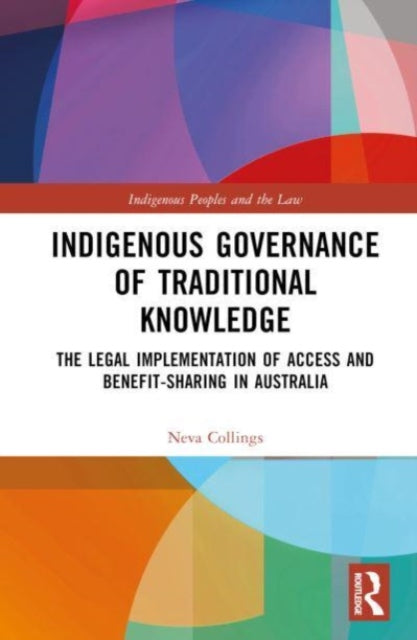
Neva Collings
Indigenous Governance of Traditional Knowledge: The Legal Implementation of Access and Benefit-Sharing in Australia
Indigenous Governance of Traditional Knowledge: The Legal Implementation of Access and Benefit-Sharing in Australia
💎 Earn 811 Points (£8.11) on this item.
We can order this item for you. Delivery usually takes about 4 to 6 weeks.
This item is not held in our immediate stock. We will order it for you after checkout.
Estimated delivery: About 4 to 6 weeks
YOU SAVE £9.63
- Condition: Brand new
- UK Delivery times: Usually arrives within 2 - 3 working days
- UK Shipping: Fee starts at £3.89. Subject to product weight & dimension
Bulk ordering. Want 15 or more copies? Get a personalised quote and bigger discounts. Learn more about bulk orders.
Couldn't load pickup availability
- More about Indigenous Governance of Traditional Knowledge: The Legal Implementation of Access and Benefit-Sharing in Australia
The book explores the intersection of international environmental law, human rights, biotechnology law, and Indigenous legal issues, attracting scholars from various fields.
Format: Hardback
Length: 282 pages
Publication date: 17 August 2023
Publisher: Taylor & Francis Ltd
The increasing interest in interdisciplinary research has led to a growing demand for scholars to explore the intersections of various fields, such as international environmental law, human rights, biotechnology law, and Indigenous legal issues. This appeal extends to scholars working in these areas, as well as those who are interested in understanding the complex relationships and challenges that arise at the intersection of these disciplines.
Interdisciplinary research has become increasingly important in today's world, as it allows scholars to approach complex problems from multiple perspectives and gain a deeper understanding of the issues at hand. By combining knowledge and expertise from different fields, researchers can develop innovative solutions and approaches to pressing social, economic, and environmental challenges.
One area of interdisciplinary research that is gaining significant attention is the intersection of international environmental law, human rights, biotechnology law, and Indigenous legal issues. This area of research is particularly relevant in today's world, as we face a range of environmental and social challenges that require a multi-faceted approach.
International environmental law is concerned with the protection of the environment and the regulation of human activities that may harm the environment. It encompasses a wide range of issues, such as climate change, biodiversity loss, pollution, and the rights of indigenous peoples to their land and resources. Human rights law, on the other hand, is concerned with the protection and promotion of human rights and the rights of vulnerable groups, such as women, children, and minorities. Biotechnology law is concerned with the regulation of genetic engineering and other technologies that have the potential to impact human health and the environment.
Indigenous legal issues are particularly important in this area of research, as indigenous peoples have long been marginalized and oppressed by dominant societies. They have unique legal and cultural traditions that are often at odds with mainstream legal systems and policies. By studying the intersection of international environmental law, human rights, biotechnology law, and Indigenous legal issues, scholars can better understand the rights and needs of indigenous peoples and develop strategies to promote their sustainable development and protection.
One of the key challenges of interdisciplinary research is the need to bridge the gap between different fields of knowledge and expertise. This can be difficult, as each field has its own language, methodologies, and assumptions. However, by working collaboratively and engaging in dialogue, researchers can overcome these barriers and develop a shared understanding of the issues at hand.
Another challenge of interdisciplinary research is the need to communicate complex ideas and findings to a broader audience. This can be achieved through various means, such as academic publications, public lectures, and social media. By making research accessible and engaging, scholars can contribute to public discourse and promote change.
In conclusion, the increasing interest in interdisciplinary research has led to a growing demand for scholars to explore the intersections of various fields, such as international environmental law, human rights, biotechnology law, and Indigenous legal issues. This appeal extends to scholars working in these areas, as well as those who are interested in understanding the complex relationships and challenges that arise at the intersection of these disciplines. Interdisciplinary research has the potential to develop innovative solutions and approaches to pressing social, economic, and environmental challenges, and it is essential that we continue to support and promote this type of research.
Dimension: 234 x 156 (mm)
ISBN-13: 9781032433998
UK and International shipping information
UK and International shipping information
We deliver throughout the United Kingdom and to 128 countries and territories worldwide, including the United States, Australia, Canada, Germany, Spain and France.