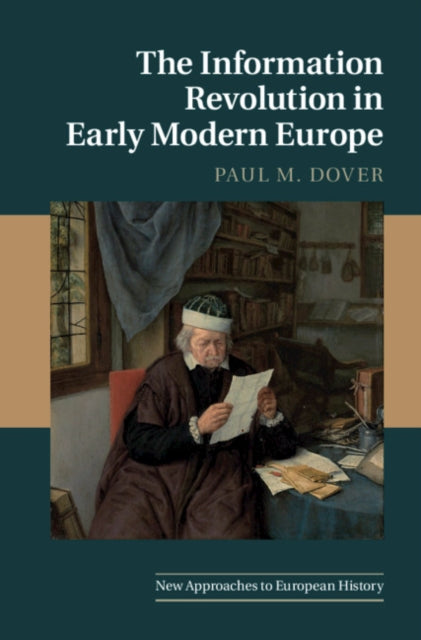
Paul M.Dover
Information Revolution in Early Modern Europe
Information Revolution in Early Modern Europe
💎 Earn 122 Points (£1.22) on this item.
We can order this item for you. Delivery usually takes about 4 to 6 weeks.
This item is not held in our immediate stock. We will order it for you after checkout.
Estimated delivery: About 4 to 6 weeks
YOU SAVE £1.46
- Condition: Brand new
- UK Delivery times: Usually arrives within 2 - 3 working days
- UK Shipping: Fee starts at £3.89. Subject to product weight & dimension
Bulk ordering. Want 15 or more copies? Get a personalised quote and bigger discounts. Learn more about bulk orders.
Couldn't load pickup availability
- More about Information Revolution in Early Modern Europe
A new history of early modern Europe argues that changes in the generation, preservation, and circulation of information, primarily on newly available and affordable paper, constituted an information revolution, profoundly impacting European life. The expansion of paper records and the efforts to store, share, organize, and taxonomize them are intertwined with essential developments such as the rise of the state, the Print Revolution, the Scientific Revolution, and the Republic of Letters. Paul M. Dover interprets the historical significance of this information revolution for the present day and suggests parallels with the informational challenges of the digital age.
Format: Paperback / softback
Length: 270 pages
Publication date: 14 October 2021
Publisher: Cambridge University Press
This groundbreaking new history of early modern Europe contends that significant transformations occurred in the generation, preservation, and circulation of information, primarily due to the availability and affordability of paper. This information revolution had a profound and transformative impact on various aspects of European life, including commerce, finance, statecraft, scholarly pursuits, science, and communication.
In the realm of commerce, finance, and statecraft, early modern Europeans were forced to prioritize information management. The vast expansion of paper records and the subsequent endeavors to store, share, organize, and taxonomize them were intricately linked to numerous crucial developments of the early modern period, such as the rise of the state, the Print Revolution, the Scientific Revolution, and the Republic of Letters. By engaging with historical questions across diverse fields of human activity, Paul M. Dover delves into the historical significance of this information revolution for contemporary times and offers thought-provoking parallels with the informational challenges of the digital age.
The availability of paper, a relatively new and affordable medium for recording and disseminating information, played a pivotal role in shaping the information revolution. Prior to the widespread use of paper, information was primarily transmitted through oral traditions, written manuscripts, and other less durable forms. However, the invention of the printing press in the 15th century revolutionized the production and distribution of knowledge. Suddenly, books, newspapers, and other printed materials could be produced in large quantities and at a lower cost, making them accessible to a wider audience.
This increased access to information had a profound impact on various aspects of European society. In commerce, for example, the availability of printed trade catalogs and price lists facilitated the growth of international trade and helped to establish new markets. The spread of knowledge through printed materials also facilitated the development of new industries and technologies, such as the textile industry and the scientific revolution.
In finance, the availability of paper records facilitated the growth of banking and financial institutions. The development of double-entry bookkeeping, a system of recording financial transactions using paper led to the creation of financial markets and the establishment of central banks. This, in turn, contributed to the development of capitalism and the rise of the modern economy.
In statecraft, the availability of paper records enabled governments to maintain better records of their citizens, taxes, and other administrative matters. This led to the development of bureaucratic systems and the rise of the modern state. The ability to store and analyze large amounts of information also enabled governments to implement policies more effectively and to monitor the activities of their citizens more closely.
In scholarly life, the availability of paper records facilitated the growth of libraries, universities, and scientific institutions. The development of the printing press allowed for the widespread dissemination of knowledge and the creation of a shared intellectual tradition. This, in turn, led to the development of new fields of study, such as mathematics, physics, and medicine.
In science, the availability of paper records facilitated the growth of scientific journals and the dissemination of scientific knowledge. The development of the scientific method, which relied on the collection and analysis of data, was made possible by the ability to record and share information. This, in turn, led to the development of new scientific discoveries and the advancement of human knowledge.
In communication, the availability of paper records facilitated the growth of postal systems and the development of written correspondence. The invention of the telegraph in the 19th century revolutionized communication by enabling the rapid transmission of information over long distances. However, the rise of digital technologies in the 20th and 21st centuries has once again challenged the traditional model of information dissemination and has led to new challenges and opportunities for information management.
In conclusion, the information revolution of the early modern period was a significant transformation that had a profound and transformative impact on various aspects of European life. The availability and affordability of paper played a pivotal role in shaping this revolution, enabling the generation, preservation, and circulation of information in new and innovative ways. The expansion of paper records and the accompanying efforts to store, share, organize, and taxonomize them were intricately linked to numerous essential developments of the early modern period, including the rise of the state, the Print Revolution, the Scientific Revolution, and the Republic of Letters. By engaging with historical questions across diverse fields of human activity, Paul M. Dover interprets the historical significance of this information revolution for the present day and suggests thought-provoking parallels with the informational challenges of the digital age.
Weight: 532g
Dimension: 153 x 228 x 22 (mm)
ISBN-13: 9781316602034
UK and International shipping information
UK and International shipping information
We deliver throughout the United Kingdom and to 128 countries and territories worldwide, including the United States, Australia, Canada, Germany, Spain and France.