Springer Verlag, Singapore
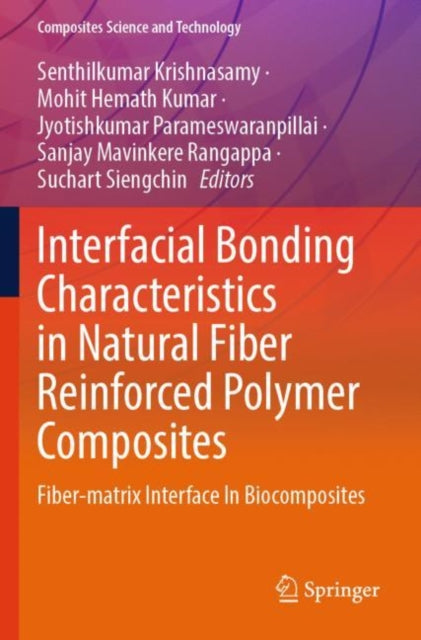
Interfacial Bonding Characteristics in Natural Fiber Reinforced Polymer Composites: Fiber-matrix Interface In Biocomposites
Interfacial Bonding Characteristics in Natural Fiber Reinforced Polymer Composites: Fiber-matrix Interface In Biocomposites
💎 Earn 777 Points (£7.77) on this item.
We can order this item for you. Delivery usually takes about 4 to 6 weeks.
This item is not held in our immediate stock. We will order it for you after checkout.
Estimated delivery: About 4 to 6 weeks
- Condition: Brand new
- UK Delivery times: Usually arrives within 2 - 3 working days
- UK Shipping: Fee starts at £3.89. Subject to product weight & dimension
Bulk ordering. Want 15 or more copies? Get a personalised quote and bigger discounts. Learn more about bulk orders.
Couldn't load pickup availability
- More about Interfacial Bonding Characteristics in Natural Fiber Reinforced Polymer Composites: Fiber-matrix Interface In Biocomposites
This book provides a general overview of the importance of fibre-matrix interfacial bonding characteristics in natural fibre-based composites to obtain optimal material properties for a specific application. Composites materials are prepared by combining fibres and polymers to achieve superior materials properties than those of the individual components. Composite materials are used to produce lightweight components with increased stiffness and strength; their properties can also be tailored for any specific applications. The glass fibre reinforced composites dominate 95% of the thermoplastic and thermoset-based composites. However, the natural fibre reinforced composites can give competition to the glass fibres due to their advantages such as biodegradability, low density, low cost, and good mechanical properties. This book looks into biocomposites and its important aspect of optimization of materials performance by fine-tuning the fibre-matrix bonding characteristics. The chapters in the book look at different plant fibres such as kenaf, pineapple leaf, jute, date palm, luffa, cotton, hemp, wood, bamboo, flax, and straw and the different approaches to enhance the fibre-matrix interfacial bonding through physical and/or chemical treatment methods. It demonstrates that the nature of fibre-matrix bonding has a significant effect on the properties such as tensile, flexural, impact, inter-laminar shear strength, moisture absorption, thickness swelling, thermal, chemical, damping, creep, and fatigue. Its content appeals to academics, students, researcher, and scientist who are working in the field to produce biodegradable and recyclable materials in the composite industry.
- Publication date: 19 January 2025
- Page count: 347
- Dimensions: Height 235 mm; Width 155 mm
- Publisher: Springer Verlag, Singapore
- Format: Paperback
- ISBN-13: 9789819983292
UK and International shipping information
UK and International shipping information
We deliver throughout the United Kingdom and to 128 countries and territories worldwide, including the United States, Australia, Canada, Germany, Spain and France.