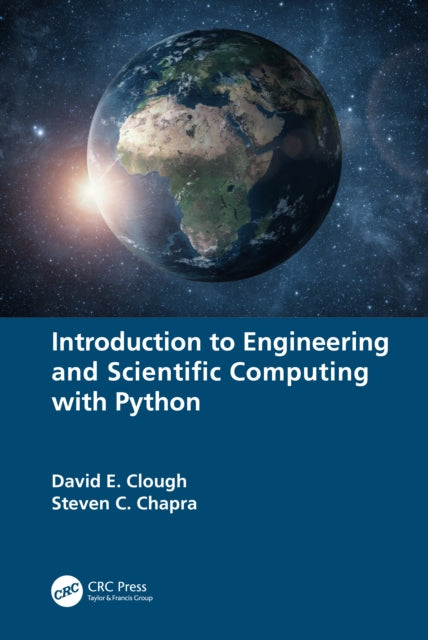
David E.Clough,Steven C.Chapra
Introduction to Engineering and Scientific Computing with Python
Introduction to Engineering and Scientific Computing with Python
💎 Earn 950 Points (£9.50) on this item.
We can order this item for you. Delivery usually takes about 4 to 6 weeks.
This item is not held in our immediate stock. We will order it for you after checkout.
Estimated delivery: About 4 to 6 weeks
- Condition: Brand new
- UK Delivery times: Usually arrives within 2 - 3 working days
- UK Shipping: Fee starts at £3.89. Subject to product weight & dimension
Bulk ordering. Want 15 or more copies? Get a personalised quote and bigger discounts. Learn more about bulk orders.
Couldn't load pickup availability
- More about Introduction to Engineering and Scientific Computing with Python
Python for Engineers and Scientists provides a classroom-tested, practical approach to teaching programming, focusing on Python, a general language, in an engineering and scientific context. It helps students and professionals use Python to solve engineering calculations.
Format: Hardback
Length: 396 pages
Publication date: 07 September 2022
Publisher: Taylor & Francis Ltd
Python is a versatile programming language that has gained widespread popularity in various fields, including engineering and science. Its simplicity and readability make it an ideal choice for beginners, while its powerful features and extensive libraries make it suitable for advanced applications. One of the key advantages of Python is its ability to provide a levelling approach, bringing students at all stages of programming experience to the same point. Whether you are a complete novice or have some prior experience, Python can help you develop your programming skills and advance your career.
Python's focus on a general language makes it an excellent choice for engineering and scientific applications. Its simplicity allows developers to write code that is easy to understand and maintain, while its powerful features enable complex calculations and data analysis. Python's extensive libraries, such as NumPy, SciPy, and Matplotlib, provide a wide range of tools and functions that can be used to solve engineering problems and visualize data.
Another advantage of Python is its practicality. The language has been extensively tested in classrooms and has proven to be an effective teaching tool. Its interactive nature and intuitive syntax make it easy for students to learn and apply, and its wide range of resources and communities make it a valuable resource for both students and professionals.
Python's ability to solve engineering calculations such as differential and algebraic equations is another significant advantage. Its libraries provide powerful tools for numerical analysis and optimization, making it easier for developers to solve complex problems and improve the efficiency of their systems. Whether you are working on a small-scale project or a large-scale enterprise, Python can help you achieve your goals.
In conclusion, Python is a versatile programming language that has gained widespread popularity in engineering and science. Its levelling approach, focus on a general language, practical approach to teaching, and ability to solve engineering calculations make it an ideal choice for beginners and professionals alike. Whether you are looking to develop your programming skills or advance your career, Python has the tools and resources to help you achieve your goals.
Weight: 742g
Dimension: 158 x 236 x 31 (mm)
ISBN-13: 9781032188942
UK and International shipping information
UK and International shipping information
We deliver throughout the United Kingdom and to 128 countries and territories worldwide, including the United States, Australia, Canada, Germany, Spain and France.