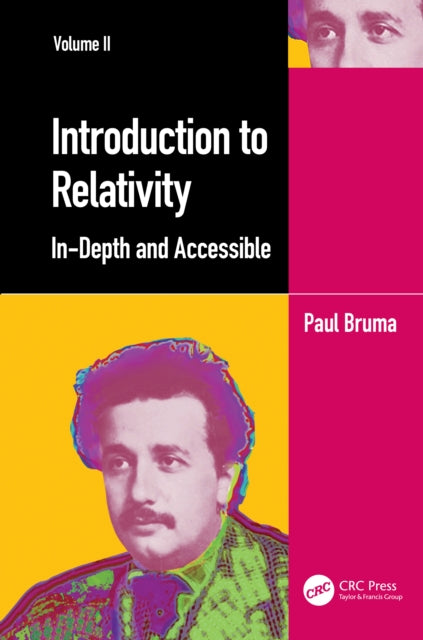
Paul Bruma
Introduction to Relativity Volume II: In-Depth and Accessible
Introduction to Relativity Volume II: In-Depth and Accessible
We can order this item for you. Delivery usually takes about 4 to 6 weeks.
This item is not held in our immediate stock. We will order it for you after checkout.
Estimated delivery: About 4 to 6 weeks
YOU SAVE £7.39
- Condition: Brand new
- UK Delivery times: Usually arrives within 2 - 3 working days
- UK Shipping: Fee starts at £3.89. Subject to product weight & dimension
Bulk ordering. Want 15 or more copies? Get a personalised quote and bigger discounts. Learn more about bulk orders.
Couldn't load pickup availability
- More about Introduction to Relativity Volume II: In-Depth and Accessible
A book that provides thorough and detailed explanations of General Relativity and Special Relativity, with simple demonstrations and physical explanations.
Format: Hardback
Length: 272 pages
Publication date: 13 September 2022
Publisher: Taylor & Francis Ltd
Rewritten text:
Exploring Einstein's Relativity: A Comprehensive Guide
Einstein's Relativity is a revolutionary theory that has transformed our understanding of space, time, and gravity. In this comprehensive guide, we delve into the intricate details of both General Relativity and Special Relativity, providing you with a clear and concise explanation that doesn't require advanced mathematical knowledge.
General Relativity:
General Relativity is a fundamental theory of physics that revolutionized our understanding of the universe. It was developed by Albert Einstein in the early 20th century and has since been confirmed by countless experiments and observations.
Key Concepts:
Spacetime: General Relativity introduces the concept of spacetime, which is a four-dimensional continuum that combines space and time into a single entity. Spacetime is curved by the presence of mass and energy, which leads to the phenomenon of gravity.
Gravity: Gravity is the force that attracts objects to each other. In General Relativity, gravity is caused by the curvature of spacetime. The greater the mass or energy of an object, the stronger its gravitational pull.
Black Holes: Black holes are regions of spacetime that are so dense that nothing, including light, can escape from them. They are formed when massive stars collapse at the end of their life cycle.
Special Relativity:
Special Relativity is a subfield of physics that applies to all physical phenomena in the absence of gravity. It was developed by Albert Einstein in the early 1900s and has since been applied to a wide range of fields, including physics, chemistry, and engineering.
Key Concepts:
Speed of Light: Special Relativity states that the speed of light is a constant in all reference frames, regardless of the relative motion of the observer. This is known as the "speed of light invariance" and has profound implications for our understanding of the universe.
Time Dilation: Time dilation is the phenomenon where time appears to slow down for an object moving relative to an observer. This is caused by the relative motion of the observer and the object and is observed in experiments such as the Michelson-Morley experiment.
Relativistic Mass: In Special Relativity, the mass of an object is not a fixed quantity but is dependent on its speed. This is known as relativistic mass and is a result of the Lorentz factor, which is a measure of the relative velocity between the object and the observer.
Applications:
Special Relativity has numerous applications in fields such as physics, chemistry, and engineering. It has helped to explain phenomena such as the behavior of particles at high speeds, the structure of the atom, and the nature of time and space.
Conclusion:
Einstein's Relativity is a groundbreaking theory that has revolutionized our understanding of the universe. In this comprehensive guide, we have explored the key concepts of both General Relativity and Special Relativity, providing you with a clear and concise explanation that doesn't require advanced mathematical knowledge. Whether you are a student, a scientist, or simply a curious mind, this guide will help you to gain a deeper understanding of the fascinating world of relativity.
Einstein's Relativity is a revolutionary theory that has transformed our understanding of space, time, and gravity. In this comprehensive guide, we delve into the intricate details of both General Relativity and Special Relativity, providing you with a clear and concise explanation that doesn't require advanced mathematical knowledge.
General Relativity is a fundamental theory of physics that revolutionized our understanding of the universe. It was developed by Albert Einstein in the early 20th century and has since been confirmed by countless experiments and observations.
Key Concepts:
Spacetime:
General Relativity introduces the concept of spacetime, which is a four-dimensional continuum that combines space and time into a single entity. Spacetime is curved by the presence of mass and energy, which leads to the phenomenon of gravity.
Gravity:
Gravity is the force that attracts objects to each other. In General Relativity, gravity is caused by the curvature of spacetime. The greater the mass or energy of an object, the stronger its gravitational pull.
Black Holes:
Black holes are regions of spacetime that are so dense that nothing, including light, can escape from them. They are formed when massive stars collapse at the end of their life cycle.
Special Relativity:
Special Relativity is a subfield of physics that applies to all physical phenomena in the absence of gravity. It was developed by Albert Einstein in the early 1900s and has since been applied to a wide range of fields, including physics, chemistry, and engineering.
Key Concepts:
Speed of Light:
Special Relativity states that the speed of light is a constant in all reference frames, regardless of the relative motion of the observer. This is known as the "speed of light invariance" and has profound implications for our understanding of the universe.
Time Dilation:
Time dilation is the phenomenon where time appears to slow down for an object moving relative to an observer. This is caused by the relative motion of the observer and the object and is observed in experiments such as the Michelson-Morley experiment.
Relativistic Mass:
In Special Relativity, the mass of an object is not a fixed quantity but is dependent on its speed. This is known as relativistic mass and is a result of the Lorentz factor, which is a measure of the relative velocity between the object and the observer.
Applications:
Special Relativity has numerous applications in fields such as physics, chemistry, and engineering. It has helped to explain phenomena such as the behavior of particles at high speeds, the structure of the atom, and the nature of time and space.
Conclusion:
Einstein's Relativity is a groundbreaking theory that has revolutionized our understanding of the universe. In this comprehensive guide, we have explored the key concepts of both General Relativity and Special Relativity, providing you with a clear and concise explanation that doesn't require advanced mathematical knowledge.
Dimension: 234 x 156 (mm)
ISBN-13: 9781032056760
UK and International shipping information
UK and International shipping information
We deliver throughout the United Kingdom and to 128 countries and territories worldwide, including the United States, Australia, Canada, Germany, Spain and France.