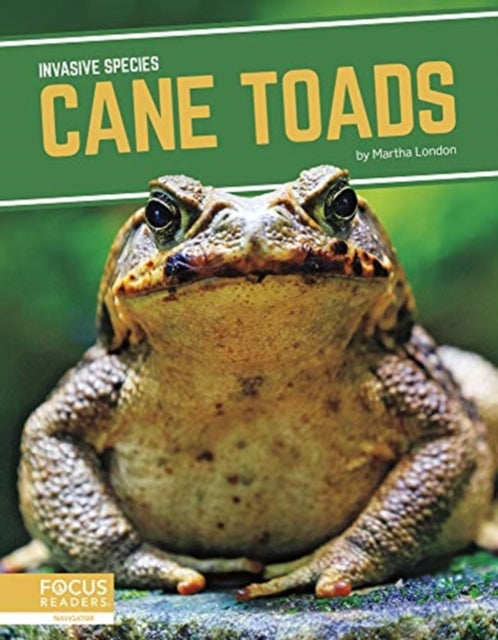
Martha London
Invasive Species: Cane Toads
Invasive Species: Cane Toads
We can order this item for you. Delivery usually takes about 4 to 6 weeks.
This item is not held in our immediate stock. We will order it for you after checkout.
Estimated delivery: About 4 to 6 weeks
YOU SAVE £10.11
- Condition: Brand new
- UK Delivery times: Usually arrives within 2 - 3 working days
- UK Shipping: Fee starts at £3.89. Subject to product weight & dimension
Bulk ordering. Want 15 or more copies? Get a personalised quote and bigger discounts. Learn more about bulk orders.
Couldn't load pickup availability
- More about Invasive Species: Cane Toads
Cane toads are invasive species that threaten ecosystems, and humans have contributed to their spread. This book provides information about the toads, their impact, and management efforts. It includes a table of contents, infographics, sidebars, a "Thats Amazing!” feature, quiz questions, a glossary, and more.
\n Format: Hardback
\n Length: 32 pages
\n Publication date: 01 August 2021
\n Publisher: North Star Editions
\n
The impact of cane toads on introduced environments, the role of humans in their spread, the threats they pose to ecosystems, and the efforts being made to manage them are all explored in this title. This book also features a table of contents, two infographics, informative sidebars, a "Thats Amazing!" special feature, quiz questions, a glossary, additional resources, and an index. This Focus Readers title is designed for students in grades 3–5 with reading levels of grades 3–5 and interest levels of grades 4–7.
The introduction of cane toads into new environments has had a significant impact on the native fauna and flora. These toads, which are native to Australia, were introduced to Queensland in the late 1930s to control pests in sugarcane fields. However, the toads quickly spread throughout the state, causing devastating effects on the local ecosystem.
One of the primary threats posed by cane toads is their toxic venom. Cane toads secrete a venom that is harmful to many animals, including mammals, birds, reptiles, and insects. This venom can cause paralysis, respiratory distress, and even death. The toads also compete with native species for food and habitat, which can lead to the decline or extinction of native species.
Another threat posed by cane toads is the spread of diseases. Cane toads are carriers of a number of diseases, including the deadly disease chytridiomycosis. This disease is caused by a fungus that grows on the toad's skin and can infect other animals, including humans. The toads can also spread other diseases, such as the bacterial disease salmonella, which can be harmful to humans.
Efforts to manage cane toads have been ongoing for many years. One of the most effective methods has been the use of bait traps. These traps are designed to attract cane toads, which are then captured and killed. This method has been successful in reducing the toad population in some areas.
Another method of control is the use of chemical pesticides. These pesticides are designed to kill cane toads, but they can also be harmful to other animals and plants. Therefore, they are only used in areas where other methods of control have been unsuccessful.
In addition to these methods of control, there are also efforts to educate the public about the dangers of cane toads. This includes providing information about the toads' toxic venom and the diseases they can spread. It also includes providing information about the methods of control that are being used to manage the toad population.
Overall, the impact of cane toads on introduced environments is significant. These toads pose a threat to the native fauna and flora, and they also pose a risk to human health. However, there are a number of efforts being made to manage the toad population, and these efforts are showing promise.
In conclusion, the introduction of cane toads into new environments has had a significant impact on the native fauna and flora. These toads pose a threat to the local ecosystem, and they also pose a risk to human health. However, there are a number of efforts being made to manage the toad population, and these efforts are showing promise. It is important that we continue to monitor the situation and take steps to manage the toad population in order to protect the local ecosystem and human health.
\n Weight: 250g\n
Dimension: 185 x 235 x 11 (mm)\n
ISBN-13: 9781644938553\n \n
UK and International shipping information
UK and International shipping information
We deliver throughout the United Kingdom and to 128 countries and territories worldwide, including the United States, Australia, Canada, Germany, Spain and France.