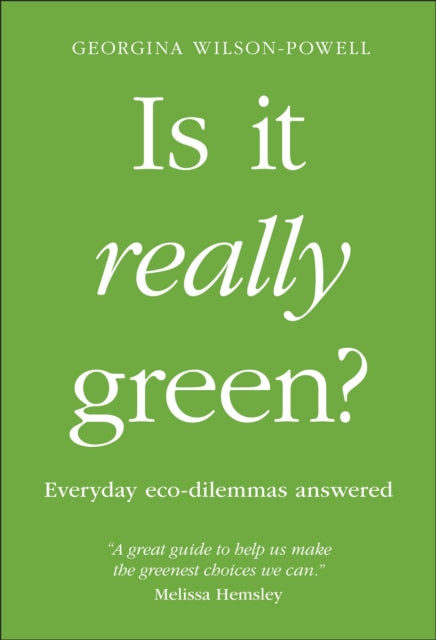
Georgina Wilson-Powell
Is It Really Green?: Everyday Eco Dilemmas Answered
Is It Really Green?: Everyday Eco Dilemmas Answered
YOU SAVE £4.10
- Condition: Brand new
- UK Delivery times: Usually arrives within 2 - 3 working days
- UK Shipping: Fee starts at £3.89. Subject to product weight & dimension
Bulk ordering. Want 15 or more copies? Get a personalised quote and bigger discounts. Learn more about bulk orders.
Couldn't load pickup availability
- More about Is It Really Green?: Everyday Eco Dilemmas Answered
This book provides answers to everyday green-living dilemmas, offering advice on making homes, shopping, and managing relationships more sustainable. It sheds light on the consequences of our decisions and empowers readers to make positive impacts on the planet. The book is also made sustainably, using recycled paper and locally based printers.
Format: Paperback / softback
Length: 224 pages
Publication date: 07 January 2021
Publisher: Dorling Kindersley Ltd
Are paper bags always more environmentally friendly than plastic?
It's a common misconception that paper bags are always more environmentally friendly than plastic bags. While paper bags are biodegradable and can be recycled, they require a significant amount of energy and resources to produce. The production process involves cutting down trees, pulping them, and processing the pulp into paper. In addition, paper bags can take hundreds of years to decompose in landfills, contributing to waste and pollution.
On the other hand, plastic bags are made from non-renewable fossil fuels, such as oil and natural gas. While they are not biodegradable, they can be recycled and reused multiple times. Plastic bags are also lightweight and durable, making them convenient for carrying groceries and other items. However, plastic bags can take thousands of years to decompose in landfills, and they release harmful chemicals into the environment during production and disposal.
In conclusion, both paper bags and plastic bags have their pros and cons when it comes to environmental impact. It's important to use both bags responsibly and to make informed choices about the products we use. For example, we can use reusable bags made from materials such as cotton or canvas to reduce our reliance on single-use plastic bags. We can also choose to support businesses that use sustainable practices, such as using biodegradable or compostable materials in their products.
How much better for the planet are electric cars?
Electric cars are becoming increasingly popular as a more sustainable and environmentally friendly alternative to traditional gasoline-powered cars. While electric cars have many benefits, it's important to consider the full lifecycle of the vehicle, including the production of the batteries, the energy used to charge them, and the disposal of the batteries.
One of the main benefits of electric cars is that they produce zero emissions, which helps to reduce air pollution and greenhouse gas emissions. Electric cars also have a lower operating cost than gasoline-powered cars, as they use less energy to power the engine and drive the wheels. Additionally, electric cars have a longer lifespan than gasoline-powered cars, which can save drivers money in the long run.
However, there are also some challenges associated with electric cars. One of the biggest challenges is the production of batteries. The batteries used in electric cars require rare earth minerals, which are often mined in environmentally sensitive areas. The mining process can also contribute to pollution and habitat destruction. Additionally, the batteries used in electric cars can be expensive to replace, which can add to the cost of ownership.
Another challenge associated with electric cars is the energy used to charge them. While electric cars can be charged at home using renewable energy sources, such as solar or wind power, many drivers still rely on traditional electricity sources, which are generated from fossil fuels. This can contribute to greenhouse gas emissions and air pollution.
In conclusion, electric cars are a promising alternative to traditional gasoline-powered cars, but it's important to consider the full lifecycle of the vehicle, including the production of the batteries, the energy used to charge them, and the disposal of the batteries. By making informed choices about the products we use and the way we live, we can help to reduce our environmental impact and promote a more sustainable future.
What saves more water - using the dishwasher or washing up by hand?
The question of whether using the dishwasher or washing up by hand saves more water is a complex one that depends on a variety of factors, including the type of dishwasher, the water efficiency of the local water supply, and the amount of water used per load.
One of the main benefits of using the dishwasher is that it can save a significant amount of water compared to washing up by hand. Dishwashers use less water per load than washing machines, as they only use water to rinse the dishes and to heat the water. In addition, dishwashers are more efficient at cleaning dishes, as they use high-pressure water jets to remove dirt and bacteria.
However, there are also some downsides to using the dishwasher. One of the biggest concerns is the energy consumption of dishwashers. Dishwashers use a lot of electricity, which can add to the cost of running your household. In addition, dishwashers can also release harmful chemicals into the environment, such as phosphates and chlorine, which can contribute to water pollution.
On the other hand, washing up by hand can save a significant amount of water compared to using the dishwasher. Washing dishes by hand requires only a small amount of water, as you can use a basin or a sink to rinse the dishes and to wash them with soap and water. In addition, washing up by hand is more environmentally friendly than using the dishwasher, as it does not release harmful chemicals into the environment.
However, washing up by hand can also be time-consuming and labor-intensive. It can take a long time to wash a large number of dishes by hand, and it can be difficult to clean dishes thoroughly by hand. In addition, washing up by hand can also use more water than necessary, as you may need to rinse the dishes multiple times to remove all the soap.
In conclusion, the question of whether using the dishwasher or washing up by hand saves more water is a complex one that depends on a variety of factors. While using the dishwasher can save a significant amount of water compared to washing up by hand, it can also be more energy-consuming and environmentally harmful. Washing up by hand can save a significant amount of water compared to using the dishwasher, but it can also be more time-consuming and labor-intensive. It's important to use both methods responsibly and to make informed choices about the products we use and the way we live.
Weight: 312g
Dimension: 134 x 198 x 17 (mm)
ISBN-13: 9780241435809
UK and International shipping information
UK and International shipping information
We deliver throughout the United Kingdom and to 128 countries and territories worldwide, including the United States, Australia, Canada, Germany, Spain and France.