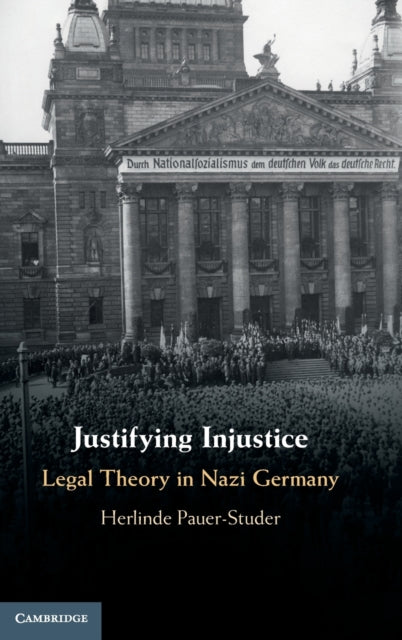
Herlinde Pauer-Studer
Justifying Injustice: Legal Theory in Nazi Germany
Justifying Injustice: Legal Theory in Nazi Germany
💎 Earn 692 Points (£6.92) on this item.
- Condition: Brand new
- UK Delivery times: Usually arrives within 2 - 3 working days
- UK Shipping: Fee starts at £3.89. Subject to product weight & dimension
Bulk ordering. Want 15 or more copies? Get a personalised quote and bigger discounts. Learn more about bulk orders.
Couldn't load pickup availability
- More about Justifying Injustice: Legal Theory in Nazi Germany
Examining how crucial parts of the distorted normative order of the Third Reich evolved and were justified by regime-loyal legal theorists, this book explains how law can bend to a political ideology and fail to keep state power from transgressing elementary standards of humanity and the rule of law.
Format: Hardback
Length: 225 pages
Publication date: 24 September 2020
Publisher: Cambridge University Press
Post-war legal scholars commonly consider the Third Reich's judicial system to be the paradigm of 'evil law'. By examining how crucial parts of this distorted normative order evolved and were justified by regime-loyal legal theorists, we can appreciate how law can bend to a political ideology and fail to keep state power from transgressing elementary standards of humanity and the rule of law. From 1933 to 1939, a flood of publications reflected on the question of how to adapt law to the political ends of National Socialism, debating both the normative and constitutional foundations of the National Socialist state, and the proper form and content of criminal and police law in this new political framework. These debates, the main threads of which are central to this book, reveal the normative ideas driving the Führer state and the legal subtext to the Nazi regime's escalating atrocities.
Weight: 548g
Dimension: 158 x 235 x 26 (mm)
ISBN-13: 9781107159303
UK and International shipping information
UK and International shipping information
We deliver throughout the United Kingdom and to 128 countries and territories worldwide, including the United States, Australia, Canada, Germany, Spain and France.